Collaborative Research Centre brings together expertise from the Paderborn University and Bielefeld University
What links a historic mural from Granada to cutting-edge research, and why are there exactly 17 different ways to tile a floor? The Mathematics underlying these questions forms the basis for the research carried out by the Collaborative Research Centre/Transregio (CRC) 358 “Integral Structures in Geometry and Representation Theory” at Paderborn University and Bielefeld University. The consortium investigates integral structures which, in geometry, occur for example as tilings and can result in complex multidimensional patterns, such as those found in the Alhambra in Spain. The initiative also makes the fundamental algebraic concepts accessible to school pupils through interactive formats. In doing so, it demonstrates that Mathematics is more than just arithmetic – it is a tool for recognising order in the world.
From the Moorish palace to a universal rule
In the Alhambra, a famous Moorish palace in Granada, endlessly repeating patterns adorn the walls. If you rotate these ornaments at certain points, they look identical. Mathematically, these are known as ‘wall pattern groups’. And this is precisely where the first surprise lies: there are only 17 different symmetry schemes for such two-dimensional patterns. Mathematically, no more are possible. The number 17 is therefore no coincidence, but part of a profound order. “In a one-dimensional strip, such as a wallpaper border, there are only seven types of such patterns. If, instead, we consider three-dimensional crystal lattices – the building blocks of materials in Physics and chemistry – the number rises to 230. These classifications form the basis for how scientists understand and develop materials,” explains Prof. Dr Igor Burban from Paderborn University, deputy spokesperson for the Collaborative Research Centre.
Integer structures as a unifying element
So what exactly is SFB 358 researching? Integer structures are arrangements that can only be moved and rotated in whole, countable steps. Much like the squares on a chessboard or the repetitions in the Alhambra pattern. This ‘integer nature’ connects seemingly unrelated elements: the geometric shapes of the wallpaper, the ring structure of the integers, and the grids used by mathematicians to measure space. The realisation that there are exactly 17 patterns opens the door to a much larger system of order in algebra. For the researchers in the consortium, the questions look something like this: How many arrangements of a particular shape are there? How does the number of points in the pattern change when the section under consideration is enlarged? Do patterns with a particularly large number of symmetries possess special properties of Mathematics? These questions lead into highly complex fields such as the theory of automorphic forms or so-called p-adic geometry. The SFB builds on a long tradition of collaboration between the Paderborn University and Bielefeld University and has intensified this enormously over the past four years of the first funding period. Results from the collaboration are already demonstrating how geometry, analysis and algebra go hand in hand. Just recently, for example , Prof. Dr Tobias Weich from Paderborn was able to prove conjectures previously left open by professors at Yale. When asked about specific applications, Prof. Burban replies: “Almost everything we research in the SFB is motivated purely by Mathematics. But if you look more closely at current technological revolutions such as artificial intelligence, quantum technologies or quantum computing, you’ll see that cutting-edge Mathematics is being used there in a fundamental way. And it is precisely these kinds of mathematical technologies that we are developing in the Collaborative Research Centre.”
Research with tiles: ‘Experience Structures!’
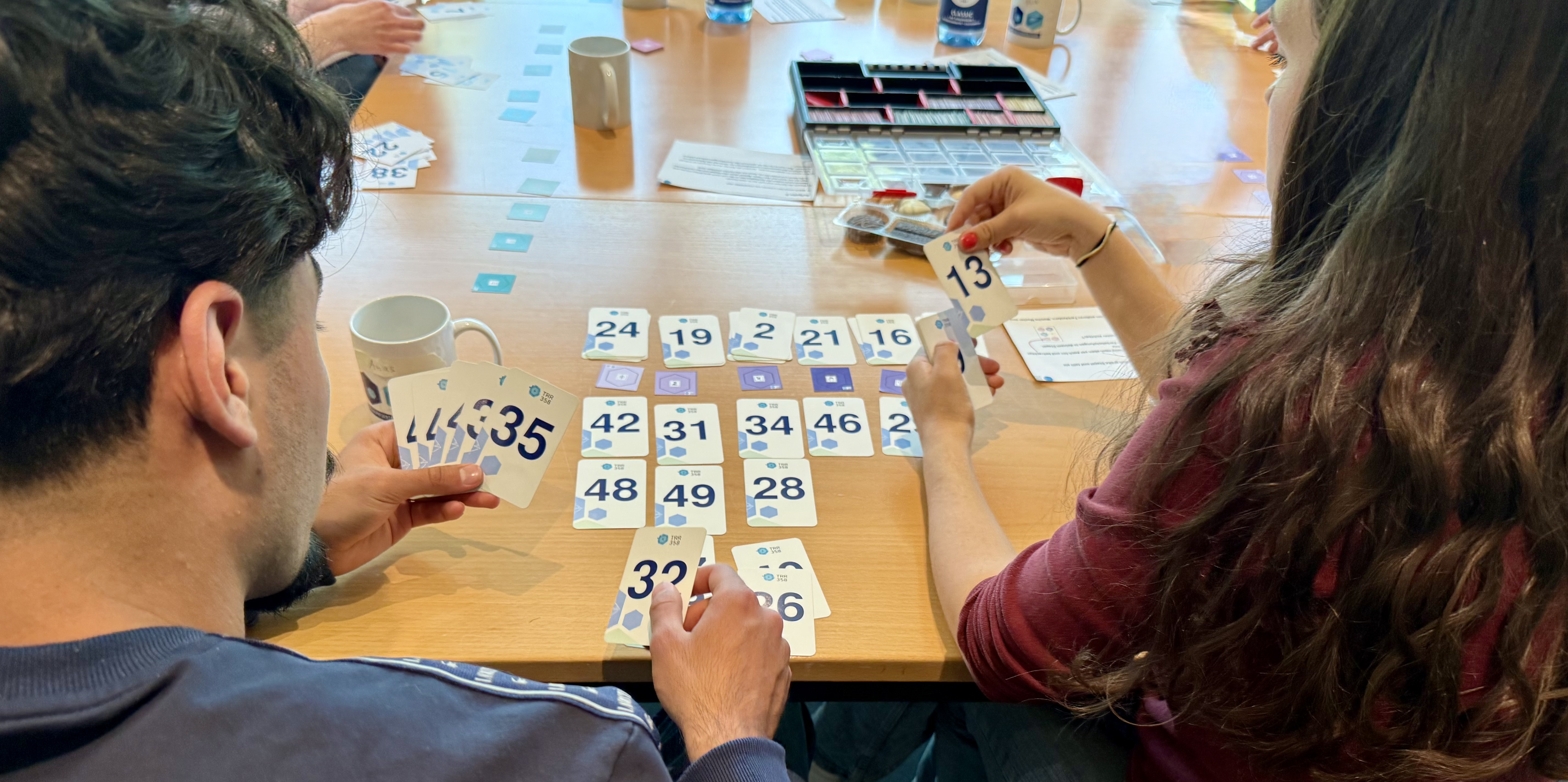
As one of very few CRC for Mathematics, the Bielefeld-Paderborn CRC has a sub-project ‘Ö’ dedicated to public relations and science communication. SFB 358 established this structure in spring 2025 as part of a successful supplementary application by the project leaders Dr. Max Hoffmann and Prof. Dr Tobias Weich, both from Paderborn University. The motto is: “Experience Structures!” The aim is to introduce school pupils, teachers and the general public to university-level Mathematics and to provide a realistic picture of modern mathematical research. Instead of dry formulas, the researchers work with tangible objects, some of which they develop themselves. Using 3D printing, they produce precisely fitting tiles – hexagons, star shapes and other geometric forms that interlock perfectly. By rotating these tiles, placing them together or animating them on screen via an app, participants create the symmetry themselves. The objectives of the SFB, and in particular of sub-project Ö, extend beyond the school workshops. The aim is to foster a lasting appreciation of the distinctive features of pure Mathematics. To this end, the researchers are developing, amongst other things, freely available teaching materials (known as OER, Open Educational Resources). The SFB thus provides ready-made concepts that teachers, students and lecturers can use, adapt and pass on.
Funding since 2023
Collaborative Research Centres are long-term research organisations at universities where researchers collaborate within the framework of an interdisciplinary research programme. A Collaborative Research Centre is termed ‘Transregio’ when it is jointly supported by two or three universities. The German Research Foundation (DFG) has been funding CRC 358 since January 2023 with a total of around 10.7 million euros.
This text was translated automatically.