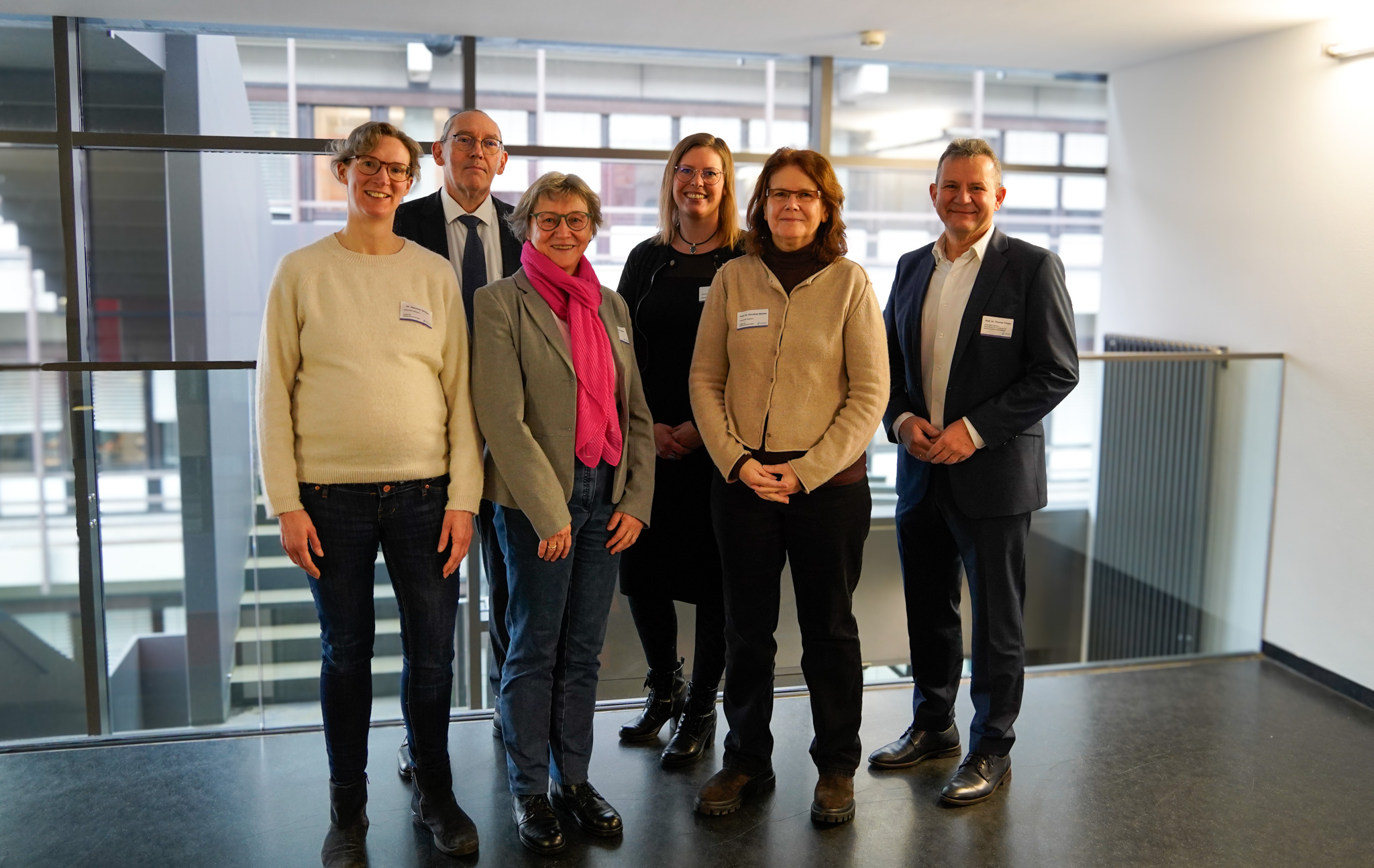
How can Open Science be further developed and what challenges are there? Teachers, researchers and doctoral students discussed these questions at the Open Science Symposium at Paderborn University. It was organised by the research team of the OASE project[1], which investigated the open access culture (OAC) at the university and developed measures to expand it. After more than two years of research, the project has now come to an end. The symposium served not only as a forum for dialogue, but also as a starting point for the participatory development of a new Open Science strategy. This means that all affected status groups are to be involved in the development process.
"Here at Paderborn University, we want to look at how the concept of Open Science can be organised and further developed under the given conditions," said Prof. Dr. Thomas Tröster, Vice President for Research and Academic Career Paths, when welcoming the attendees. Anna Nickel, Director of the University Library, and Dr Jeannine Teichert, research assistant at the Institute of Media Studies, then gave impulses from the OASE project and reported on the development of an OAK at Paderborn University.
A keynote speech by Dr Rafael Ball, senior librarian at ETH Zurich, focused on the tension between artificial intelligence (AI) and openness. He emphasised that in addition to all the opportunities that open access offers, the risks should also be discussed. These include a lack of transparency in the use of data and the partial lack of copyright in AI as well as the loss of data sovereignty. When dealing with AI and open access, the aim is to maintain scientific quality and trust in science. During the subsequent Q&A session, he made it clear that science should not put up walls around itself, but should be open and visible.
Conclusion of OASE
The aim of open access is to make research findings and data available on the internet free of charge worldwide without technical or legal barriers as soon as they are published. This offers many advantages for both researchers and interested parties. The OASE project team has set itself the goal of taking stock of the situation at Paderborn University, developing measures to disseminate OAK and using the findings to create a transfer concept for other universities.
The key results of the surveys and interviews show that Open Access is supported by many academics at the university. However, this support is not yet reflected in daily practice, as knowledge on the topic is not yet widely available and there is a lack of skills to implement open access practices. According to the team, obstacles are usually anchored more systematically, including through complex implementation and changing academic staff due to temporary positions.
In addition to the Open Science Symposium, the research team has organised various open access talks and workshops to raise awareness and discuss the topic from different angles. The OASE project is being sponsored by the Federal Ministry of Research, Technology and Space until March. "An open access culture is not yet firmly established at Paderborn University, but it is not an isolated case among universities. It has become clear that open access is part of an open science culture and that other topics such as open data face the same challenges," says Prof Dr Gudrun Oevel, CIO of the university. Prof Dr Dorothee M. Meister from the Institute of Media Studies adds: "Our goal now is to think bigger and move from Open Access towards Open Science." To this end, measures from the project, such as information events and training courses, are to be continued. The project team recommends systematically developing an open science culture in order to create overall guidelines for action within the university. This should include the opportunities and challenges of open access to science.
This text was translated automatically.
[1] OASE stands for "Systematic development of an open access culture at the university - a development-orientated empirical case study"