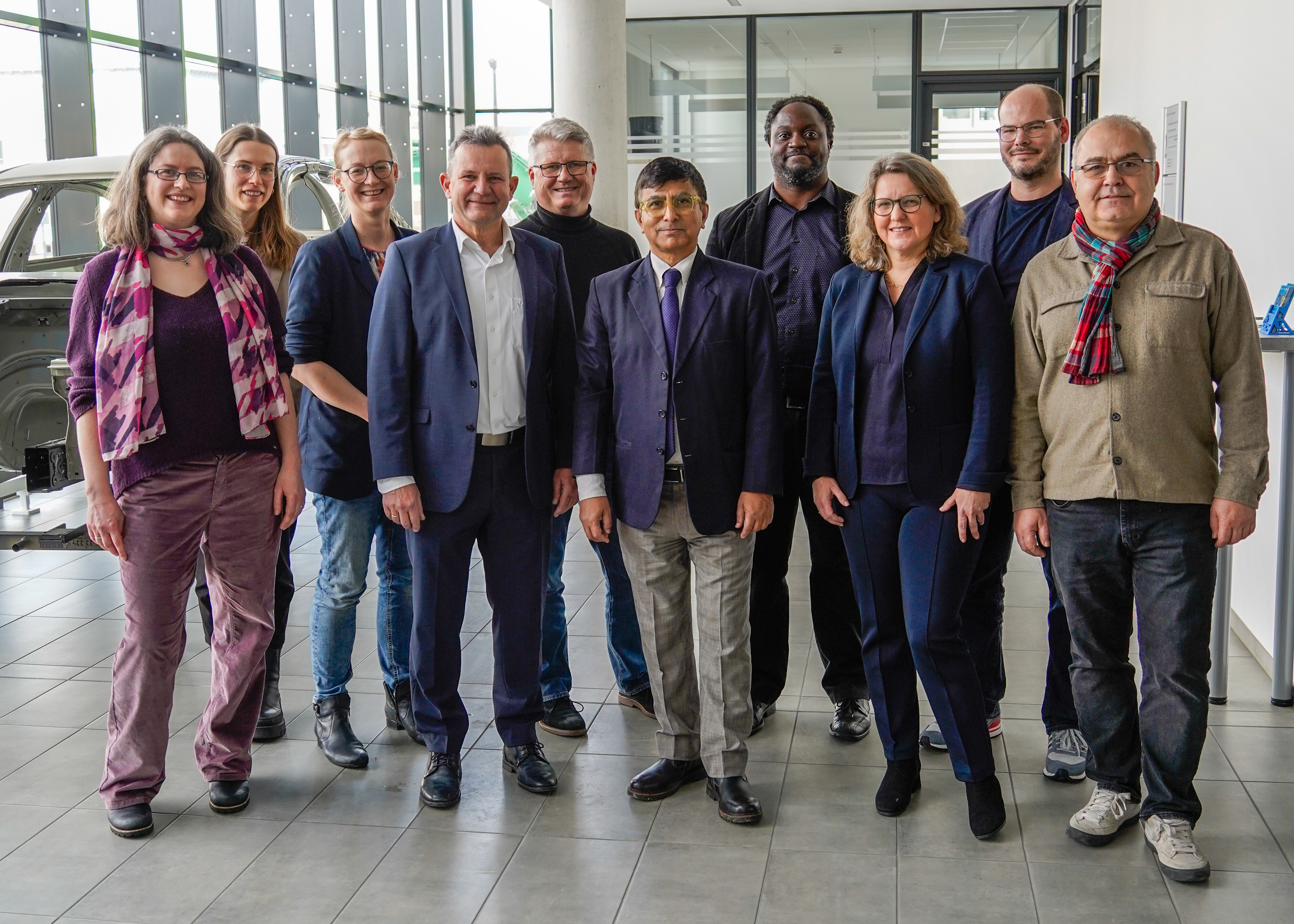
On Friday, 30 January, Dr. Ramanuj Banerjee, Science Counseller at the Indian Embassy in Berlin, visited Paderborn University. He gained insights into various areas of research at the university and had the opportunity to exchange ideas with scientists, staff, and students.
Prof. Dr. Thomas Tröster, Vice-President for Research and Academic Careers, guided participants through the program and provided an overview of the main areas of research at the Institute for Lightweight Design with Hybrid Systems (ILH). The scientists focus on simulation and method development as well as the sustainable development of materials and processes for innovative lightweight construction solutions.
The Institute for Photonic Quantum Systems (PhoQS) was also presented. Scientists with various areas of expertise work together there to research the smallest particles of light, known as quanta. Research into photonic, i.e., light-based, quantum technologies is of great importance for key optical technologies with a very broad field of application.
“India is making significant investments in research and innovation, particularly in areas such as supercomputing, cyber physical systems, quantum technologies, and sustainable energy. It was inspiring to learn about the expertise at Paderborn University and to explore potential avenues for collaboration. I am sincerely grateful for this opportunity,” says Dr. Banerjee. Following on from this, the Department of Energy System Technologies (EST) was presented. Here, scientists research, develop, and realise holistic concepts for sustainable energy use. The cross-sectoral research work covers regional energy systems and grids, with a focus on the energy transition in industry, among other things.
Furthermore, the Workgroup „System and Circuit Technology“ was introduced. The scientists research integrated digital, analogue, and photonic circuits and systems. They design microchips, measure their properties in the laboratories of the Heinz Nixdorf Institute at Paderborn University, and cooperate with world-leading chip manufacturers and academic partners. Further insights were provided by the Data Science research group, which is dedicated to research at the interfaces between humans, machines, and data. The scientists research, develop, and evaluate methods and tools for designing data-driven systems securely and efficiently.
“Since artificial intelligence is also considered one of the key technologies that India is focusing on, these insights into the research being conducted at Paderborn University are very valuable. I greatly value these discussions and am impressed by the dedication and rigor with which innovative solutions are being pursued here,” Dr. Banerjee summarizes his impressions. “We not only talked about our common interests in research and innovation but also opened new perspectives for the exchange of students, scientists, and research projects. I therefore welcome this encounter as mutual learning at the highest scientific level,” says Prof. Tröster.
Scientific cooperation between Germany and India
Last year, the German Academic Exchange Service (DAAD) published a strategy paper highlighting the great potential of academic exchange and scientific cooperation between Germany and India. As India is developing into an important centre for science and innovation, there are numerous opportunities for bilateral cooperation.