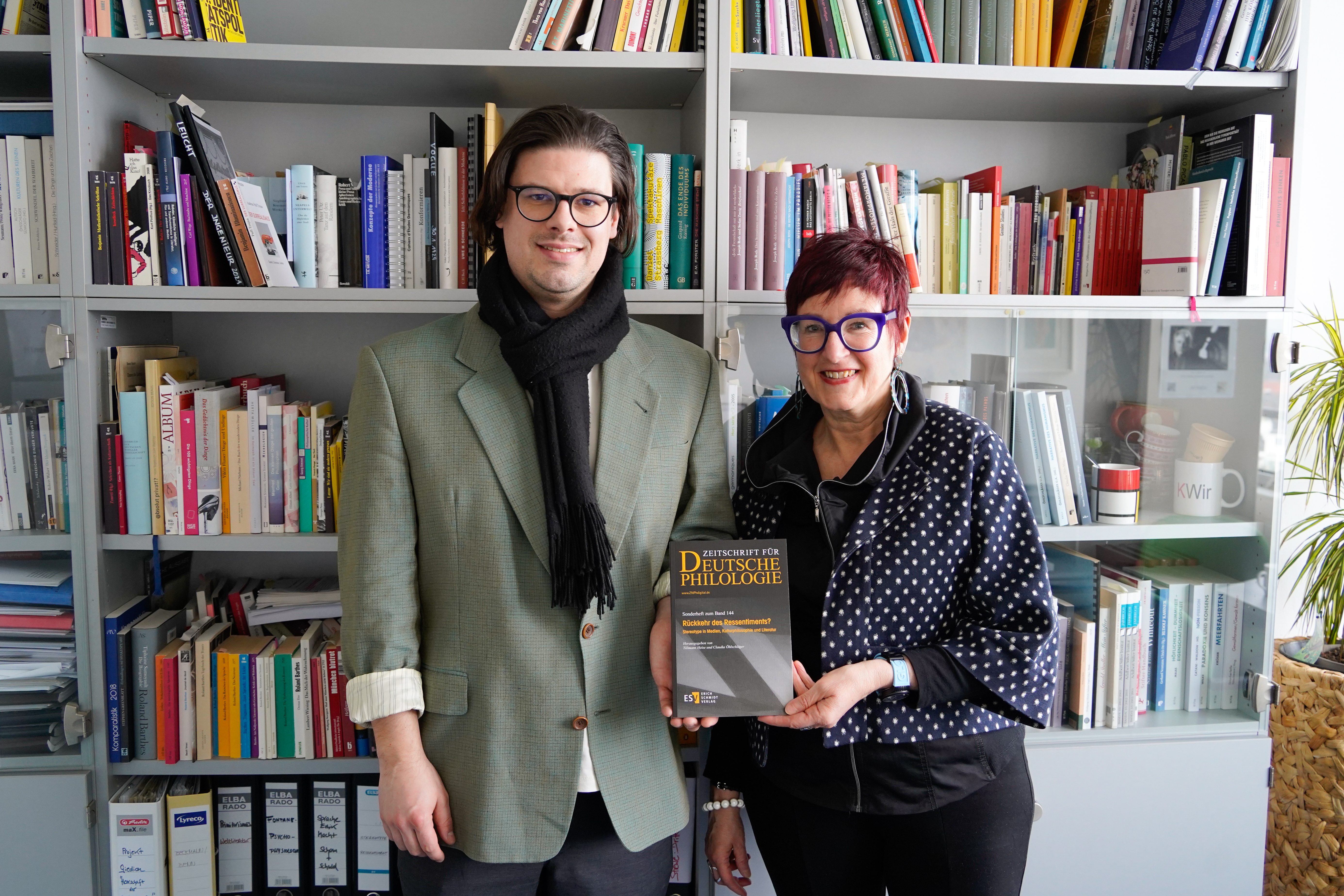
Prof Dr Claudia Öhlschläger and Dr Tillmann Heise conduct research at the Paderborn Institute of German and Comparative Literature on the connections between stereotyping and resentment, among other things. In this interview, they talk about how existing cultural and political stereotypes are not only reinforced and legitimised in literature, but also potentially challenged and possibly even revoked.
What is the difference between "stereotypes" and "resentments"? What characterises them in each case?
Claudia Öhlschläger: Resentment is an emotion of resentment, of postponed anger. It is a suppressed affect that becomes effective in social interactions and contexts and creates images of the enemy. Most theorists agree that resentment is predominantly directed at an 'other' or 'others'. They assume that weak people, i.e. those who feel inferior and incapable of acting with sovereignty, are prone to this type of resentment. In other words, those who believe they have fallen short or been left behind. Only more recent theories have pointed out that resentment can also come from 'above', i.e. from actors with great cultural, social and/or economic capital, and that the suspicion of resentment can also be directed at those who attest to a resentful attitude towards others.
Tillmann Heise: In contrast, stereotypes are first and foremost cognitive schemata that make conventionalised knowledge about certain actors and groups quickly available, for example. They can be realised in different ways, for example in literary texts. Resentment and stereotypes are therefore not the same thing, but we assume that they often occur together. For example, texts that express a resentful mindset often use stereotypical (foreign) attributions to construct the above-mentioned enemy images. On the one hand, resentful writing and speaking is based on existing stereotypes and is therefore involved in passing them on. On the other hand, this moment of resumption and appropriation of stereotypical attributions also harbours the potential for their variation or even liquefaction. Seen in this way, the repetition of stereotypes can - depending on the precise ways and contexts of use to be analysed - not only contribute to their consolidation, but also to their questioning.
In the publication edited by the two of you "The return of resentment? Stereotypes in the media, cultural philosophy and literature" which appeared in December as a special issue of the Zeitschrift für deutsche Philologie, you speak of a revival of resentment in the current culture of debate. Have these ever disappeared there?
Heise: Resentment is of course not an exclusive contemporary phenomenon. They were already the subject of philosophical reflection in the 18th century and the theories of resentment by Friedrich Nietzsche and Max Scheler, which are still influential today, date back to the decades around 1900. Scheler in particular argues that resentment is a specifically modern reaction to the unfulfilled promises of equality in liberal-democratic, capitalist societies. In short: the equality of all citizens guaranteed in constitutions, for example, in formal and legal terms, meets the individual experience of de facto inequality in property, opportunities and social participation. The greater the gap between society's promise and the individual's own reality as perceived by their contemporaries, the more likely it is that resentment will be articulated, for example in public debates. In this respect, the question of the 'return' of resentment does not imply that it has completely disappeared in the meantime. However, their appearance during economic cycles shows that they are closely linked to the overall social situation. Accordingly, resentments are of interest to many disciplines in the field of cultural and social sciences.
Which currently occurring resentments are also strongly represented historically and what social, political and economic circumstances lead to their recurrence?
Öhlschläger: One of the most persistent resentments is certainly the silent or loud resentment towards 'foreigners' and their devaluation. People are considered foreign if they do not fit unconditionally into familiar social and cultural patterns. Xenophobia, i.e. the fear of foreigners and strangers who are seen as a threat to one's own identity or culture, has been recognised as a literary motif since ancient times, e.g. in Sophocles' tragedy "Oedipus". In the Middle Ages, it was pilgrims and crusaders, merchants, witches, sorcerers or Jews and Muslims who were seen as foreign, as they moved outside established forms of rule or the world of ideas of Christian salvation. The fear of the foreigner has remained to this day and in times of societal, social and economic upheaval and crisis, as we are currently experiencing worldwide, resentment towards anything that appears to be different is gaining momentum. Such xenophobic resentment is being cultivated in right-wing and far-right forums and discourses in particular.
You are both researching not only the consolidation of resentments and stereotypes in the media, but also the revocation and "healing" of these. What can this process look like?
Heise: A recommended strategy for identifying and questioning resentments and stereotyped ways of thinking is to meticulously analyse what is written and spoken. This is precisely where we see our specific expertise as literary scholars: to focus a micro-perspective on the concrete linguistic, media and material articulations and aestheticisations of resentments and stereotypes. If, for example, one stumbles across stereotypical attributions of others or oneself in a text, an important question is that of their context and function. Are stereotypical attributions used to fuel resentment or to validate resentful attitudes? But conversely, are stereotypes also used, for example, to ironise, question and thus reverse them? Incidentally, this critical view can and should not only be directed at others, but also at oneself and one's own attributions, judgements and ways of speaking.
Öhlschläger: In addition to critical self-reflection, the French philosopher and psychoanalyst Cynthia Fleury also suggests humour and future orientation as strategies to 'heal' resentment, as she calls it, in her book "Hier liegt Bitterkeit begraben" (2023), which is well worth reading. At university, the process of revoking resentful ways of thinking can also be favoured by choosing specific seminar topics, for example from the context of feminism and/or post-colonialism.
This text was translated automatically.