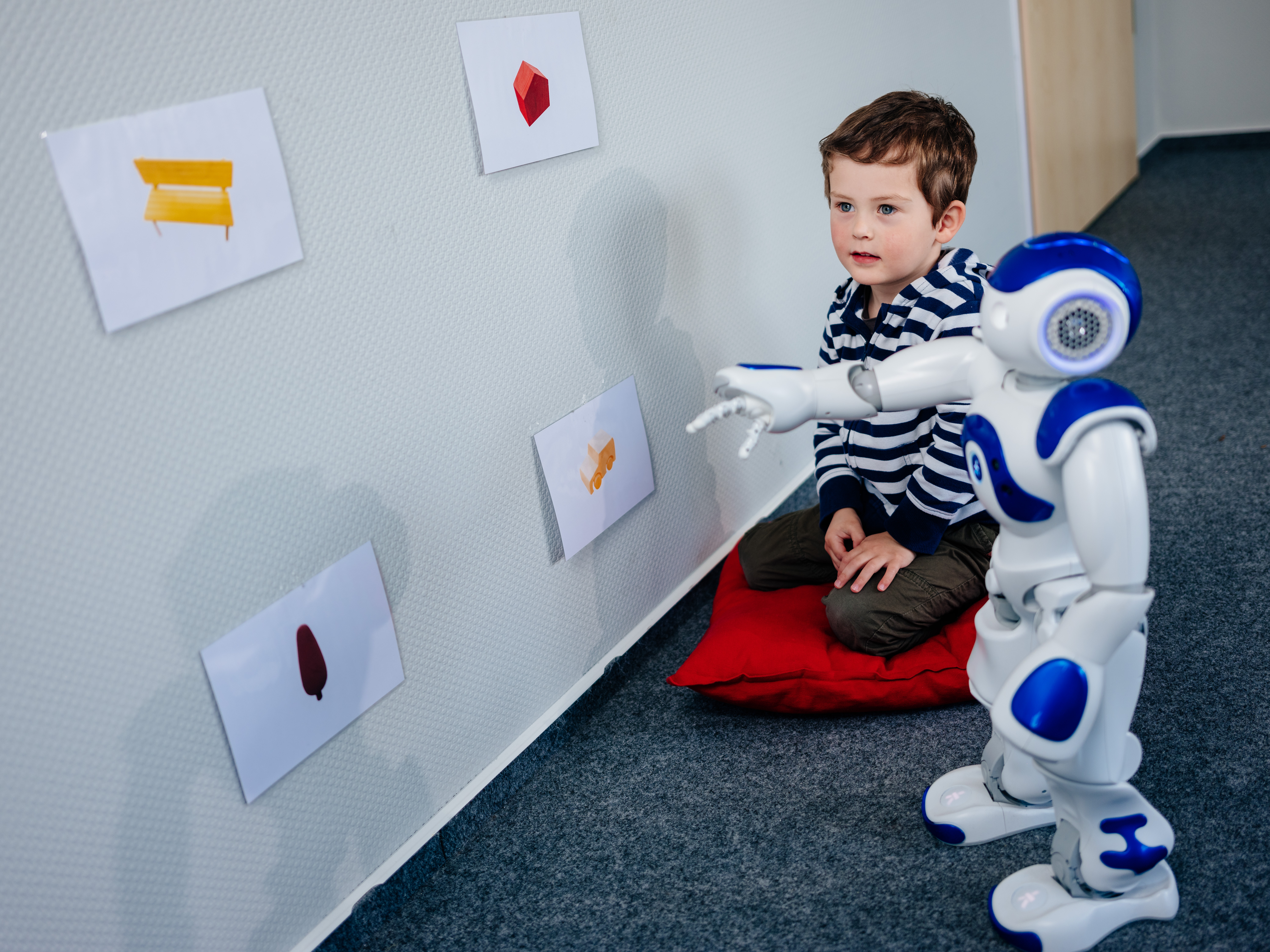
No longer a future scenario: children prepare for tasks and robots can help them. This is exactly what a research team from the Psycholinguistics group at Paderborn University is investigating in a recent study. The aim is to find out how social robots can prepare children for tests in new communicative situations. Parents are cordially invited to register their children aged between five and six for participation. Individual appointments will be made. Participation lasts approximately 40 minutes and as a thank you there is an expense allowance of 15 euros as well as a small gift for the children. Interested families can contact the project worker Valeriia Tykhonenko by email or phone for further information: valeriia.tykhonenko@uni-paderborn.de or 05251/ 60-4309.
During the individual sessions, the children take part in a warm-up phase with the small, humanoid robot "NAO". This is followed by several short, age-appropriate tasks. These include speaking, learning, remembering, understanding, problem-solving, and decision-making. The study centres on the question of whether robots can help children feel less stressed, better prepared and even more confident for further tasks. "Modern technologies are increasingly shaping how we live, learn and communicate. By investigating which warm-up methods prepare preschool children for tests and tasks, we want to better understand how AI tools, especially robots, can play a role in children's learning," explains Tykhonenko. It is important that robots react sensitively to children's actions and adapt to their behaviour. Shy children, for example, need more time and flexibility, while more sociable children interact more quickly. Understanding such individual interactions helps researchers to develop robots that better support learning.
This text was translated automatically.