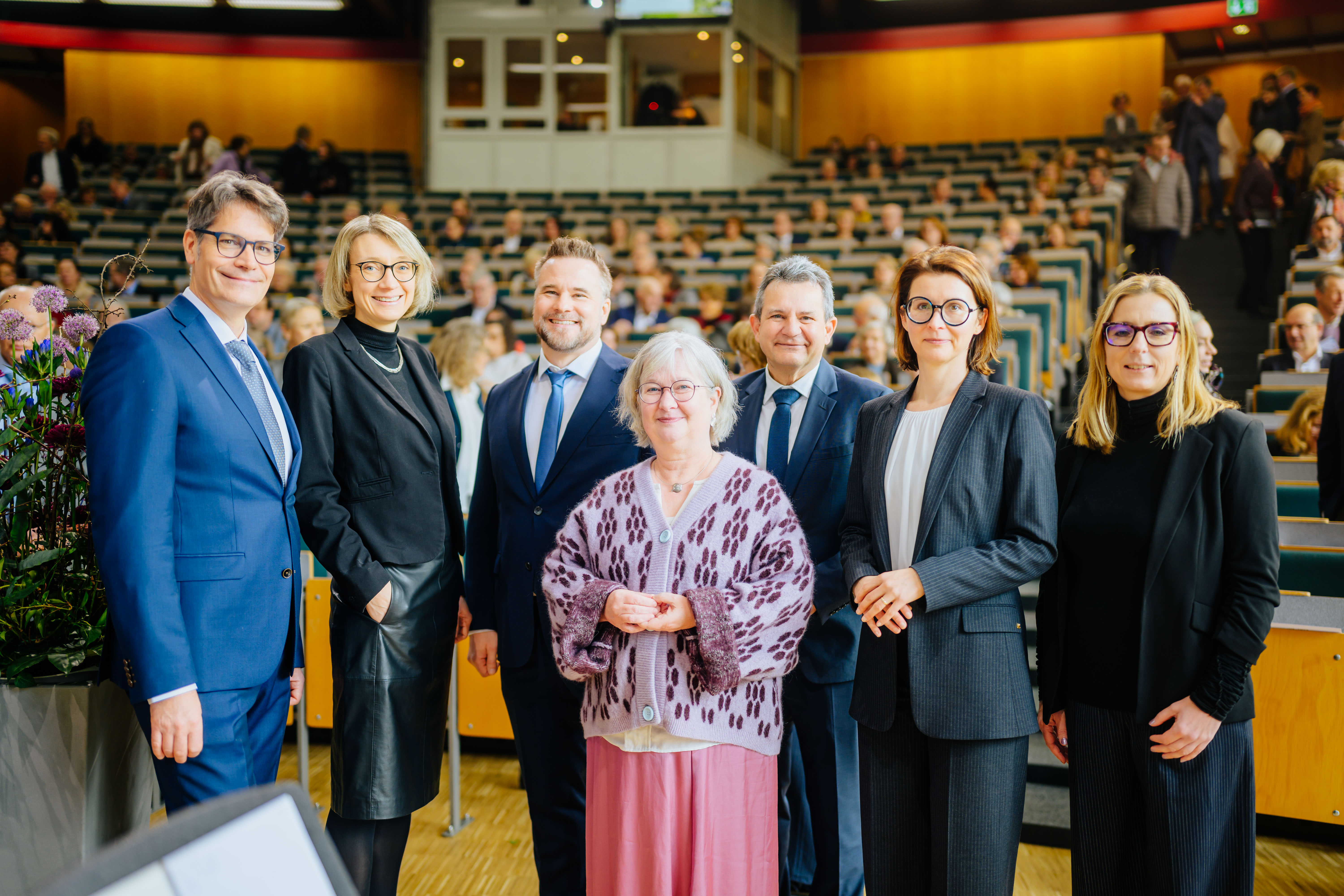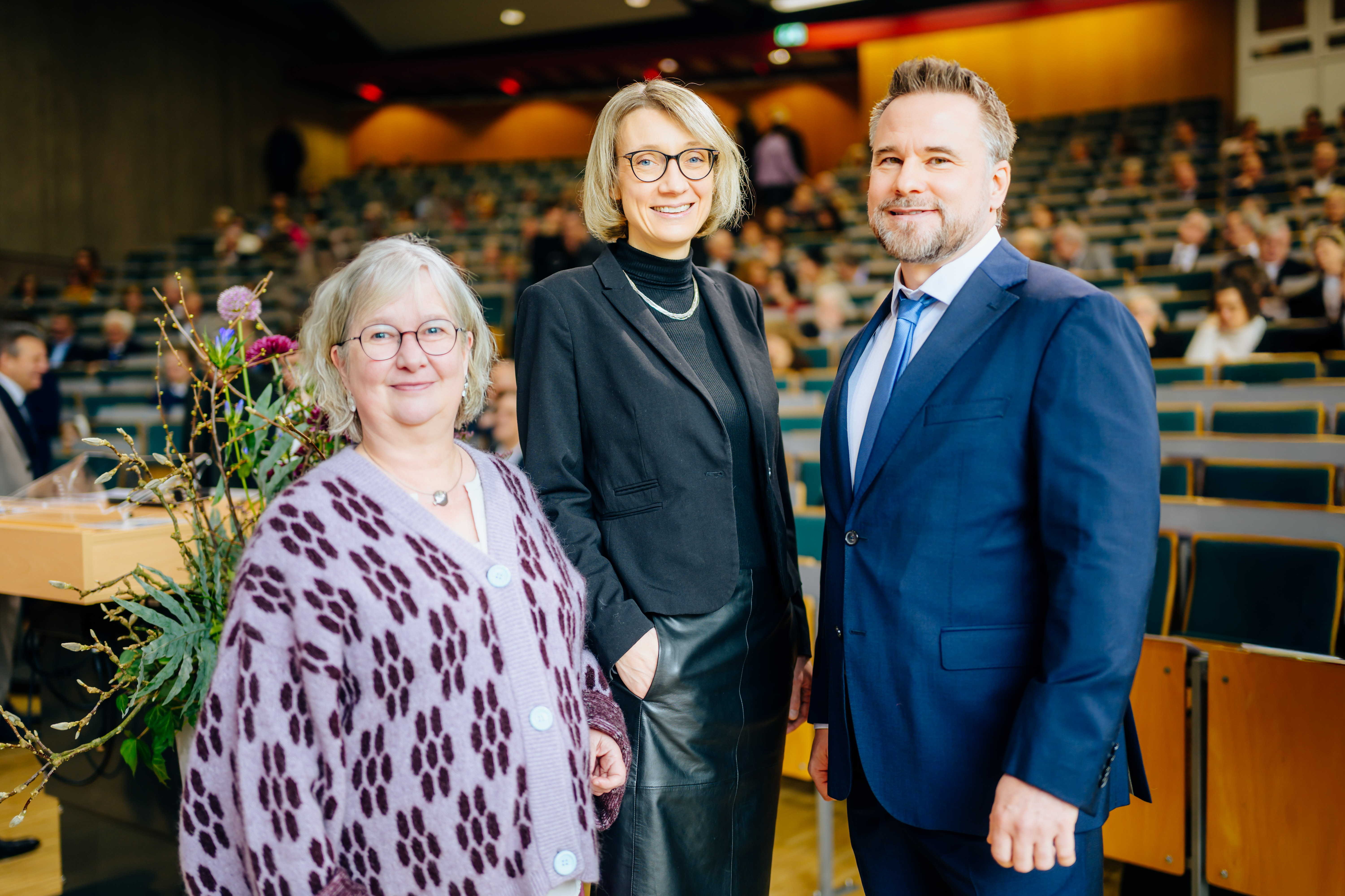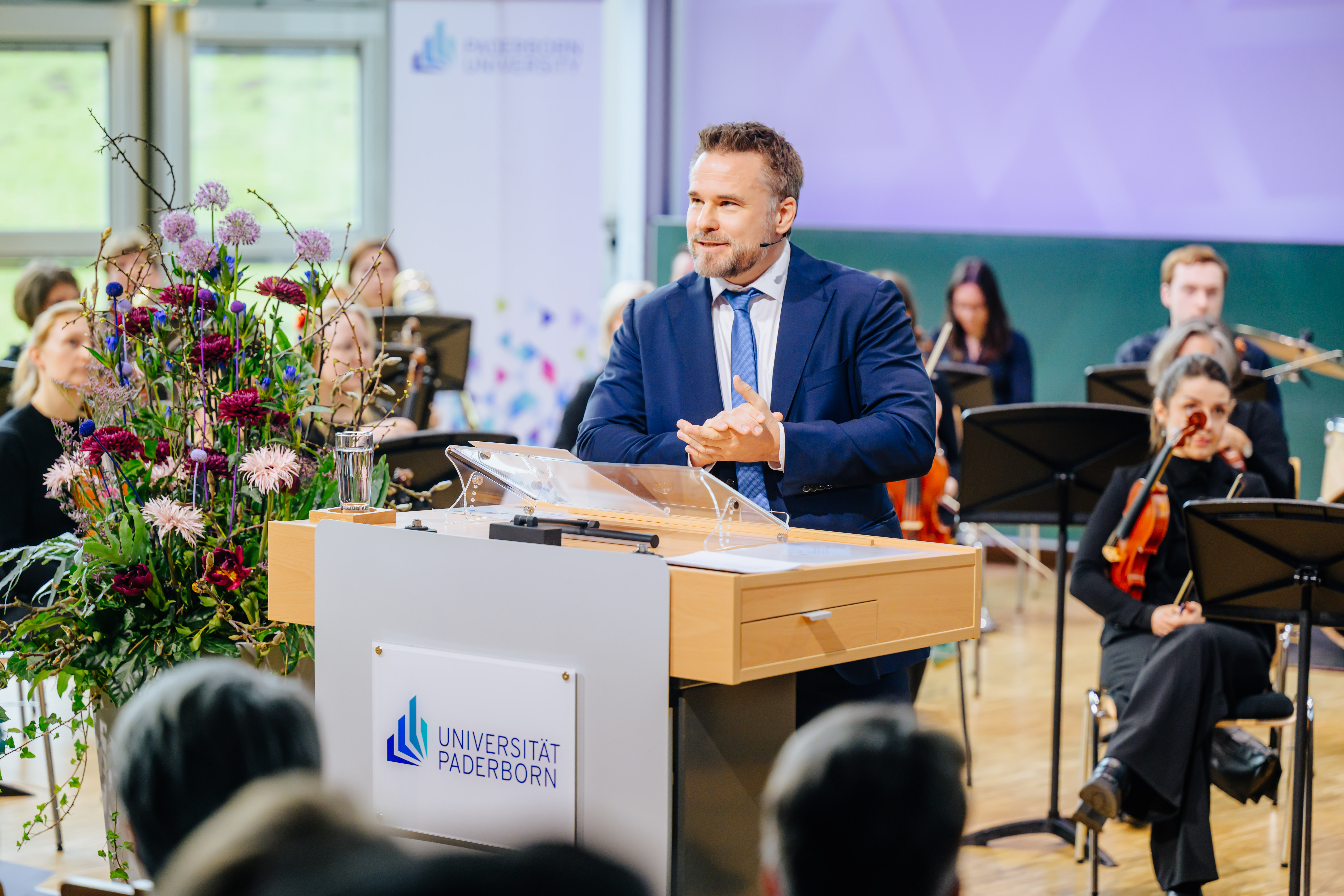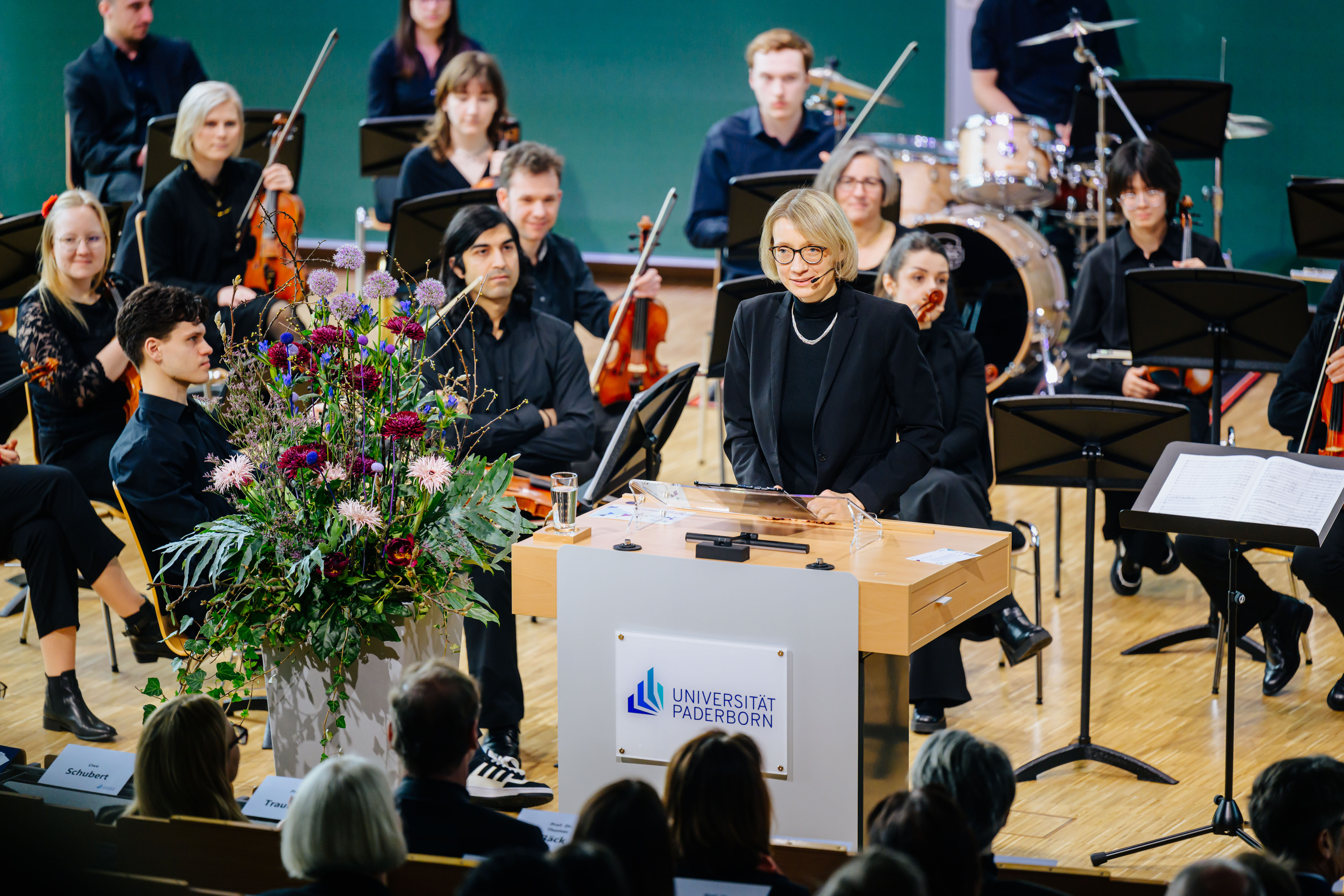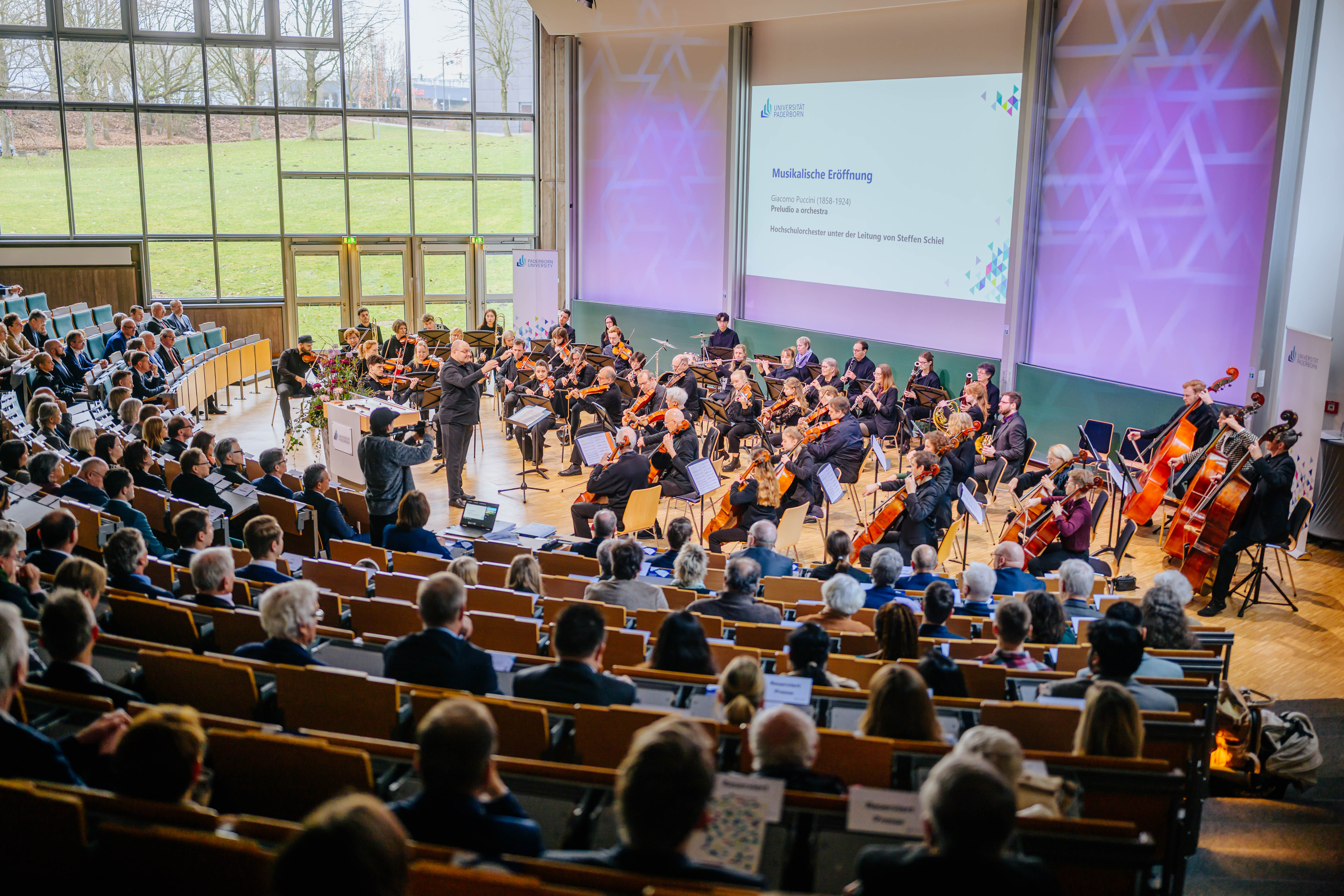
On Sunday, 18 January, Paderborn University celebrated its traditional New Year's reception with around 400 guests from academia, business and politics in the Auditorium maximum. Prof Dr Matthias Bauer, President of the University, welcomed those present to the first New Year's reception of the new Presidential Board.
"What shines alongside a new beginning is undoubtedly success. And there were many of these at our university last year," he emphasised in his speech. He looked at a selection of "lighthouses" and emphasised in particular the Collaborative Research Centres (CRCs), which make the university visible both nationally and internationally and are based in each of the five faculties. CRCs are long-term university research institutions in which scientists work together as part of an interdisciplinary research programme. They are funded by the German Research Foundation (DFG) for a period of up to 12 years. On the other hand, the University President mentioned lighthouses in the University's infrastructure such as the commissioning of the "Otus" supercomputer last year, the opening of the PhoQS Lab in February and the planned remodelling of the Kunstsilo (Building S).
"We scientists reap successes and recognition that would not be possible without you and that are all too often taken for granted. Thank you very much for this," said Prof Bauer to the employees from technology and administration. The occasion was the storm damage to the Auditorium maximum in June last year. Heavy rain caused the building to flood. Many dedicated employees ensured that there was no more damage six months later. Prof. Bauer: "This example shows a shine that does not fade, but stands for our university and for the people who work here."
With the state government's cuts to basic funding, Prof Bauer also addressed the challenges that the university would face, but which it could meet through transparency, far-sighted planning and discussions at eye level. "And this is what we as the Presidential Board have done together with the faculties. In a combination of directional definitions and creative freedom in the faculties. Always accompanied by open and constructive discussions with equal consideration of all status groups." At the same time, however, he also made it clear that savings in basic funding affect the performance of the academic system - "and therefore the future viability and innovative strength of our country". For the universities, this means making the best of the situation and ensuring that the quality of teaching and research is not compromised.
He concluded his speech by emphasising the democratic responsibility of the university, which must be actively communicated to the outside world, especially in difficult times. The work of the last few months had encouraged him that Paderborn University would master this task.
The full speech is available here.
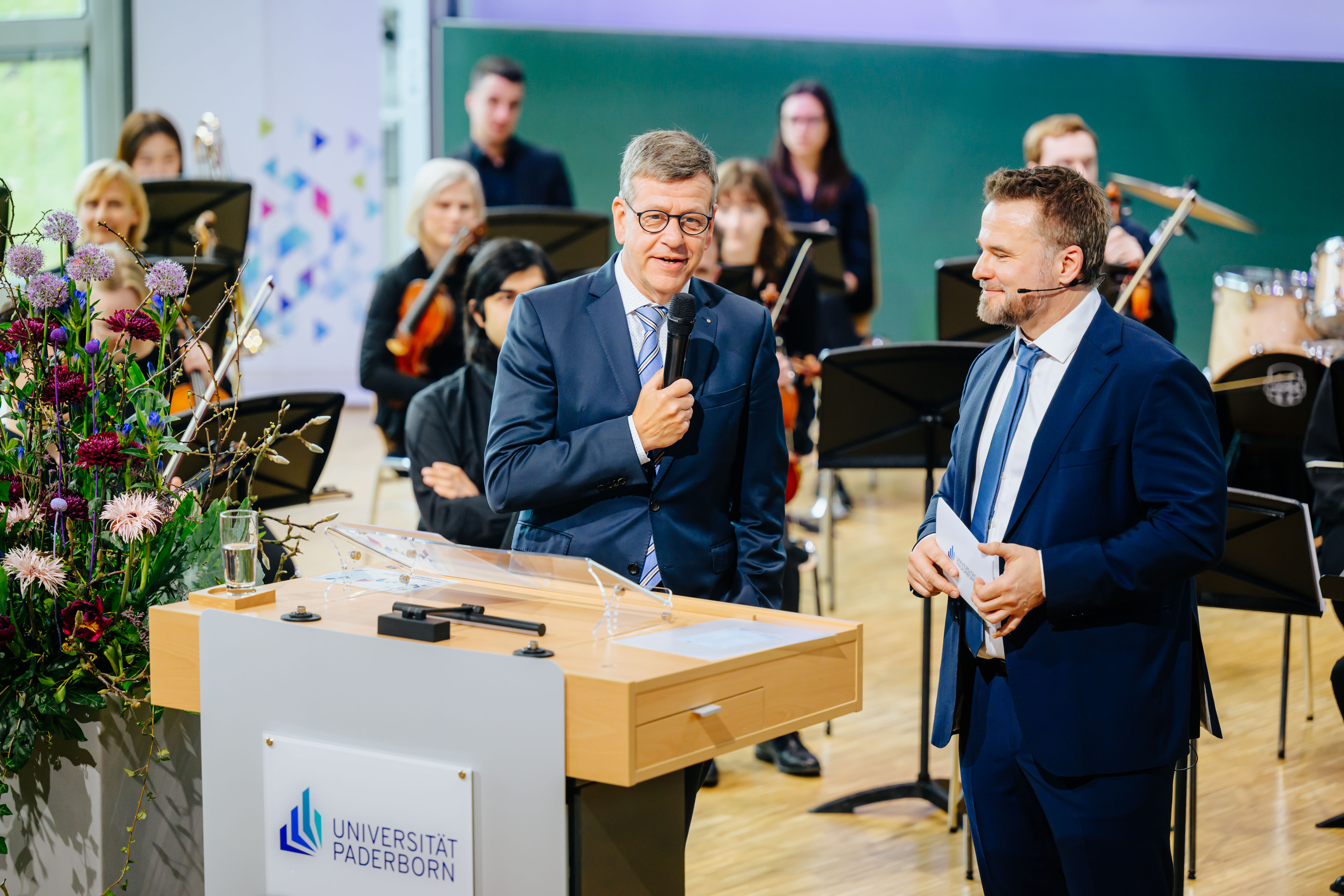
After his speech, Prof Bauer, standing in for Ulrich Lettermann who was ill, switched from the role of host to that of moderator of the event. In a short interview with Prof Dr Andreas Siebe, Chairman of the University Society, the focus was on the tasks and commitment of friends and sponsors of the university. In addition to the annual prizes awarded to outstanding students, the Friends of the University Society also supports young academics and student activities. His wish is to further strengthen this commitment this year.
Prof Dr Michaela Vogt, Vice-Rector for International Affairs, Diversity and Society at Bielefeld University, gave the keynote speech on the topic of "Science and Impact - Why a strong region needs strong universities". She focussed in particular on the relevance of good cooperation between universities. She cited joint special research centres, Campus OWL and the OWL Study Fund as examples of cooperation between Paderborn University and Bielefeld. Prof Vogt also emphasised that universities are indispensable for democracy. Accordingly, a university must make it visible that it is part of a region and promote exchange within it.
Outstanding academic achievements honoured
As part of the New Year's reception, Paderborn University honours outstanding achievements by academics and students every year. In addition to the awards presented by the Presidential Board, prizes were also awarded by the University Society and the German Academic Exchange Service (DAAD). The laudatory speeches can be found on the event website.
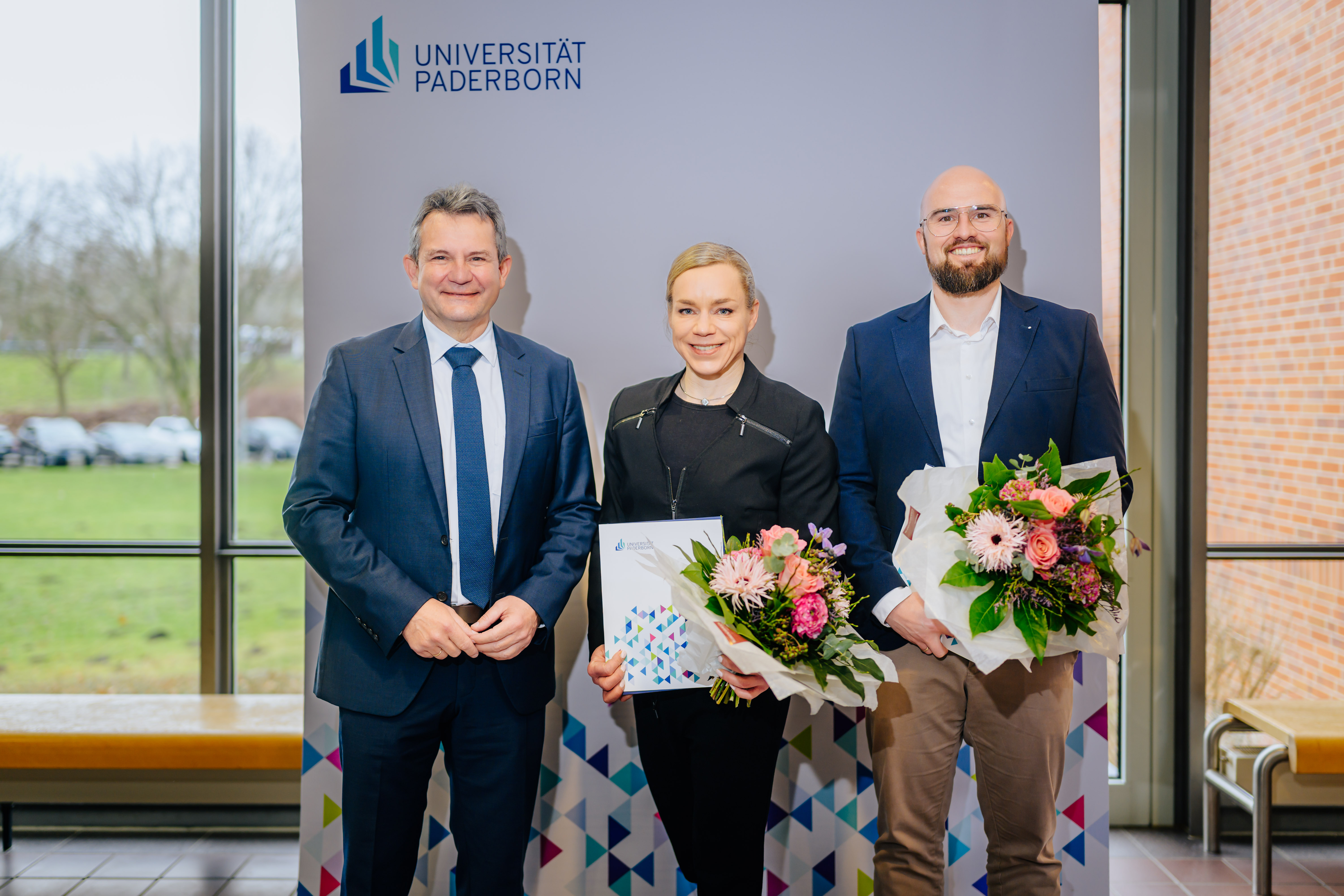
The Paderborn University Research Prize honours exceptional research projects and sponsors innovative ideas for science. This year, Dr Sandra Gausemeier, an expert in driver assistance systems in the "Control Engineering and Mechatronics" department at the Heinz Nixdorf Institute, and Dr Tim Lehmann, a research assistant in the Training and Neuroscience division of the Department of Sport & Health, received the prize, which is endowed with 150,000 euros. Their project aims to help autonomous vehicles recognise pedestrians' intentions by using a combination of AI methods and motion analysis. The project was presented in a video at the New Year's reception. "This approach can substantially increase the safety of all road users," says Prof Dr Thomas Tröster, Vice President for Research and Academic Career Paths.
Honours for excellent doctoral dissertations
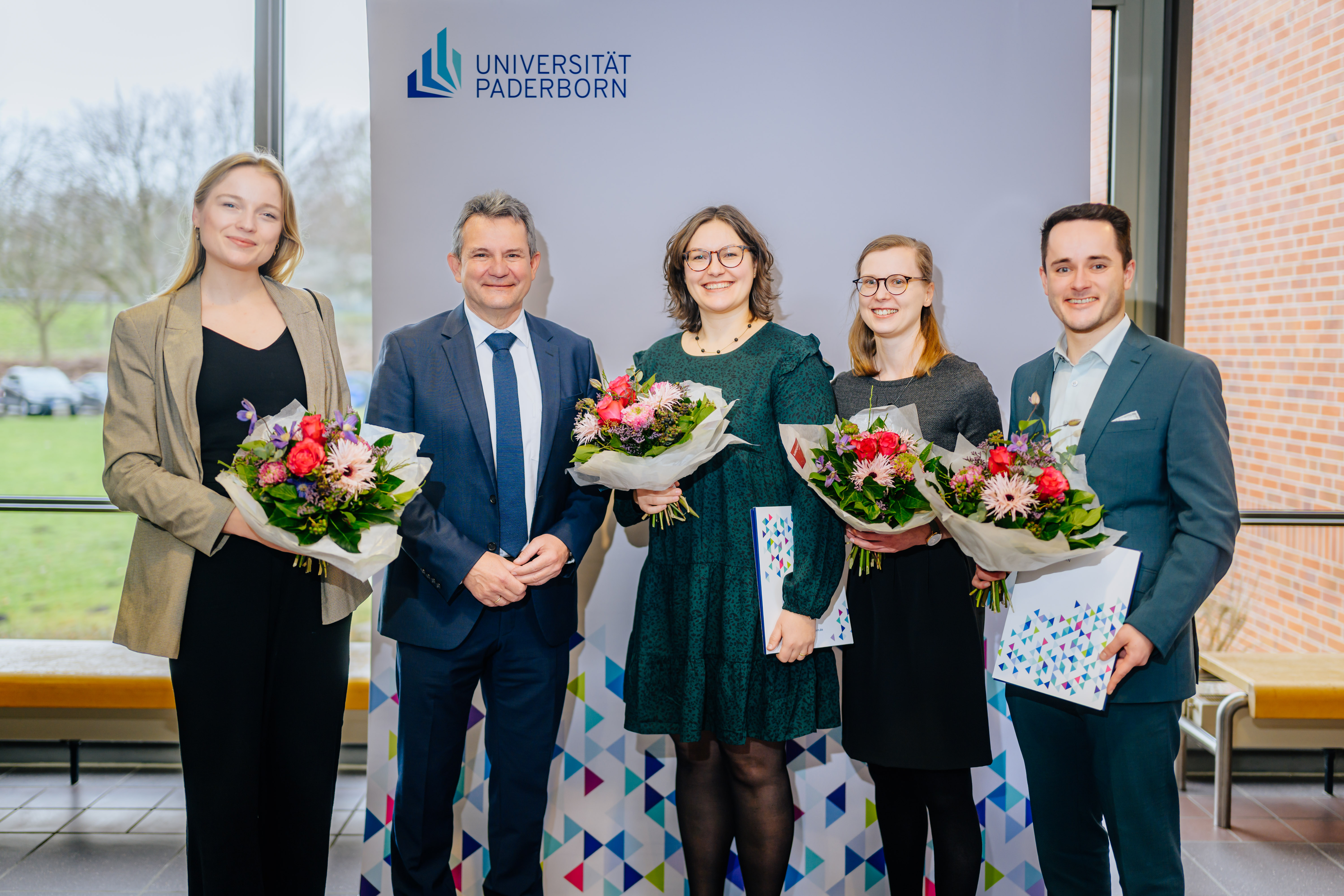
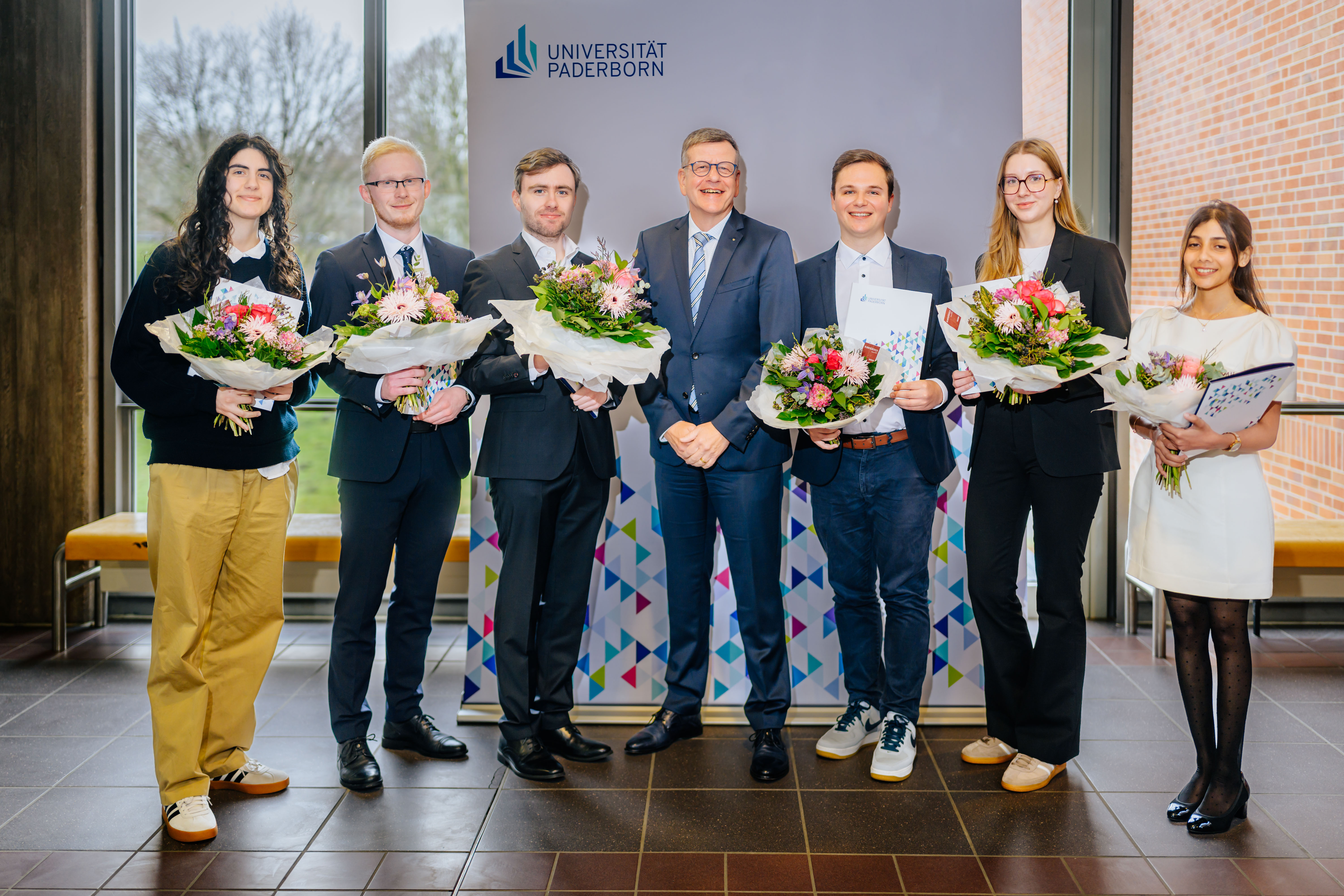
On behalf of the Presidential Board, University President Prof Bauer presented four academics with prizes for outstanding doctoral dissertations, each worth 2,500 euros. Dr Livia Boerner (Faculty of Business Administration and Economics/Organisational, Media and Sports Economics) was awarded a prize for her work on "Cognitive Decision Bias among Entrepreneurs and Investors in Televised Startup Pitch Competitions". Two researchers from the Faculty of Arts and Humanities were also honoured: Dr Anne Breckner (Protestant Theology) researched the topic "Lord's Prayer parodies in continuity and change: theological and cultural studies analyses" and Dr Kirsten Behr (Romance Literary and Cultural Studies/Didactics) examined "Female Disasterscapes: women in the natural disaster novel of the French-speaking Caribbean". Dr.-Ing. Mats Vernholz from the Faculty of Mechanical Engineering, Department of Technology Didactics, received the prize for his "Analysis of academic self-concepts of industrial-technical teacher training students with special consideration of socio-demographic heterogeneity and comparative processes as developmental influences - a mixed-methods study in the context of technology didactics".
Special theses and international students honoured
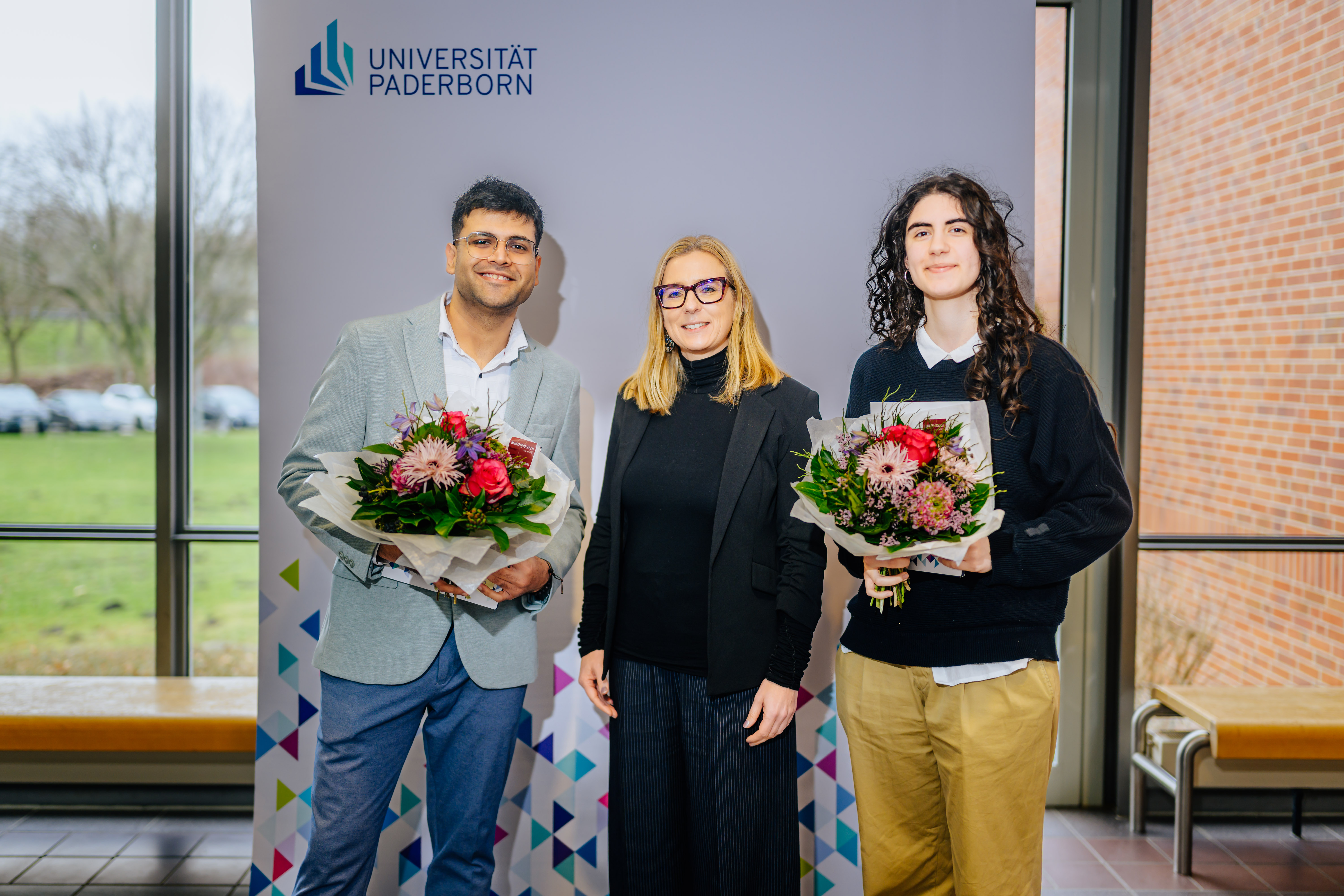
Five graduates from all faculties of Paderborn University were honoured with prize money of 1,000 euros each. The University Society honoured Rose Sunil, Luca Maurice Jotzo, Paul Steinmeier, Niklas Lamberty and Nicole Grieger for their outstanding Master's theses. Hasna Mahmoud received the University Society's prize for international students with outstanding academic achievements and great social commitment. The DAAD sponsorship prize for international students went to Lakshay Khanna. This prize is awarded once a year at each university.
The university orchestra under the direction of Steffen Schiel rounded off the event with a varied programme of classics and film music.
This text was translated automatically.


![Neue Technologie für sicheres autonomes Fahren [Forschungspreis der Universität Paderborn 2025]](/typo3temp/assets/_processed_/c/8/csm_youtube_fffb31dfa884ff3ae2e8f9cfaedf6ef5_3e264e14cf.jpg)