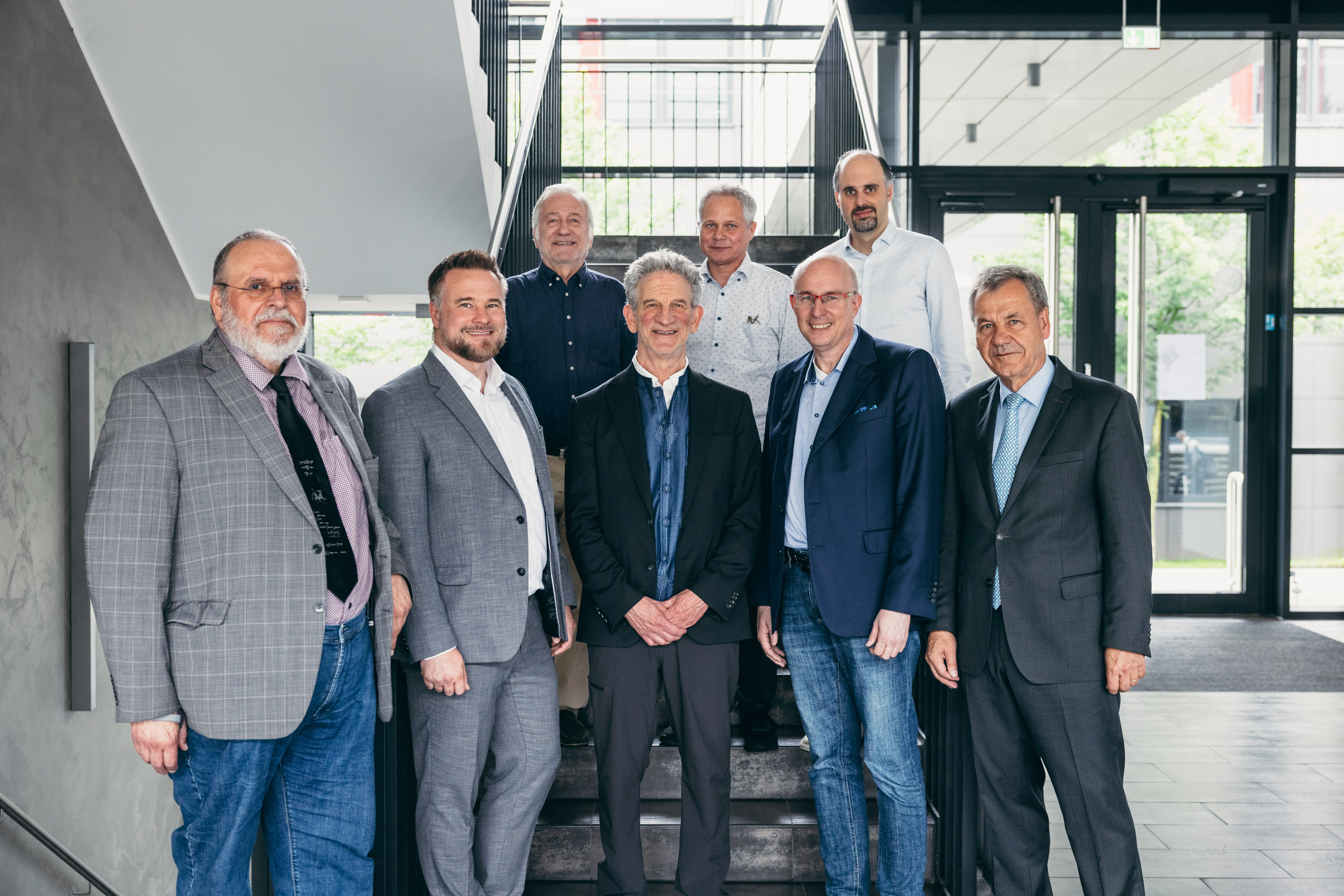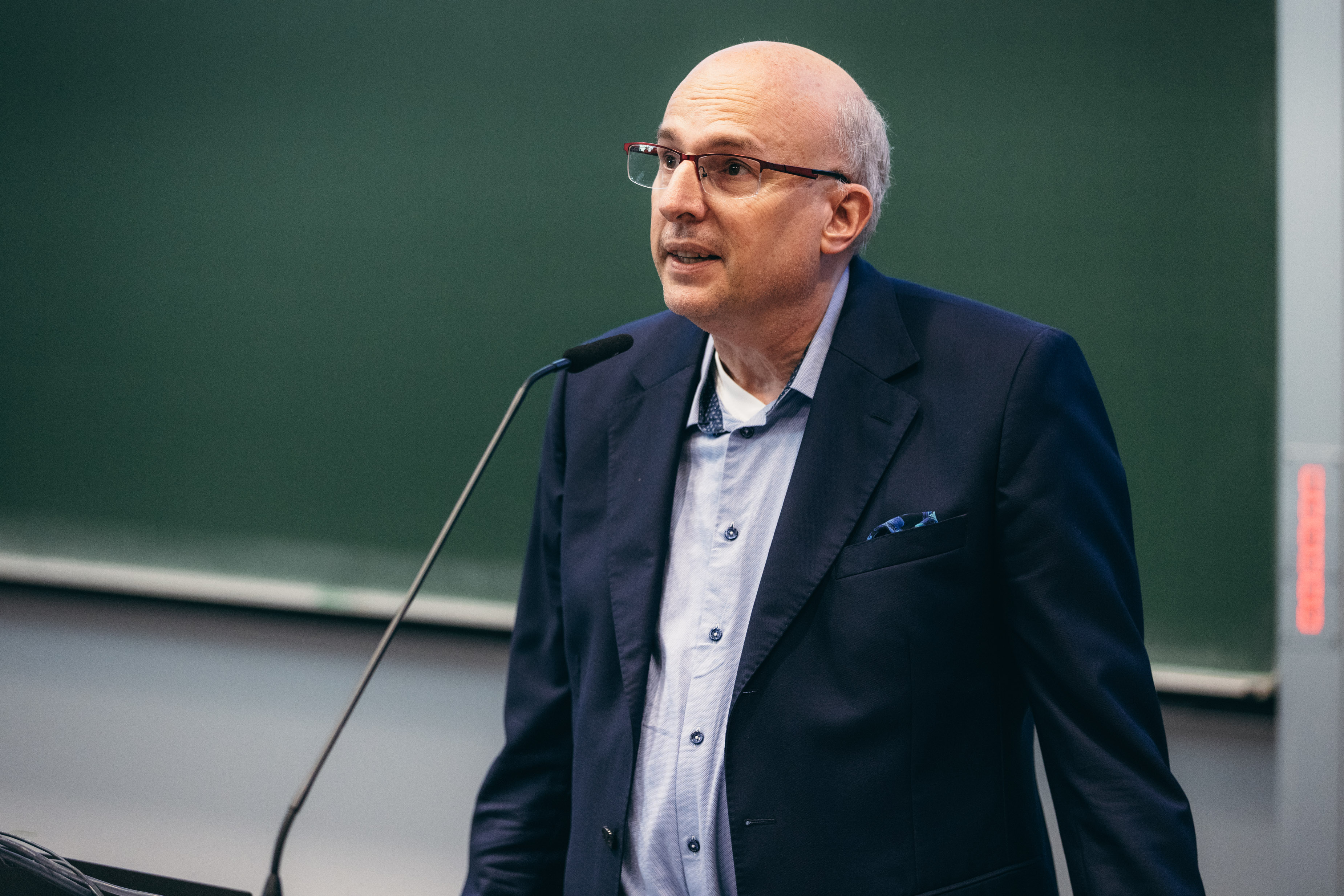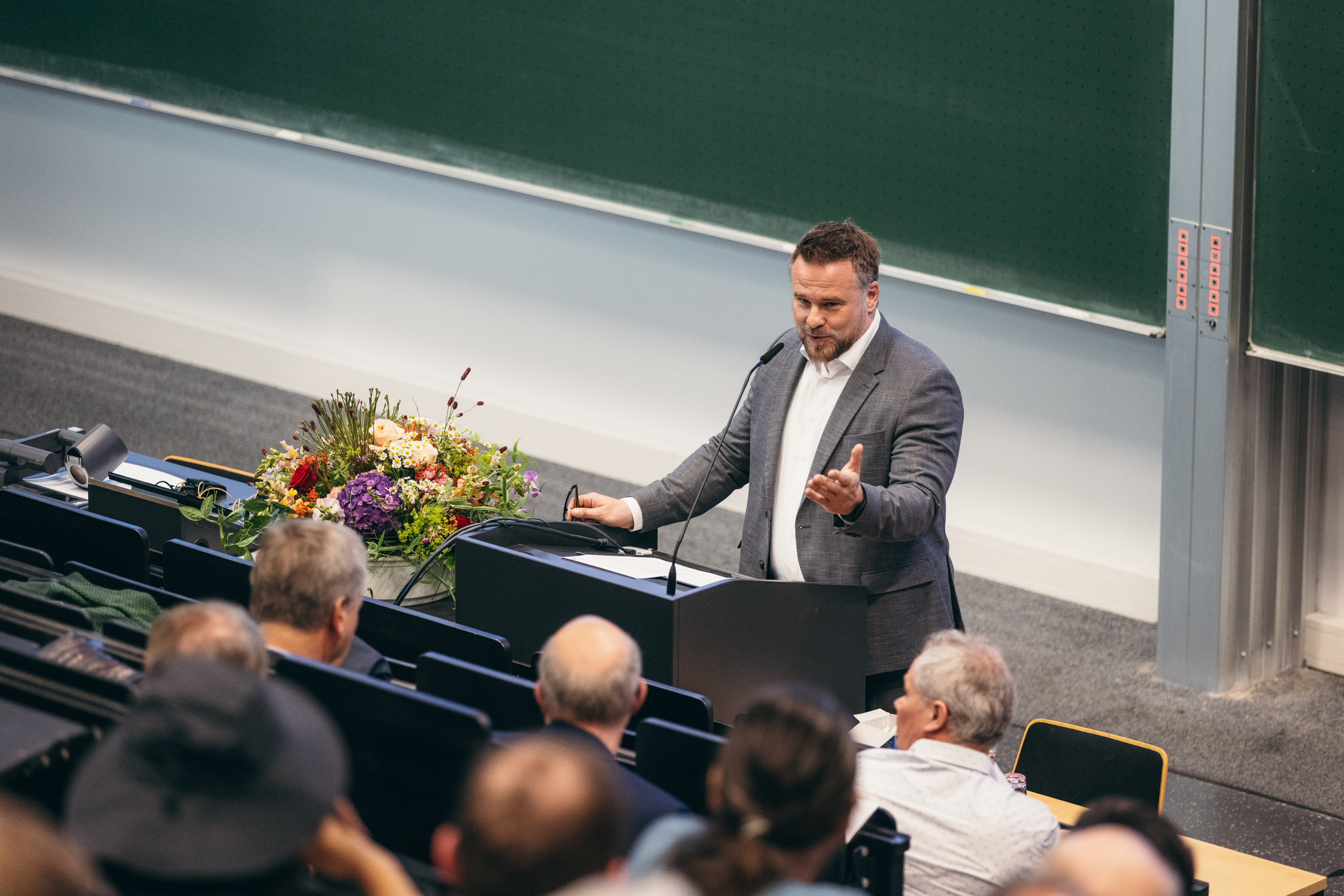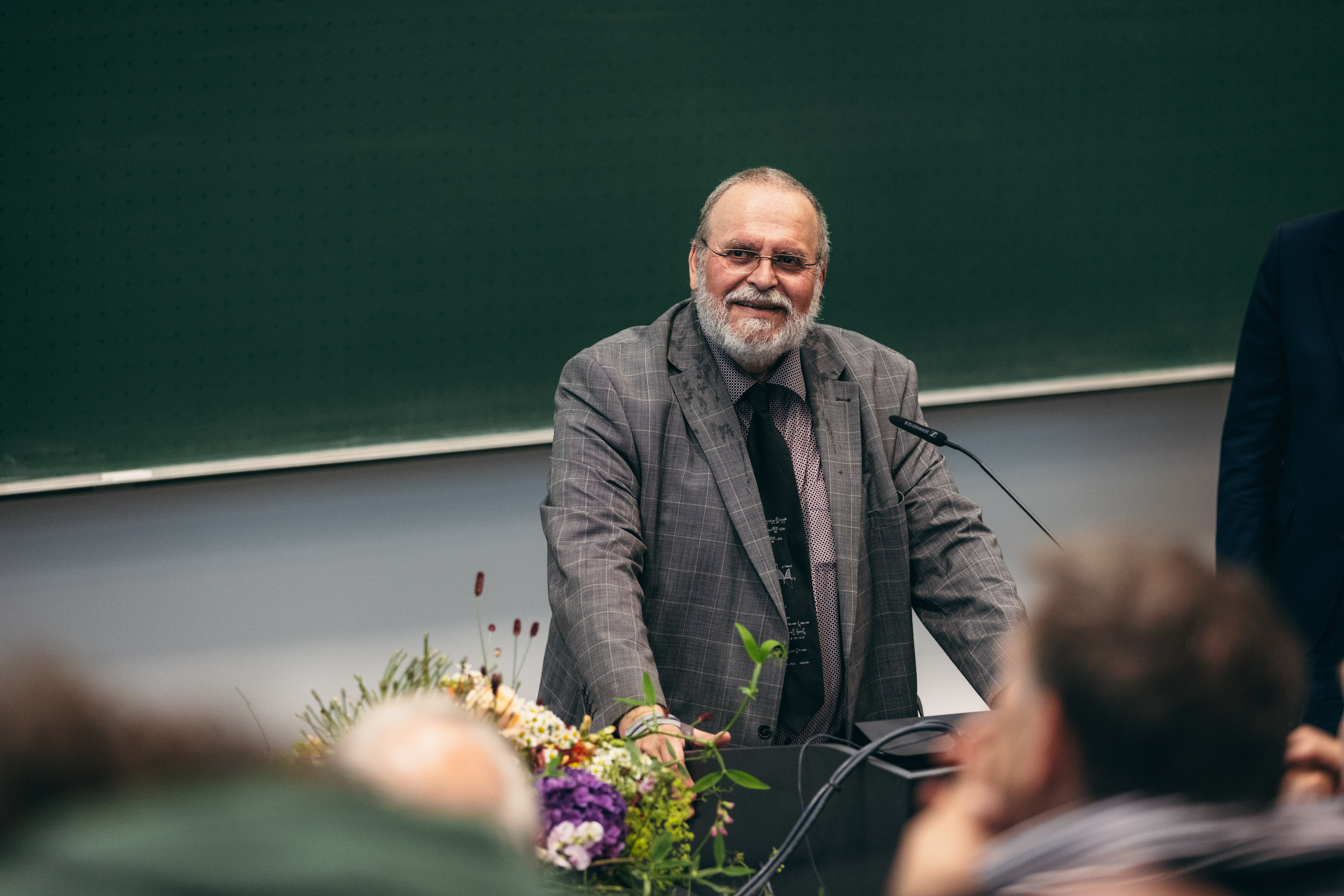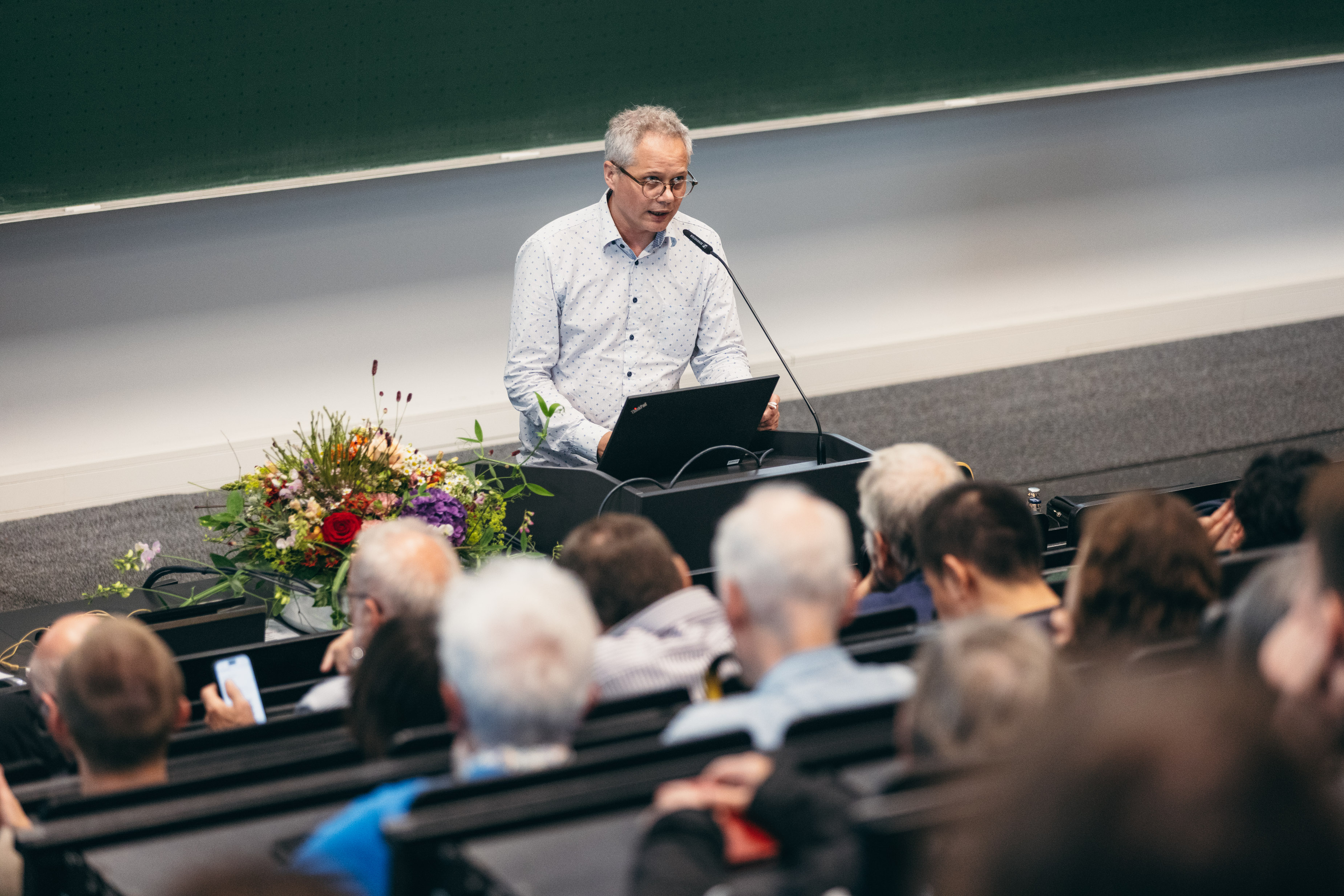
Prof. Dr Peter Clive Sarnak, an internationally acclaimed mathematician who has received numerous awards, gave an insight into his research as this year’s keynote speaker at the Weierstrass lecture at Paderborn University. The lecture, which also attracts considerable international attention, is named after Karl Weierstrass, who in 1834 graduated from the Theodorianum Grammar School in Paderborn as the school’s top student. Weierstrass is regarded as one of the most important mathematicians of the 19th century and is considered, among other things, the founder of modern analysis.
Prof. Dr Matthias Bauer, President of the University, highlighted the significance of the lecture series right at the start: “The Weierstrass Lecture strengthens Paderborn’s position as an international centre for research in Mathematics and, at the same time, honours the historical significance of our city as the place where one of the greatest mathematicians of the 19th century worked.”
Prof. Dr Jürg Kramer, Chairman of the German Mathematical Society, introduced the organisation and gave an overview of Weierstrass’s academic career. The dean of the Faculty of Computer Science, Electrical Engineering and Mathematics, Prof. Dr Jürgen Klüners, welcomed those present: “The lecture honours the legacy of Karl Weierstrass and at the same time reflects the university’s appreciation of the various disciplines of Mathematics.”
The historical lecture on medieval astronomy from around 700 years ago was delivered by Prof. Dr Thomas Sonar from the Technical University of Braunschweig. The scholar specialises in the history of Mathematics, particularly the work of Dedekind, Gauss, Newton and Leibniz.
Prof. Dr Martin Kolb, Professor of Stochastics at Paderborn University and co-organiser of the lecture, introduced the commemorative lecture. He described Prof. Sarnak as brilliant and called it a “pleasure to be able to listen to him”.
In his lecture, Prof. Sarnak discussed the so-called Markov spectrum. This is a well-known concept from number theory. It describes a set of real numbers that appear as lower bounds (‘minima’) of indefinite binary quadratic forms.
Prof. Sarnak worked at Stanford University, USA, until 1991. Since 1991, he has been a professor of Mathematics at Princeton University, also in the USA. Since 2007, he has also been one of eight permanent members of the prestigious “School of Mathematics” at Princeton. His awards include the “George Pólya Prize” from the “Society for Industrial and Applied Mathematics” (SIAM), the “Ostrowski Prize” and the “Levi L. Conant Prize”. For his work in number theory, he was awarded the “Frank Nelson Cole Prize” by the “American Mathematical Society”.
This text was translated automatically.