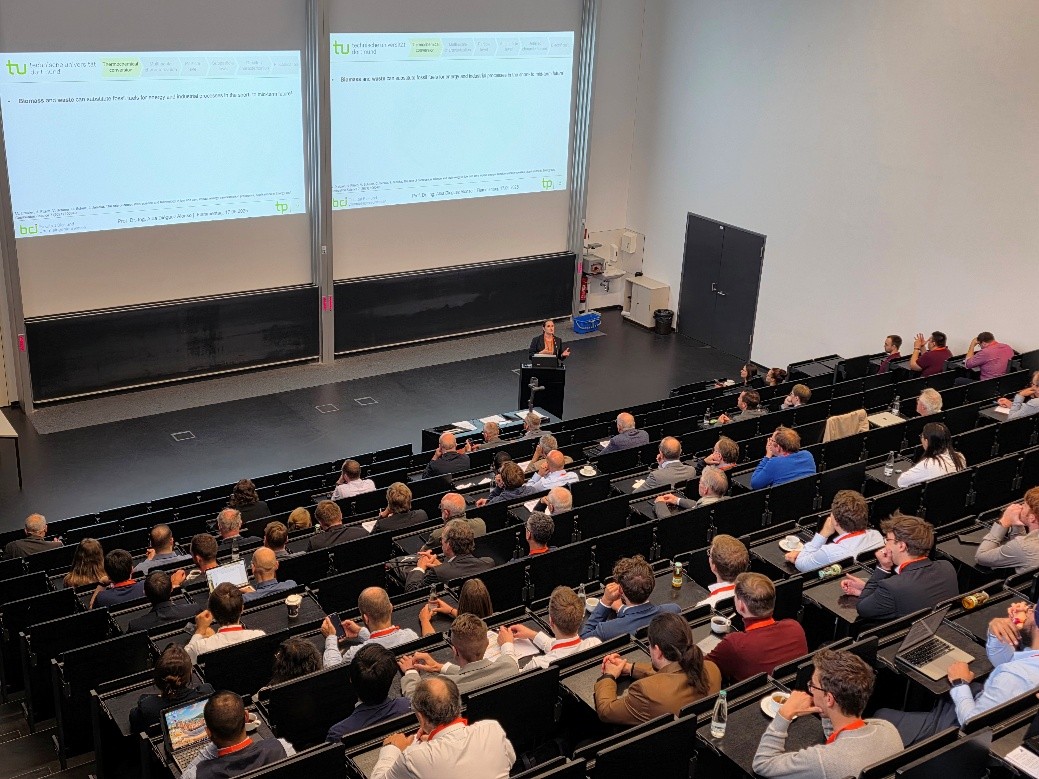
The 32nd German Flame Day took place from 15 to 17 at Paderborn University. Over three days, more than 200 participants from industry and research shared their scientific findings.
The conference is jointly organised every two years by the German Association for Combustion Research (DVV) and the German section of the Combustion Institute (CI). This year, the German Flame Day was organised at Paderborn University by the KET Department of Technical Thermodynamics under the direction of Professor Dr. Tina Kasper.
The energy transition poses new challenges for technical combustion processes and the integration of sustainable technologies in various applications. The use of sustainable fuels in various forms, such as green hydrogen or fuels from plants, or thermochemical recycling processes are just two examples. These and other combustion research topics were presented and debated at the 32nd German Flame Day 2025 at Paderborn University from 15 to 17 September 2025. The German Flame Day serves the transfer of new scientific findings from the basics to application between science and industry. The conference is jointly organised every two years by the German Association for Combustion Research (DVV) and the German section of the Combustion Institute (CI). This year, the German Flame Day was organised at Paderborn University by the Chair of Technical Thermodynamics under the direction of Professor Dr. Tina Kasper.
225 participants from academia, industry and public authorities met and presented their current research results. A total of 150 contributions were submitted, of which 88 were technical presentations and 62 were poster contributions. Particularly noteworthy are the two keynote lectures: "Advancing thermochemical conversion processes: Integrating High-Resolution Models with In-Depth Experimental Characterisation" by Prof. Dr.-Ing. Alba Diéguez Alonso from the Technical University of Dortmund and "The Future of Thermoprocessing: Renewable Gases vs. Electricity" by Prof. Dr.-Ing. Christoph Wieland from the University of Duisburg-Essen. The scientific conference programme at the Paderborn University campus was complemented by networking events. On 15 September, young scientists met at the Early Stage Combustion Researcher networking event and on 16 September, all conference participants were able to exchange ideas in an informal atmosphere during a joint visit to the Heinz Nixdorf Museum. Here, prizes were awarded by both organisations for outstanding achievements: Ms Erika Fixel from the University of Stuttgart received the DVV Study Award for her master's thesis. The CI's Warnatz Prize honours achievements during or shortly after a doctorate. This year, it went to Dr Lukas Berger from RWTH Aachen University. Prof. Dr. Abdulla Ghani from the University of Hanover and Dr. Fabian Hampp from the University of Stuttgart were honoured for their achievements as independent young scientists. Thomas Kolb from the Karlsruhe Institute of Technology received the Rudolf Günther Prize for outstanding, long-term achievements in the scientific research and industrial utilisation of safe, environmentally friendly and effective combustion processes.