A team of researchers from the Institute for Photonic Quantum Systems (PhoQS) at Paderborn University has taken a decisive step towards universal photonic quantum computers. Using a novel time-multiplex architecture, the team led by group leader Dr Benjamin Brecht from the‘Integrated Quantum Optics’research group, headed by Prof. Dr Christine Silberhorn, has succeeded in realising a high-precision quantum gate circuit containing the so-called C-NOT gate. With a quality factor of around 94 per cent, this approach opens the door to larger, reconfigurable quantum circuits, thereby overcoming previous scaling problems in quantum technology. The results have now been published in the prestigious journal *Nature Communications*.
Quantum computers promise computational power that enables them to solve certain problems where classical computers reach their limits. The basic building block of many quantum computers is the qubit. Whilst various physical platforms such as superconducting circuits or trapped ions are being researched, photonic quantum computing offers unique advantages. Dr Federico Pegoraro from PhoQS explains: “Photons are exceptionally well isolated from disruptive environmental influences and can be controlled. However, one challenge for us is that photons do not normally interact with one another.”
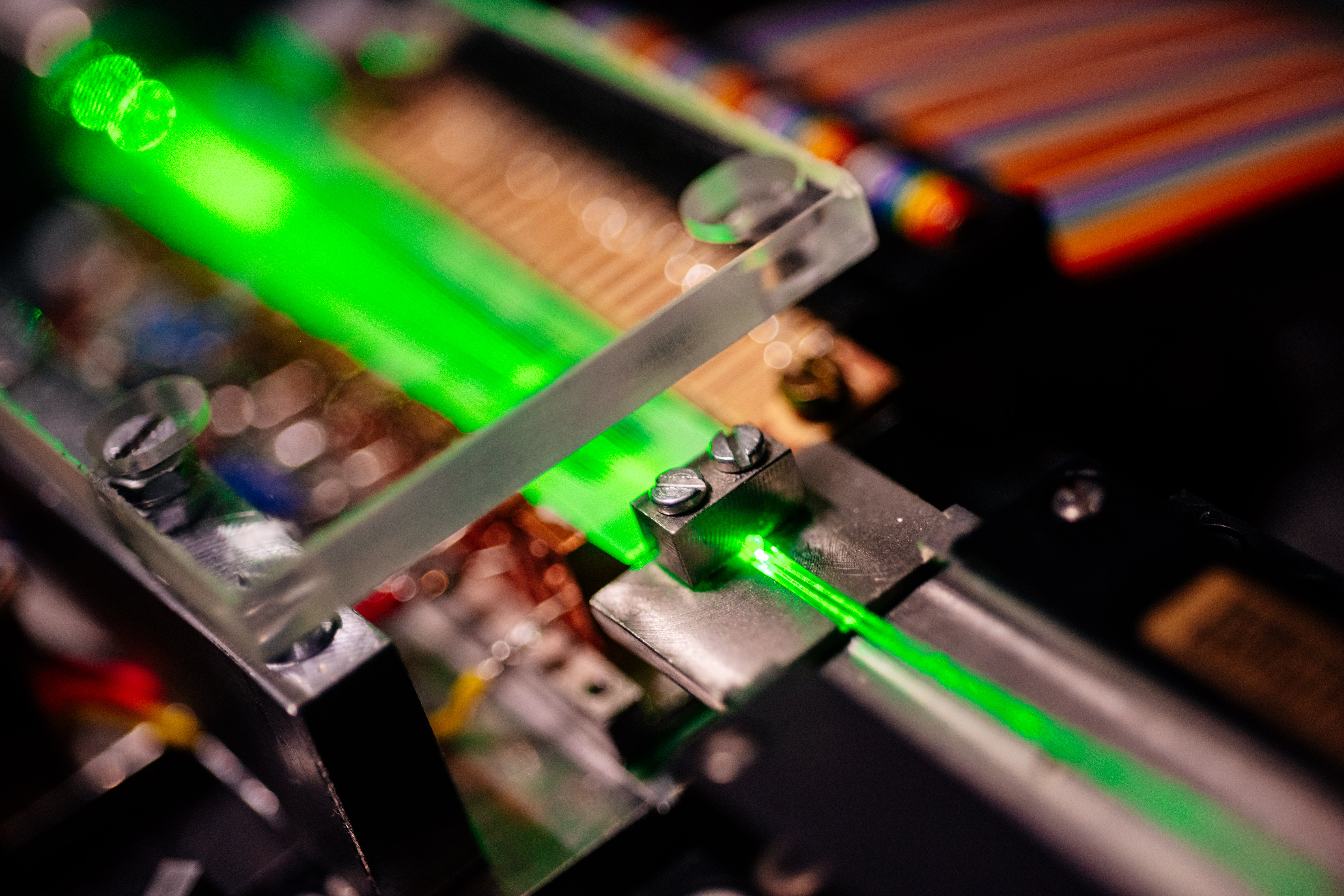
Performing logical quantum operations, such as the C-NOT gate – which operates on two qubits – is necessary to generate entanglement and execute quantum algorithms. Until now, this has often required complex optical set-ups, which, however, could only be scaled to a limited extent. The researchers have adopted an innovative approach: instead of encoding quantum information spatially across different light paths, it is encoded temporally. This so-called ‘time-multiplexing’ makes it possible to send multiple qubits through a single optical module by transmitting them in different time slots.
Looking ahead, the researchers see potential in further developing the hardware. Faster electro-optical circuits could increase data rates thirty-fold in the foreseeable future and further boost the system’s efficiency.
Read the paper: https://www.nature.com/articles/s41467-026-74861-9
This text was translated automatically.