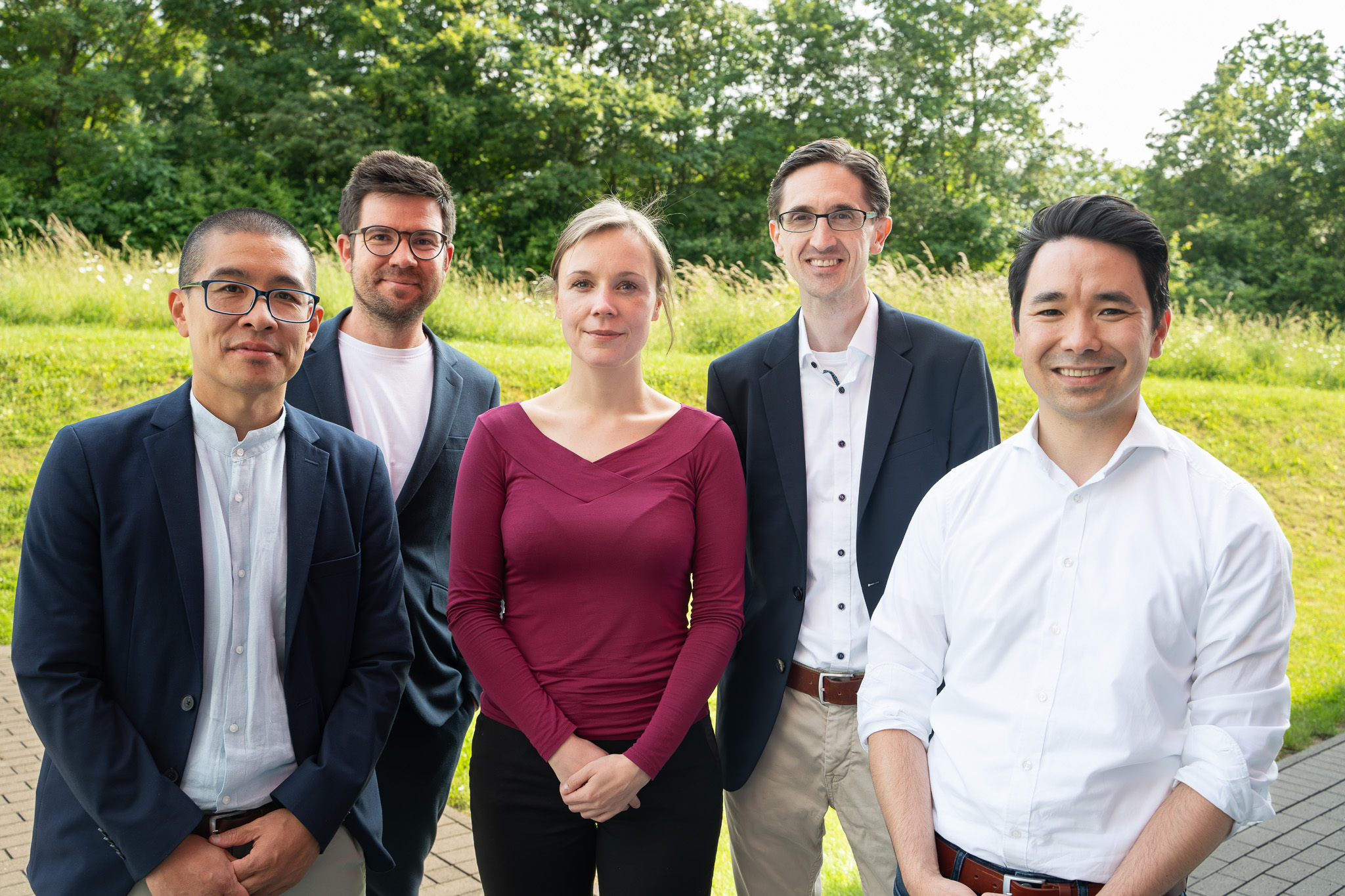
Researchers at Paderborn University publish findings and recommendations
There is now widespread awareness of the urgency of the global transition to a low-carbon economy. However, what is crucial above all is the consistent implementation of appropriate measures. At the ‘Paderborn Research Centre for Sustainable Economy’ (PARSEC) at Paderborn University, a working group funded by the German Committee Future Earth (DKN)¹ is dedicated to this topic and has now published an article in the renowned journal ‘Nature Portfolio Journal: Climate Action’. They argue that technological innovation and a coherent policy framework are not enough. Rather, particularly within public administration, there is a need for a workforce possessing the relevant skills – so-called green skills – to accelerate the introduction of low-carbon technologies, services, and business models. This will ensure that climate action measures are effectively embedded within institutional, economic, and social contexts.
Green skills must be clearly defined
Prof. Dr Daniel Reimsbach, spokesperson for the working group at PARSEC, explains: “We are observing that the development of green skills is under threat. On the one hand, governments worldwide have begun to promote the development of these skills. On the other hand, the current geopolitical instability – resulting, for example, from shifts in the US government’s priorities and from ongoing wars or regional conflicts – could lead to cuts in public funding.” Prof. Dr Martin Kesternich, also a spokesperson for the working group, adds: “We would like to advance the debates on green skills in the context of the global ecological transition and link them to discussions on effective policy measures for the sustainable transformation of the public sector.” In the article, the researchers in the working group emphasise the importance of this integrated approach and the need for a more precise conceptual framework that makes it possible to measure and compare green skills among administrative staff. The researchers focus on those who have direct contact with citizens in their day-to-day work and who implement policy programmes and guidelines at an operational level. “As little is currently known about the specific skills required for the effective implementation of sustainable policy systems in the field of public administration, we aim to encourage a clearer definition and conceptualisation of green skills,” said Prof. Reimsbach. The aim is to lay the groundwork and provide concrete guidance on how green skills can help to better implement sustainability goals in politics and public administration in the future.
Working group conducts research into the implementation of public funding programmes
The working group brings together experts from the academic disciplines of environmental and behavioural economics, Business Informatics, business education, and business administration – in particular reporting, corporate governance, human resource management, and leadership. The researchers are focusing on staff in cities, towns and local authorities, and in particular on funding programmes aimed at private households. Through PARSEC, the Faculty of Business Administration and Economics at Paderborn University is strengthening its faculty-wide activities on the topic of sustainability.
The article (Open Access) can be found at: www.nature.com/articles/s44168-026-00389-9
1 The DKN is an independent scientific advisory body of the German Research Foundation (DFG).
This text was translated automatically.