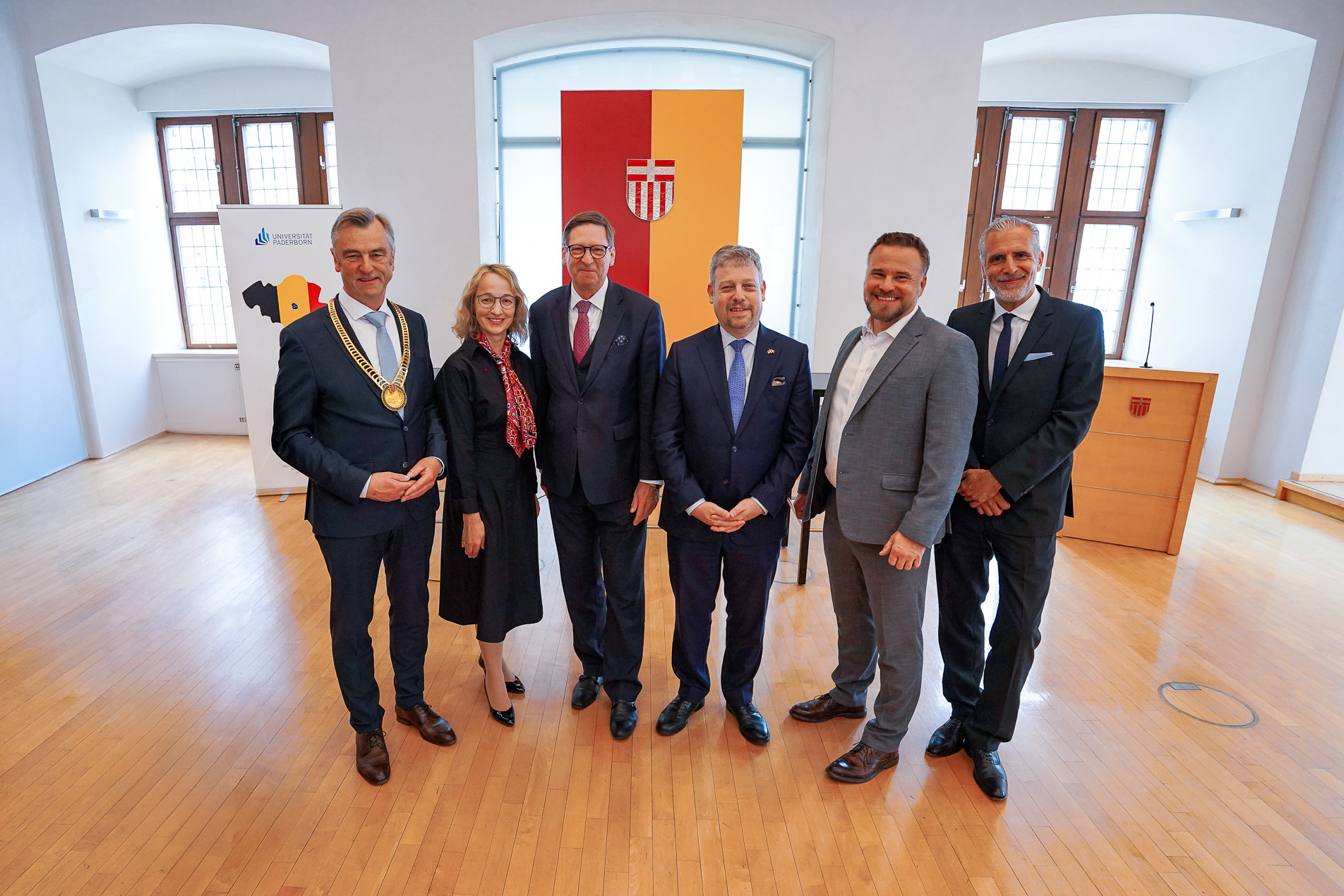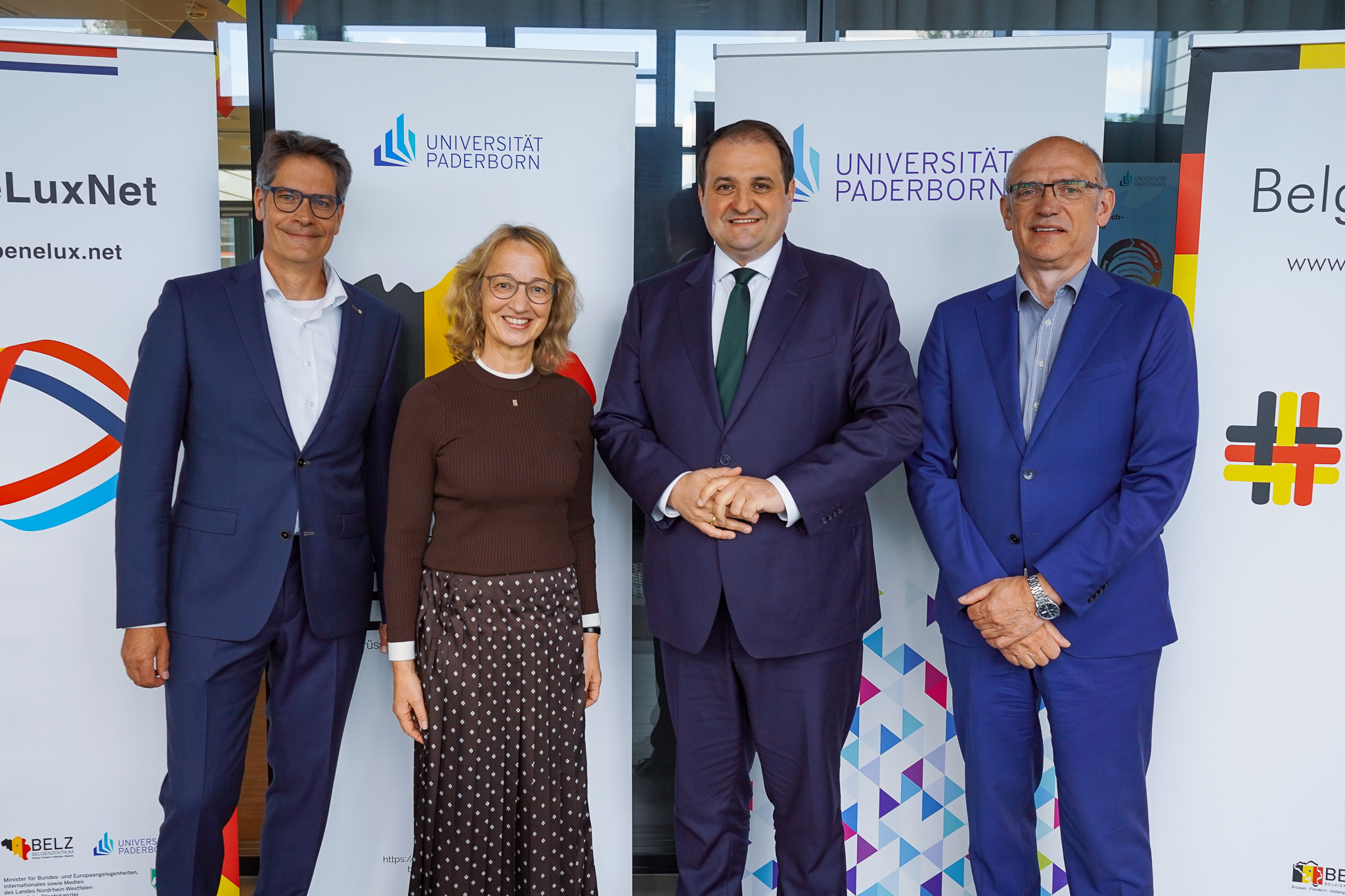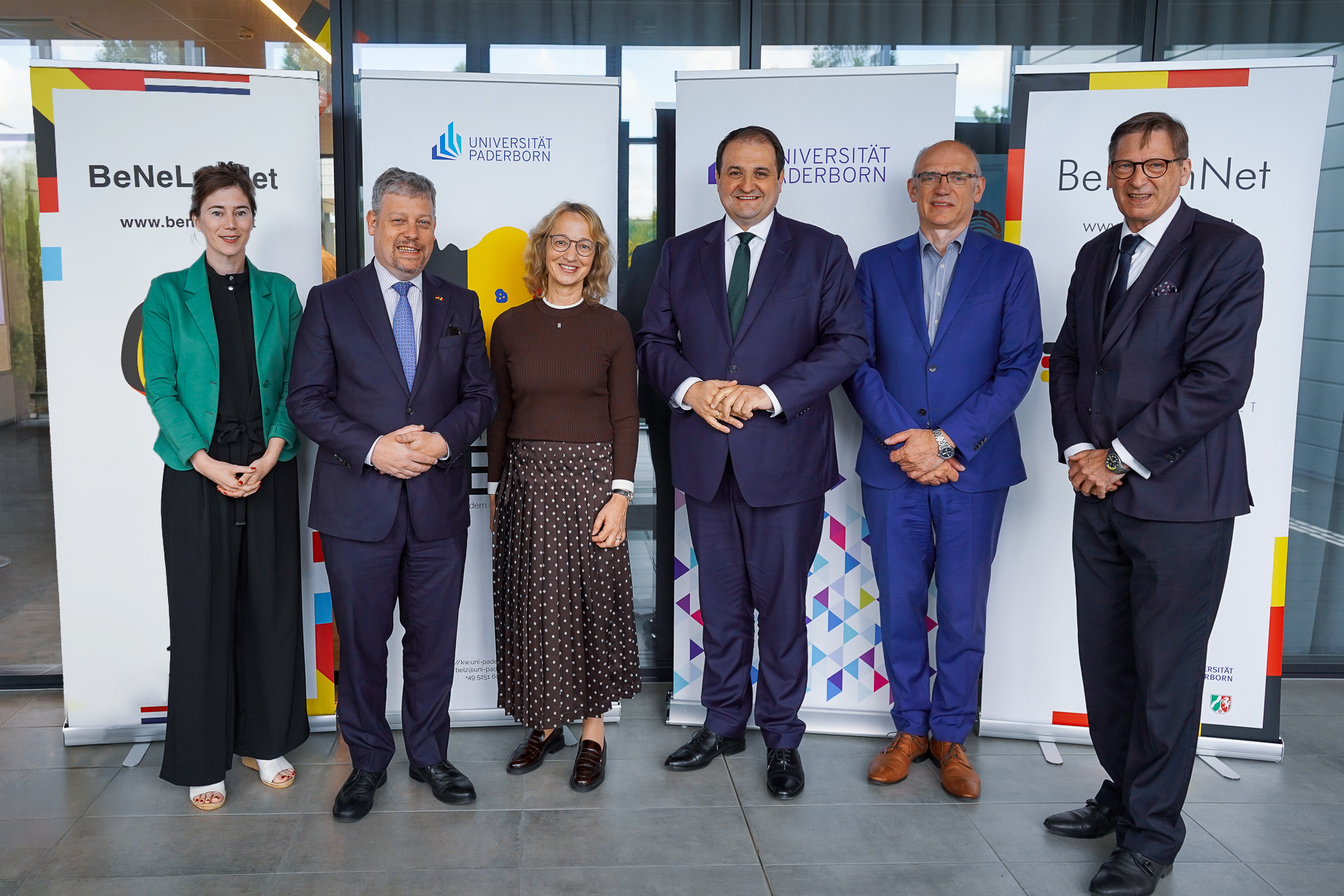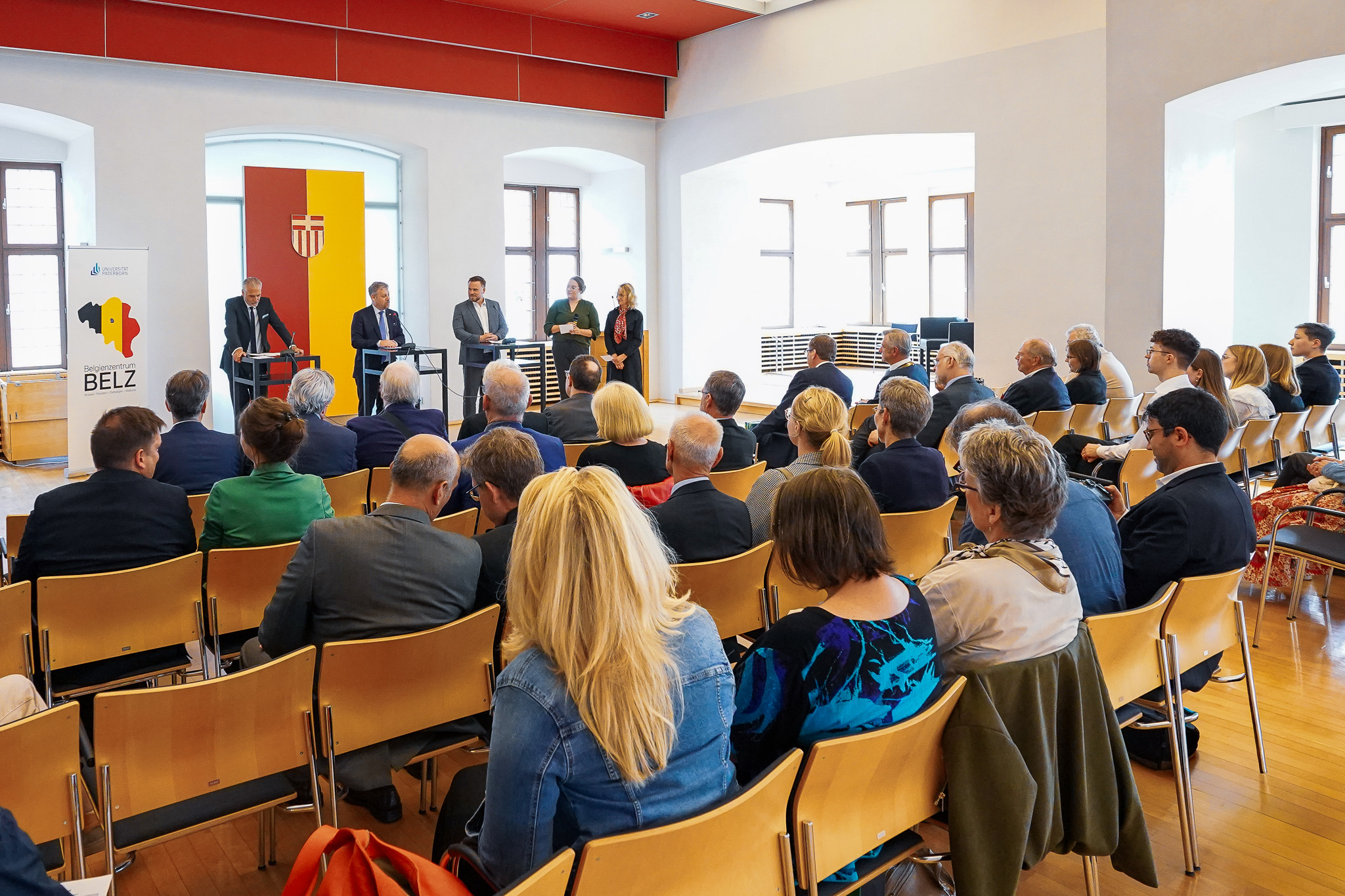
Diversity makes us strong – under this motto, representatives from academia, business, politics and civil society celebrated the tenth anniversary of the Paderborn Centre for Belgian Studies (BELZ). This institution at Paderborn University focuses on the interplay between regions and communities in Belgium, the country’s prevailing multilingualism, and its role as a historically significant hub of European history and politics. Every year, the centre organises ‘Belgium Day’, which this year focused on the circular economy from a Belgian-German perspective.
Among those who offered personal congratulations on the anniversary was Nathanael Liminski, Minister for Federal and European Affairs, International Relations and Media for the State of North Rhine-Westphalia. “Those who know Belgium realise that it lends itself very well as a subject of research. Here in Paderborn, this was recognised early on,” he said, praising the centre’s commitment. “We maintain not just a partnership with Belgium, but a friendship. Belgium Day highlights this and fosters understanding of our neighbouring country. Europe needs these connections.”
Over the past ten years, BELZ has not only facilitated exchange across national borders but has also left a visible mark on the university campus in Paderborn: in the library, an entire reading lounge is dedicated to literature from and about Belgium. Colourful stained-glass windows – created through a collaboration between the Paderborn-based glass art specialists ‘Peters Art & Concept GmbH’, the Walloon artist Etienne Tribolet and the Flemish artist Christine Vanoppen, and funded by a donation from the Belgian regions and communities – adorn the room both inside and out. With the ‘BeNeLux Studies’ study programme, Paderborn University offers a unique, trilingual Master’s study programme. In addition, all students, regardless of their degree programme, can obtain a Belgium certificate.
As Chair of the BELZ Board, Prof. Dr Sabine Schmitz has driven this development forward. For her commitment, the professor of Romance literature and cultural studies has already been awarded the title of ‘Officer of the Order of the Crown of Belgium’ by the Belgian Royal Family. University President Prof. Dr Matthias Bauer also thanked Prof. Schmitz during the anniversary celebrations and, at the same time, looked ahead: “Ten years provide an excellent foundation for future cooperation. The national border has, in fact, evolved into a space for interaction. We can make even greater use of this, particularly in the area of student exchange.”
The circular economy as a key issue for Europe
In line with the ‘Circular Economy Act’, which the European Union has announced for the end of 2026, this year’s Belgium Day focused on the circular economy. To this end, BELZ collaborated with the Chair of Materials Science held by Prof. Dr.-Ing. habil. Mirko Schaper at the Paderborn Institute for Lightweight Construction with Hybrid Systems. Representatives from regional companies and the Belgian political sphere discussed current challenges and possible solutions. A guided tour of the Y-Building gave guests an insight into Paderborn’s fundamental research into hybrid lightweight construction and additive manufacturing.
Minister for European Affairs Liminski emphasised: “The circular economy does not stop at national borders. That is why we need European solutions – and strong regional partnerships. North Rhine-Westphalia and Belgium, in particular, can, together with the Netherlands, play a pioneering role in Europe in this field.” As evidence, he pointed to the existing trilateral cooperation between North Rhine-Westphalia, Flanders and the Netherlands. “This partnership works so well partly because companies, ports, research institutions and industry in our three countries are already closely linked. We want to build on this in the future.”
At the Theodorianum Grammar School, too, pupils discussed the topic of the circular economy with representatives from politics and business and presented their analogue and digital museum kits from the “Benelux macht Schule” project. This collaboration between the university and the school took place for the fifth time. At the subsequent ceremony in the town hall, Dr. Sven Mossler from the Federal Foreign Office and Belgium’s Ambassador Piet Heirbaut emphasised the BELZ’s role as a bridge. “Friendship and integration within a European alliance of states require knowledge of our neighbours. Belgium is absent from many people’s mental map. With the Belgium Centre, we want to change that,” explains Prof. Schmitz. A trilingual panel discussion – in German, Dutch and French – as well as a talk on the importance of cultural education and Music by the Belgian guitarist Jacques Stotzem rounded off the evening’s programme.
This text was translated automatically.