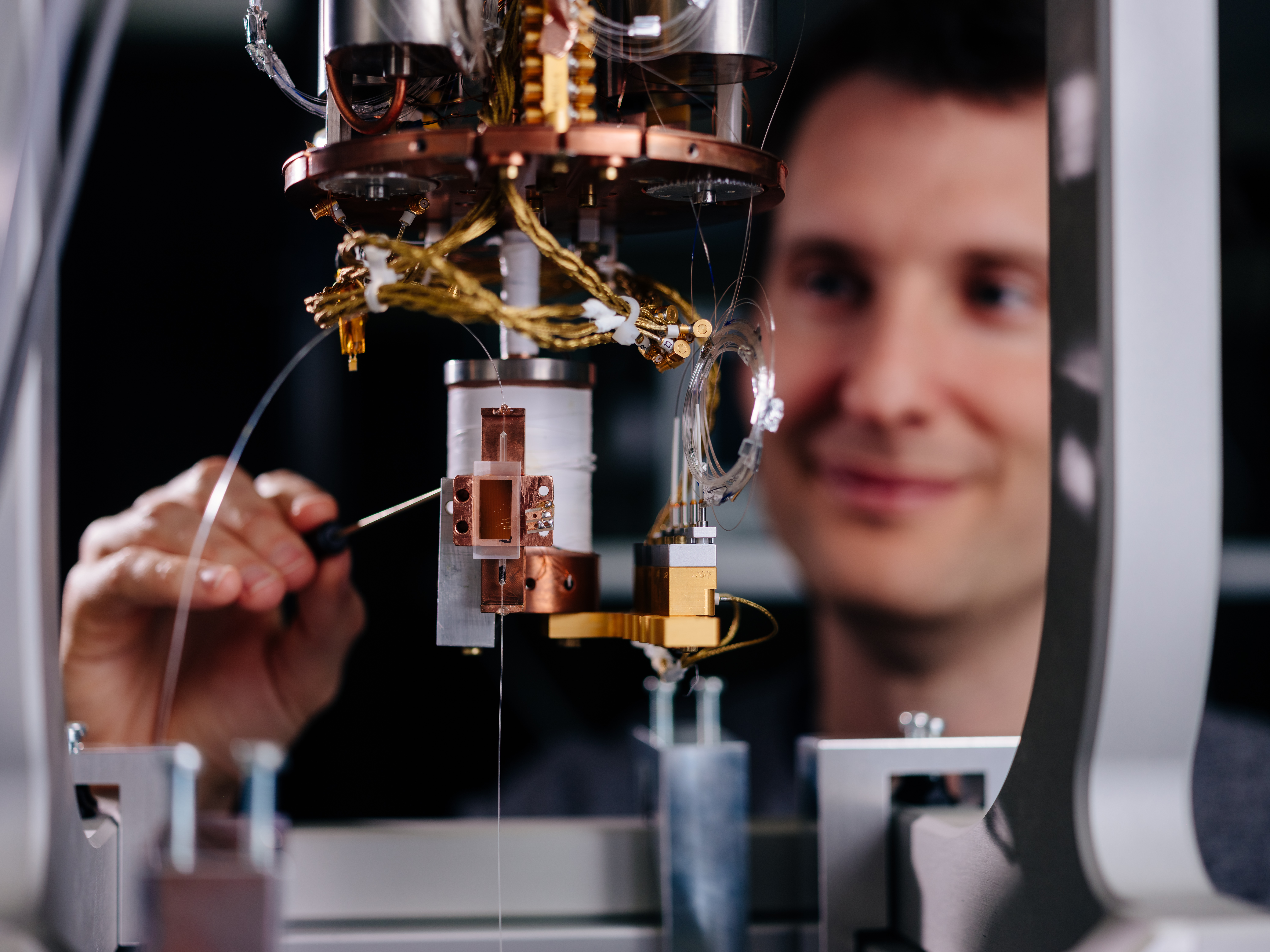
Quantum technologies in Germany are making enormous strides, particularly in computing, communications, and sensor technology. However, researchers and developers face many technical and geopolitical challenges in the development and further advancement of these technologies. Through the funding scheme ‘Enabling Technologies for Resilient R&D Supply Chains in Quantum Technologies’, the Federal Ministry of Research, Technology and Space (BMFTR) is funding pre-competitive collaborative projects focused on the development and further advancement of fundamental technologies for quantum computers and quantum sensors. Coordinated by Paderborn University, the collaborative project ‘Detector Engineering to Enable Quantum Technology’ (DETEQT) has now been launched and will receive funding of around six million euros over a period of three years.
Project redefines scalability and interoperability
Photonics-based quantum processor units (QPUs) are indispensable in photonic quantum computing, quantum communication, and sensor technology. Whilst they may offer an advantage over classical components, their functionality is often limited by their single-photon detector systems. The ‘DETEQT’ project aims to overcome these limitations and holistically further develop QPUs based on so-called single-photon nanowire detectors (SNSPDs).
“Although individual SNSPDs can, when considered in isolation, meet the stringent performance criteria required to enable photonic QPUs, it remains a major challenge to maintain this performance when integrated into the QPU at the required scale. As a result, photonic QPUs are currently facing clear limitations, whether due to limited detector efficiency, cryogenic thermal load, low-loss integration with other components, or insufficient photon number resolution, PNR for short. With our project, we aim to overcome these technical hurdles holistically and resolve the issue of poor interoperability. In this way, we are creating the conditions for practical integration,” explains Prof. Dr. Tim Bartley, coordinator of the collaborative project and group leader at the Institute for Photonic Quantum Systems (PhoQS) and the Department of Physics at Paderborn University.
Strong consortium from academia and industry
This project involves joint research and development by Paderborn University, the Technical University of Munich, the University of Heidelberg, the Physikalisch-Technische Bundesanstalt, Swabian Instruments GmbH, Munich Quantum Instruments GmbH, the Leibniz Institute for Photonic Technologies, Single Quantum Germany GmbH, the University of Münster, Pixel Photonics GmbH, Quandela GmbH and the associated partner attocube systems GmbH.
At the same time, the ‘Photonics Systems Engineering’ cluster is also being launched; this comprises a total of seven collaborative projects under the funding programme and is likewise coordinated by Paderborn University, under the leadership of Prof. Bartley. The cluster represents the combined strength of research institutes, universities, start-ups and small and medium-sized enterprises under a single umbrella brand. This network underscores the strategic importance of photonics as an ‘enabling technology’ for quantum research, aiming not only to promote knowledge transfer between the collaborative projects but also to build bridges to other projects in the field of quantum technology in Germany.
This text was translated automatically.