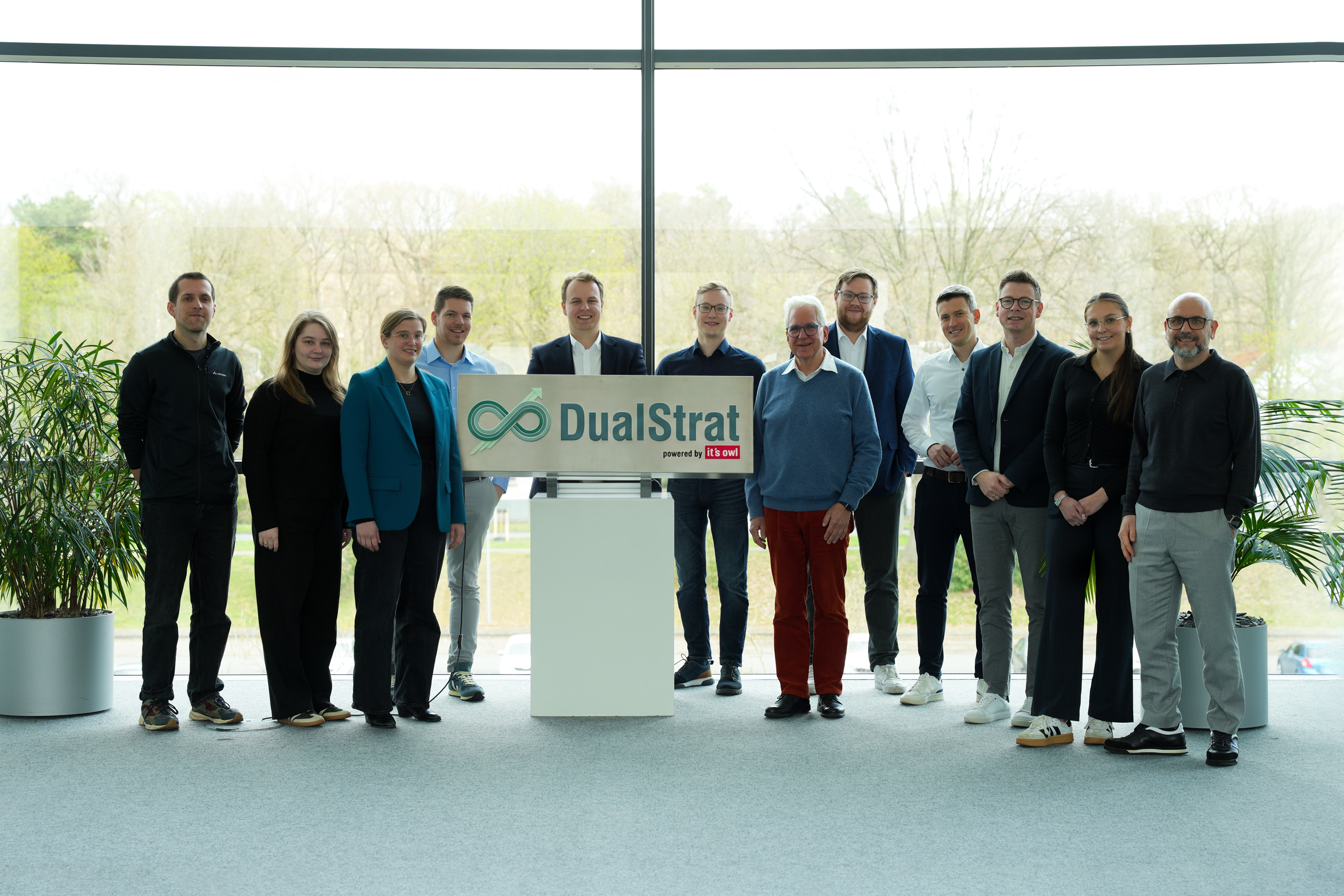
Sustainability and digitalisation are two key areas of focus within companies that are crucial to business success. In the “DualStrat” project, partners from academia and industry have therefore set out to examine these two areas together and to develop an approach to the strategic management of what is known as the “dual transformation” in industrial companies. Researchers from the “Behavioural Economic Engineering and Responsible Management” research group at Paderborn University have, amongst other things, developed conceptual models and methods for the strategic management of the Dual Transformation, as well as tools for data-driven sustainability management.
Whilst digital transformation has been firmly on the strategic agenda of many companies for several years now, corporate sustainability transformation is also becoming increasingly relevant. This is partly driven by legal frameworks such as the European Green Deal. “Experience shows that digital technologies can provide excellent support in achieving economic, social and environmental goals,” explains Thorben Scholz, a research assistant in the research group at the Heinz Nixdorf Institute in Paderborn. “However, holistic planning and agile management of this dual transformation require an integrated strategic management approach that also involves internal and external stakeholders.”
Solutions for specific use cases
In the manufacturing sector, sustainability aspects that can be influenced can be found, for example, both among suppliers – such as when purchasing recyclable raw materials – and among customers – for instance, through the low-emission use of the product sold. The “DualStrat” project consortium has therefore focused on the entire value chain of manufacturing companies. Using specific use cases as examples, a digital product passport and a data-based analysis of the product life cycle were designed and implemented. The project also produced scientifically sound models and methods for the strategic management of the Dual Transformation, including a reference model, a process model for strategy development, and governance and evaluation tools that support companies in integrating sustainability and digitalisation. In addition, researchers at Paderborn University, in collaboration with Weidmüller Interface GmbH & Co. KG, developed an approach for the data-driven management of sustainability strategies, including a system of key performance indicators and a digital dashboard.
“Despite the research findings achieved, the systematic and large-scale implementation of the dual transformation in industry is still not common practice. Rather, there is a need for targeted methodological support in implementing technically complex transformation projects at the interface between sustainability and digitalisation,” explains Scholz. This research is being further developed in current projects such as ‘GoProZero’ and ‘iPassPro ’.
New focus group “Sustainability & Circular Economy”
Furthermore, continuous dialogue between industry and research is essential for practical implementation. For this reason, the working group initiated as part of the project will be made permanent and transformed into an it’s OWL focus group on “Sustainability & Circular Economy”. Even after the project has concluded, this will enable other interested industrial companies and research organisations to exchange views on sustainability and digitalisation-related issues in the region.
The “DualStrat” project was funded over three years with 3.28 million euros by the Ministry of Economic Affairs, Industry, Climate Protection and Energy of the State of North Rhine-Westphalia. The consortium was led by it’s OWL GmbH. Alongside Paderborn University, the Fraunhofer IEM, InnoZent OWL, the Wuppertal Institute and the companies Böllhoff, Hanning, Schmitz Cargobull and Weidmüller were involved in the project. The key findings, in the form of presentations, a white paper and project videos, can be viewed on the it’s OWL innovation platform and are available free of charge.
This text was translated automatically.