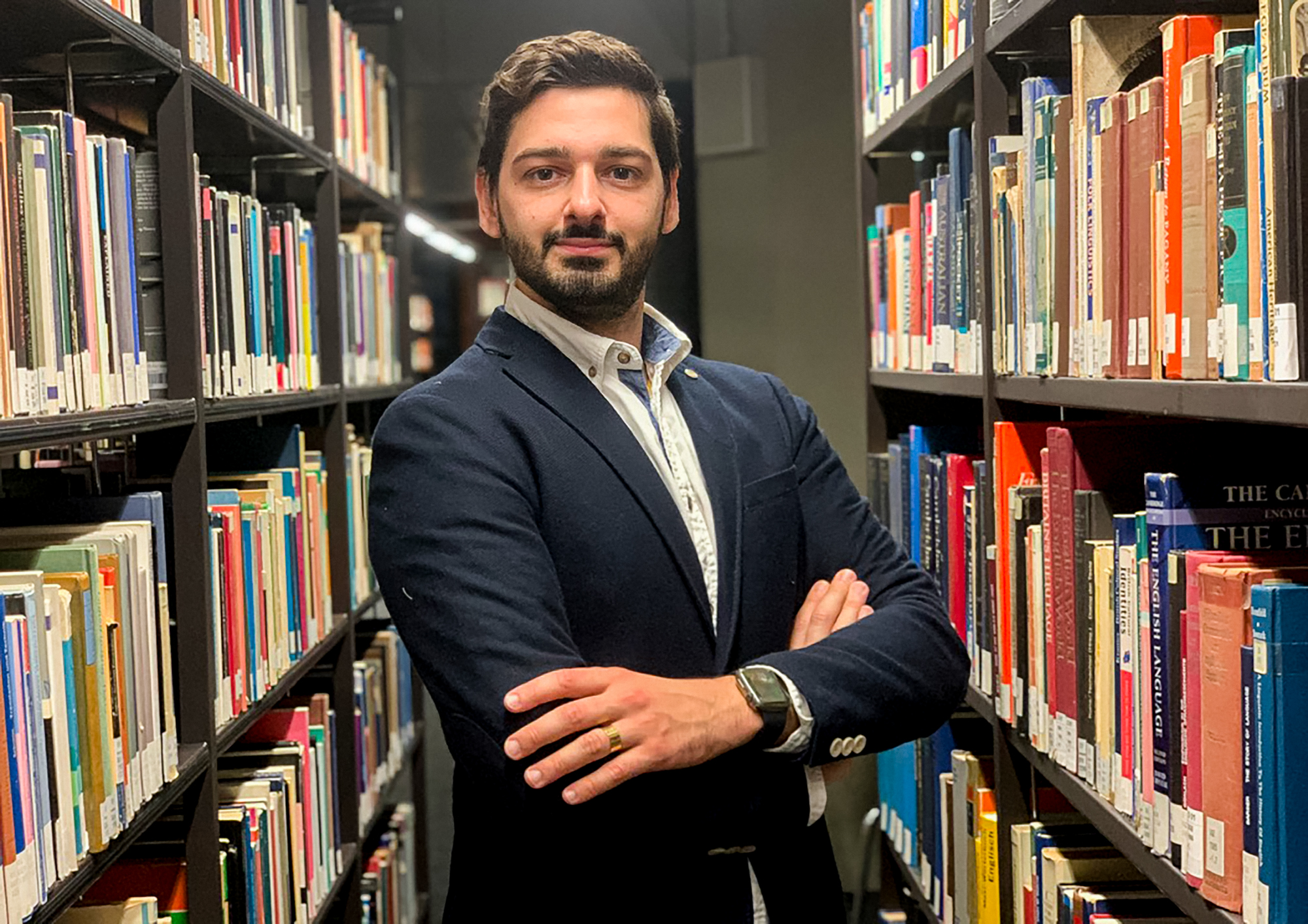
Can pop songs help with learning vocabulary? And what role does the ‘earworm’ phenomenon play in this? Dr Antonio Vivone explored these questions in his doctoral dissertation at Paderborn University, in collaboration with the University of Applied Sciences for Theatre and Media in Hanover (HMTMH) and the University of Toronto. For this work, he has been awarded the Student Prize for Social Innovation (StiPS) by the Federal Ministry for Research, Technology and Space (BMFTR). With this award, Federal Minister Dorothee Bär recognises innovations that bring about genuine social change.
From piano lessons to language lessons
“As a schoolboy, I had to learn English vocabulary lists by heart and intuitively began to incorporate these words into the scales that I had been practising daily since the age of four – under the guidance of my mother, a professor of piano. Surprisingly, this resulted in catchy tunes through which I unconsciously learnt the vocabulary,” says Dr. Vivone, explaining the idea behind his research. Two studies involving over 250 Year 6 pupils showed that singing pop songs supported the retention of English vocabulary more effectively in the long term than conventional learning methods. Many of the sung words and phrases remained in the memory as ‘catchy tunes’ and were involuntarily repeated mentally, which helped to consolidate them in the long term.
Learning with music boosts well-being and performance
“The most surprising finding, however, was that learners who sang experienced a significant increase in their subjective well-being – to an extent rarely observed in educational research,” reports Dr Vivone. At the same time, those pupils who felt better also learnt more. This observation suggests that music does not merely make lessons more enjoyable, but actively creates the psychological conditions under which learning becomes possible. Two-thirds of the learners in the music group also reported having had catchy tunes stuck in their heads during the study – they found themselves unconsciously repeating song lyrics outside the classroom. Consequently, the learners with songs stuck in their heads also achieved greater vocabulary gains than those without, suggesting a mechanism that has never before been empirically demonstrated in a school context: songs continue to teach, even long after the lesson has ended.
Findings transform teaching
“The findings of my doctoral dissertation are fundamentally changing the way I think about and design lessons. A good lesson is not just one in which content is conveyed efficiently, but one in which the emotional and cognitive conditions for sustainable learning are actively created. ‘So I select songs not only on the basis of their lexical content, but also on their ability to stick in the listener’s mind,’ summarises Dr Vivone. Her doctoral supervisors are Prof. Dr Dominik Rumlich from the Institute of English Studies and American Studies at Paderborn University, Prof. Dr Andreas Lehmann-Wermser from the Institute for Music Education Research at the HMTMH, and Prof. Dr Roger Mantie from the Institute for Art, Culture and Media at the University of Toronto.
As a forward-looking model that adapts learning processes to the demands of tomorrow, the dissertation project impressed the StiPS ‘Education & Work’ panel and took third place. In his postdoc project at the University of Toronto and the University of Music, Drama and Media, Hanover, Dr Vivone is now continuing his research in greater depth under the supervision of Prof. Dr Mark Schmuckler and Prof. Dr med. André Lee. In a cross-national study, he is comparing Canadian (native English speakers) and German (English as a foreign language) learners. He is placing a particular focus on neurophysiology: using various measurements of brain activity, he aims to identify neural signatures that could underlie the observed learning effect in correlation with the ‘earworm’ phenomenon.
This text was translated automatically.