The NeMo.bil project, funded by the federal government, celebrated its successful conclusion
Those involved have drawn a very positive conclusion at the end of the NeMo.bil project, which was initiated by “Neue Mobilität Paderborn e. V.” (NeMo). The initiative, which brings together more than 70 network partners under the leadership of Paderborn University, acts as an application centre dedicated to linking the transport and energy transitions. In doing so, it is revolutionising the transport of people and goods through innovative vehicle concepts and sustainable energy generation. The project, which received around 18 million euros in funding from the Federal Ministry for Economic Affairs and Energy, has developed and built a prototype of an innovative mobility system for demand-responsive passenger and freight transport. At the closing event held at Paderborn’s ‘Zukunftsquartier’, high-ranking representatives from the federal government and the ministry met with the project partners.
NeMo.bil pursued an innovative approach involving two coordinated vehicle types. Swarms of smaller autonomous vehicles (Cabs) serve the first and last miles. Over longer distances, they join together to form a convoy pulled by a larger vehicle (Pro). This system is ideally suited to enabling resource-efficient, personalised public transport, particularly in rural areas.
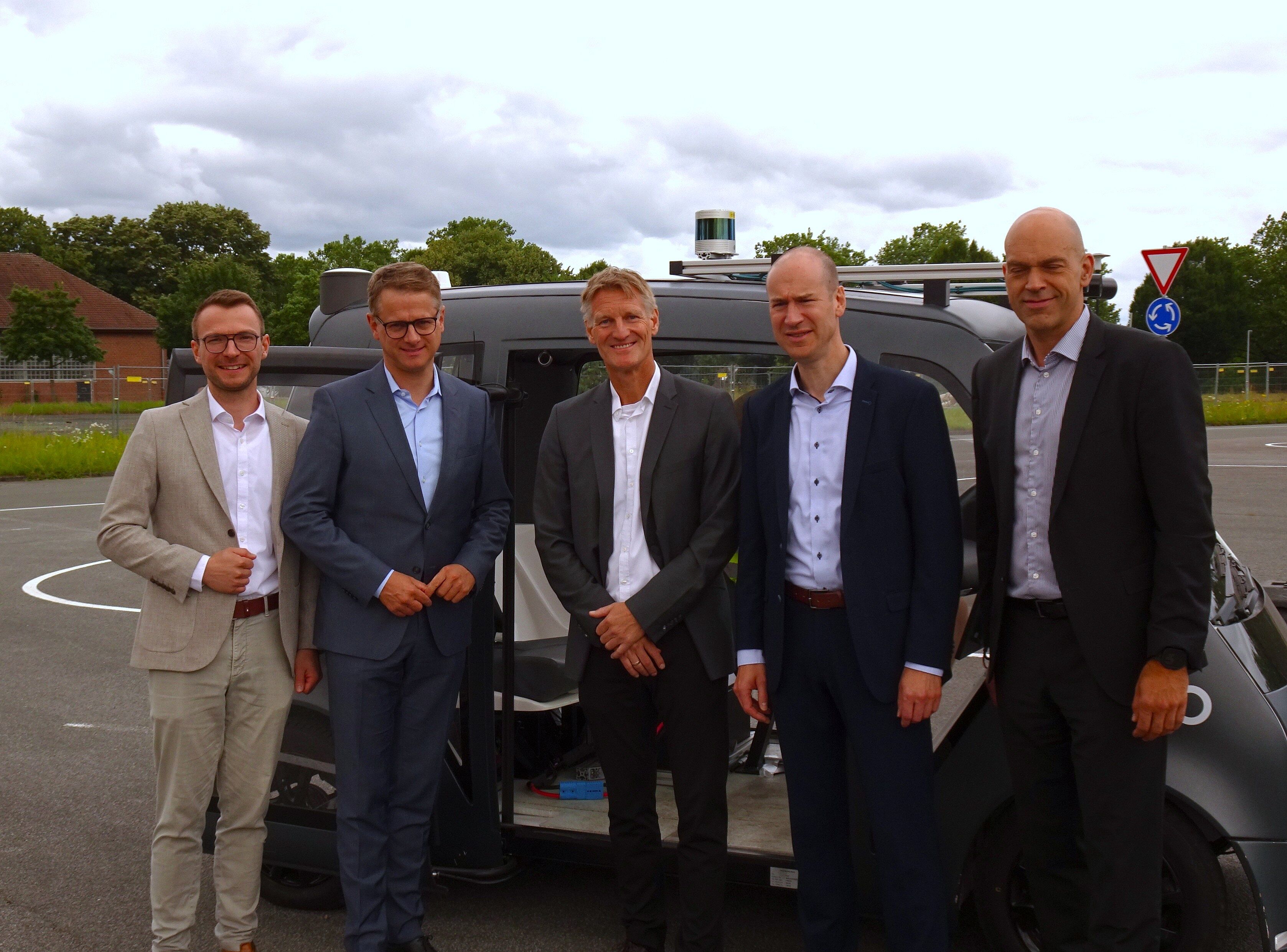
At the closing event in the Zukunftsquartier in Paderborn, guests were able to experience the project’s results in their entirety for the first time. Stakeholders from politics, business, academia and administration gained insights into the vehicles, digital applications and technical systems that had been developed. Discussions around the technical exhibition and during test drives demonstrated how the individual components of the mobility concept work together and what potential they hold for the mobility of the future.
“With the NeMo.bil project, NeMo e.V. has launched an initiative from its Paderborn base that has attracted considerable attention both nationally and internationally. All those involved in the project have delivered impressive results. I very much welcome the fact that NeMo e.V. intends to drive forward the transfer of research findings into concrete applications,” emphasises Dr Carsten Linnemann, Member of the Bundestag and Chair of the NeMo e.V. Advisory Board.
Consortium leader Marcus Zwick emphasises: “What has inspired me about NeMo.bil from the very beginning is the focus on the bigger picture: not a single technology, but an integrated system that truly moves people. I am particularly keen to see rural areas connected – regions that are often left behind by traditional public transport services that are not on offer. I am convinced that autonomous, zero-emission shuttles can make a real difference here: they are reliable, comfortable and accessible to all. NeMo.bil has shown that this is no longer just a vision for the future – it is achievable.”
“As NeMo e.V., we will actively utilise the insights gained from the NeMo.bil project. In doing so, our association will evolve from a network player into the leading platform for the implementation of autonomous mobility in the Hochstift region. With this new focus, we will emerge as a visible pioneering region and make further significant strides with a supra-regional impact,” emphasises NeMo Chair Christoph Rüther, District Administrator of the Paderborn district.
NeMo initiator Prof. Dr Thomas Tröster, Vice-President for Research and Academic Careers at Paderborn University, notes: “With NeMo.bil, we have developed a system that reconciles society’s need for mobility with the urgent requirements of environmental protection. By combining autonomous vehicles with sustainable energy generation, we can establish a standard that will pave the way for the mobility of the future.”
Although the successful completion of NeMo.bil marks the end of the project’s duration, NeMo e.V. will continue to develop the solutions that have been created. The lightweight vehicles developed in the project for the first and last mile form an important basis for future swarm mobility concepts. The focus here is particularly on the further development and industrialisation of the systems. The resulting prototypes are to be deployed, tested and gradually optimised in follow-up projects.
The Pro towing vehicle also offers a wide range of possibilities beyond the original approach. In addition to further investigating convoy operation, particular attention is being paid to the vehicle’s potential as a mobile charging station for various use cases. The coupling system developed in the project will not only enable the automated formation of vehicle convoys in future, but will also open up new possibilities for the automated charging of autonomous vehicles at individual charging stations.
Furthermore, the results in the field of digital systems can be utilised in the long term. Many of the components developed according to open-source principles are accessible to the specialist and developer community. This allows the insights gained to be incorporated into further applications and to contribute to general progress in the field of connected and autonomous mobility.
This text was translated automatically.