An international research team involving the Institute for Photonic Quantum Systems (PhoQS) at Paderborn University has made significant progress in researching so-called quantum materials. Their extraordinary properties - electrical conductivity, magnetism and superconductivity - make them relevant for applications such as artificial intelligence and quantum computers. In a recent paper, the scientists describe novel, highly conductive zones at the interfaces within these systems. Until now, these areas were considered electrically insulating. The new findings have now been published in the renowned journal "Nature Communications".
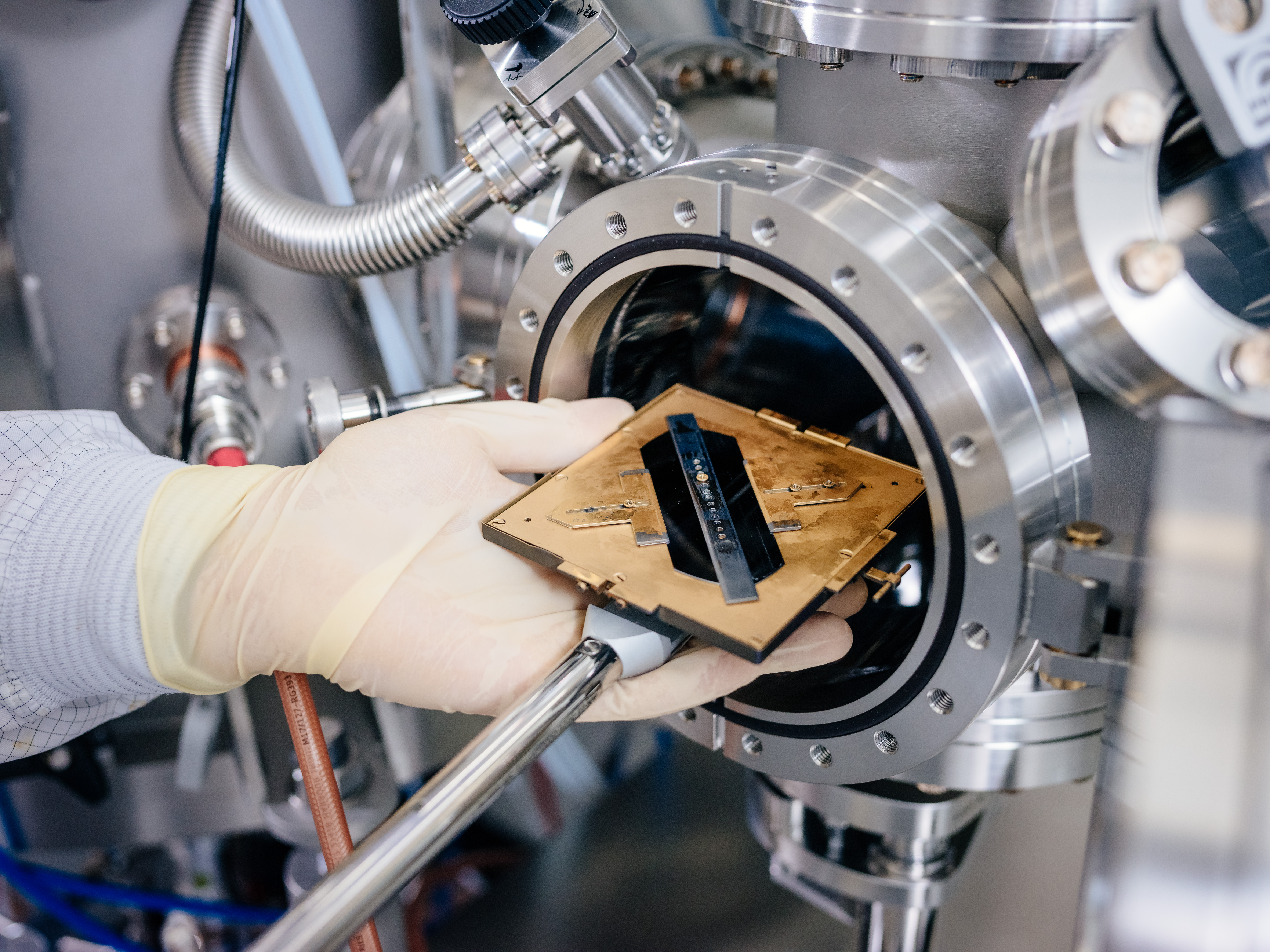
Specifically, it is about "twisted interfaces" - the technical term for materials that consist of stacked crystalline layers arranged at a certain angle to each other. This arrangement leads to unique physical properties. Until now, investigations into twisted interfaces have mainly focussed on so-called van der Waals materials. The scientists have now been able to demonstrate that the targeted twisting of two large crystals of lithium niobate, which is not one of the classic van der Waals materials, enables the creation of novel interfaces. The two lithium niobate layers were bonded using a thermal compression bonding method, i.e. by means of heat and mechanical pressure. It was then possible to manipulate the electrical properties at the interface. "We observed that, depending on the angle of rotation, new types of highly conductive zones are created at the interfaces between these otherwise electrically insulating materials," explains Dr habil. Michael Rüsing from PhoQS.
"With our work, we show that the electronic properties of materials can be precisely controlled. In particular, the ability to twist even strongly bound crystals in a targeted manner and control their interfaces opens up fascinating prospects for future quantum and nanoelectronics. This allows us to achieve a miniaturisation and functionality of components that was previously unthinkable," Dr. Rüsing continues.
Scientists from Germany, Spain, the UK and the USA were involved in the work. The project, in the context of which the publication was created, is funded by several national and international organisations. In Germany, it is supported by the German Research Foundation (DFG) as part of a research group, which is represented at PhoQS with a sub-project led by Professor Dr Christine Silberhorn. The results emphasise the importance of global and interdisciplinary cooperation in basic research. In the long term, they open up new possibilities for the construction of computer chips and memory elements, for example for quantum applications or ultra-fast computing technologies.
The paper is open access and can be viewed at: https://doi.org/10.1038/s41467-026-68553-7.
This text was translated automatically.