Research and industry develop solutions for SMEs
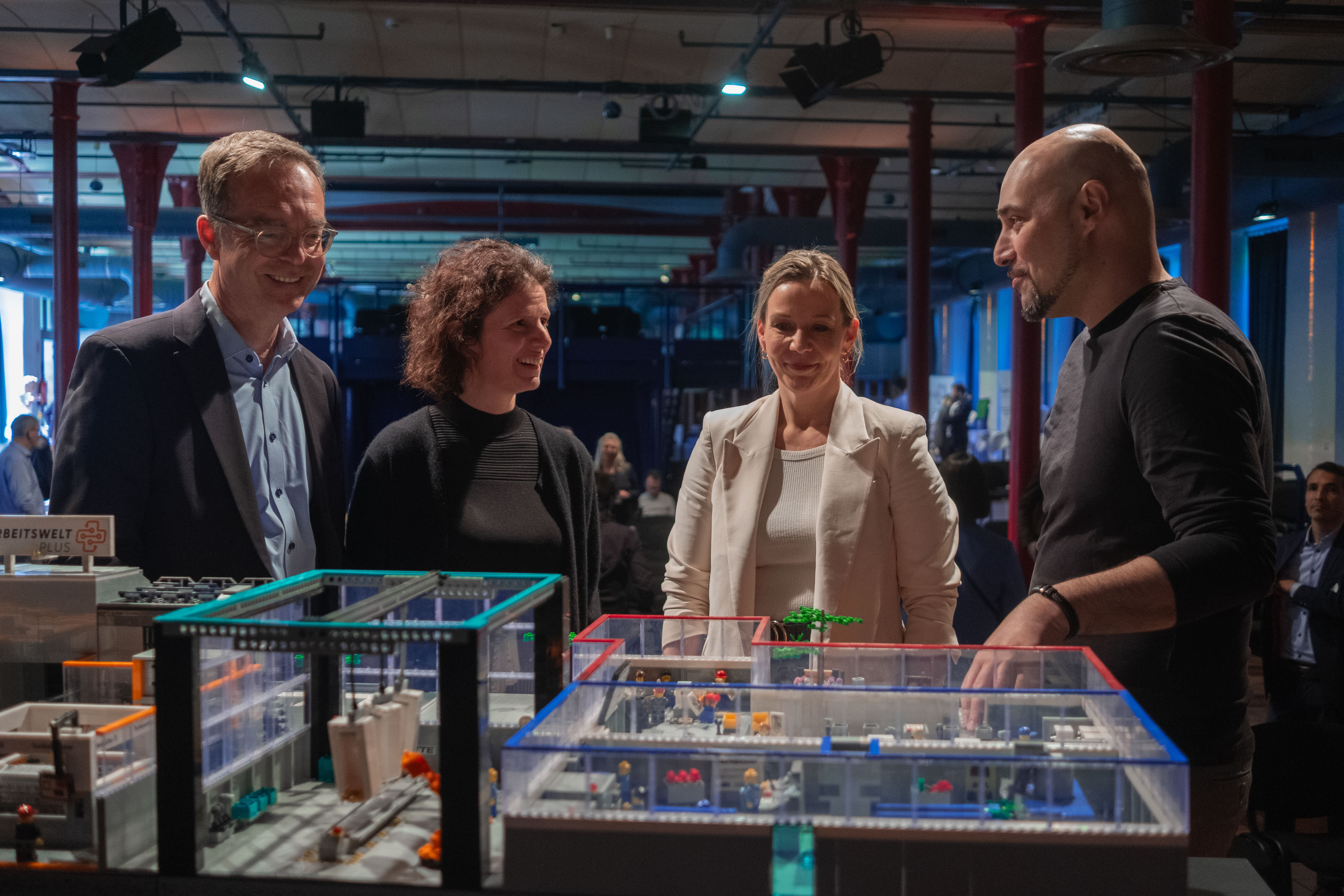
Artificial intelligence (AI) has long since found its way into various areas of the working world. How can small and medium-sized companies in particular implement technological change sensibly and effectively? A competence centre from research and industry in Ostwestfalen-Lippe has been working on this question for the past five years. With numerous experience reports, solution approaches and competencies relating to the topics of AI and Work 4.0, the "Arbeitswelt.Plus" competence centre has produced a result that can go straight into application. Paderborn University was involved in the project with the SI-Lab at the SICP - Software Innovation Campus Paderborn.
Focus on people
Paderborn economists have been working on human-centred workplace design and change management processes, i.e. the structured planning of changes in companies. "A first, important prerequisite for the success of digitalisation and AI projects is a clear vision: what is to be achieved, what resources are available and why a decision is made in favour of a particular tool and against others," explains Professor Dr. Kirsten Thommes, who heads the Chair of Organisational Behavior at Paderborn University. There has to be transparency about this, as this is the only way to get employees on board. "Building on this, we investigated how AI systems can be introduced socially and fairly in the workplace. The focus was therefore on the needs of employees. It became clear that, above all, safe learning environments must be created in which employees can gain real experience and are also allowed to make mistakes."
Processing large amounts of data
Meanwhile, in Computer Science, the "Data Science" (DICE) working group at the Heinz Nixdorf Institute, headed by Professor Dr Axel Ngonga, developed methods for automatic knowledge extraction and semantic search in cooperation with the project partners. The focus was on how content from technical documents and accumulated empirical knowledge can be structured, linked and made intuitively accessible to plant operators in a knowledge graph. "Technical manuals contain large amounts of valuable knowledge. The problem is that you have to find it first. Our system makes exactly that possible: operators can ask the app questions in their own words and receive a suitable answer," says Daniel Vollmers, research associate at DICE.
Transfer to the SME sector
The combination of different research perspectives has made it possible to harmonise the latest technological processes with the realities of the working world in the best possible way. The results are available to all interested parties at www.arbeitswelt.plus. The information platform bundles best practice examples and free offers such as lectures, training courses and guidelines for action. Continuing/further education, professional development [je nach Kontext] is used to train company employees in the use of AI technologies.
One concrete example of successful transfer is the project "Machine learning to optimise the safety stock in production and distribution networks - ML4SafetyStock". The Paderborn Business Informatics experts Prof. Dr. Oliver Müller and Marcel Meyer worked together with the medium-sized software and consulting company OPTANO to develop methods for optimising safety stocks in complex supply networks. The aim was to provide dispatchers with data-based support in defining robust warehouse strategies and to make target conflicts between service levels and capital commitment transparent. By using reinforcement learning, even highly complex, multi-level network structures can be systematically analysed and evaluated in terms of their stability - including scenarios that can only be mapped to a limited extent using conventional methods. The system thus provides new insights into the dynamics of supply chains and shows options for action under uncertainty.
"Particularly in light of the rapid development of AI technologies, our transfer projects show that close collaboration between science and industry is worthwhile in order to bring innovations into application. The aim is to jointly test new approaches and adapt them to the specific requirements of companies so that they can then be transferred directly into operational processes," summarises Dr. Christoph Weskamp, Manager of the "Artifcial Intelligence" competence area at SI-Lab.
About the project participants
The "Arbeitswelt.Plus" competence centre was founded by the leading-edge cluster it's OWL by Professor Dr. Ing.Roman Dumitrescu (Managing Director of it's OWL Clustermanagement GmbH) and was jointly coordinated by the Software Innovation Lab of Paderborn University at the SICP - Software Innovation Campus Paderborn, Bielefeld University, TH OWL, Bielefeld University of Applied Sciences, Paderborn University of Applied Sciences (FHDW), Fraunhofer IEM and Fraunhofer IOSB-INA, as well as the companies Atos, Bette, Deutsche Angestellten-Akademie OWL, Dr. Oetker, Kannegiesser, Dr. Oetker and Dr. Oetker. Oetker, Kannegiesser, NTT DATA Business Solutions, Lenze, Miele, WAGO, Weidmüller and IG Metall. This research and development project was funded by the Federal Ministry of Research, Technology and Space (BMFTR) in the programme "Future of Value Creation - Research on Production, Services and Work" and supervised by the Project Management Agency Karlsruhe (PTKA).
This text was translated automatically.