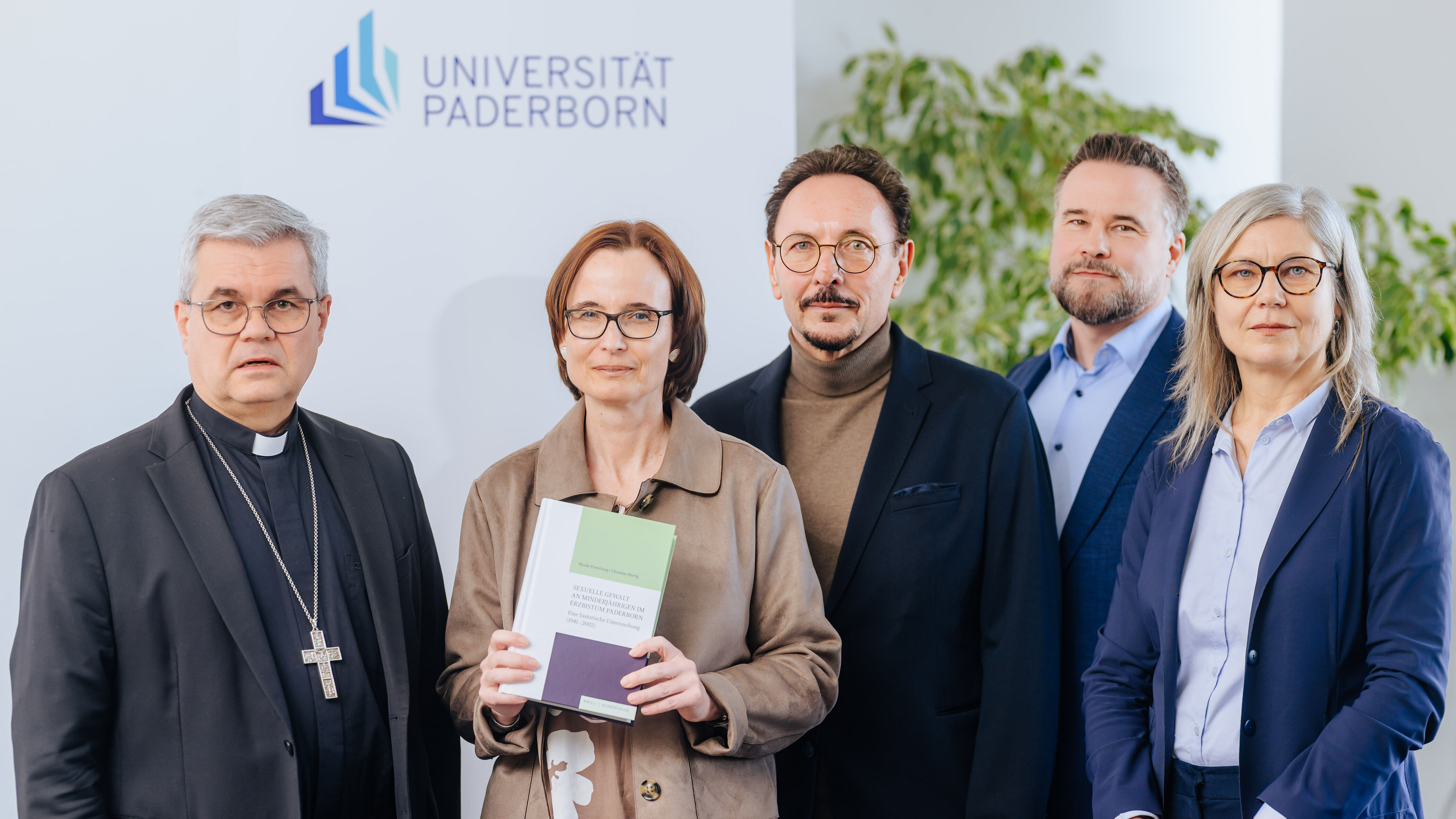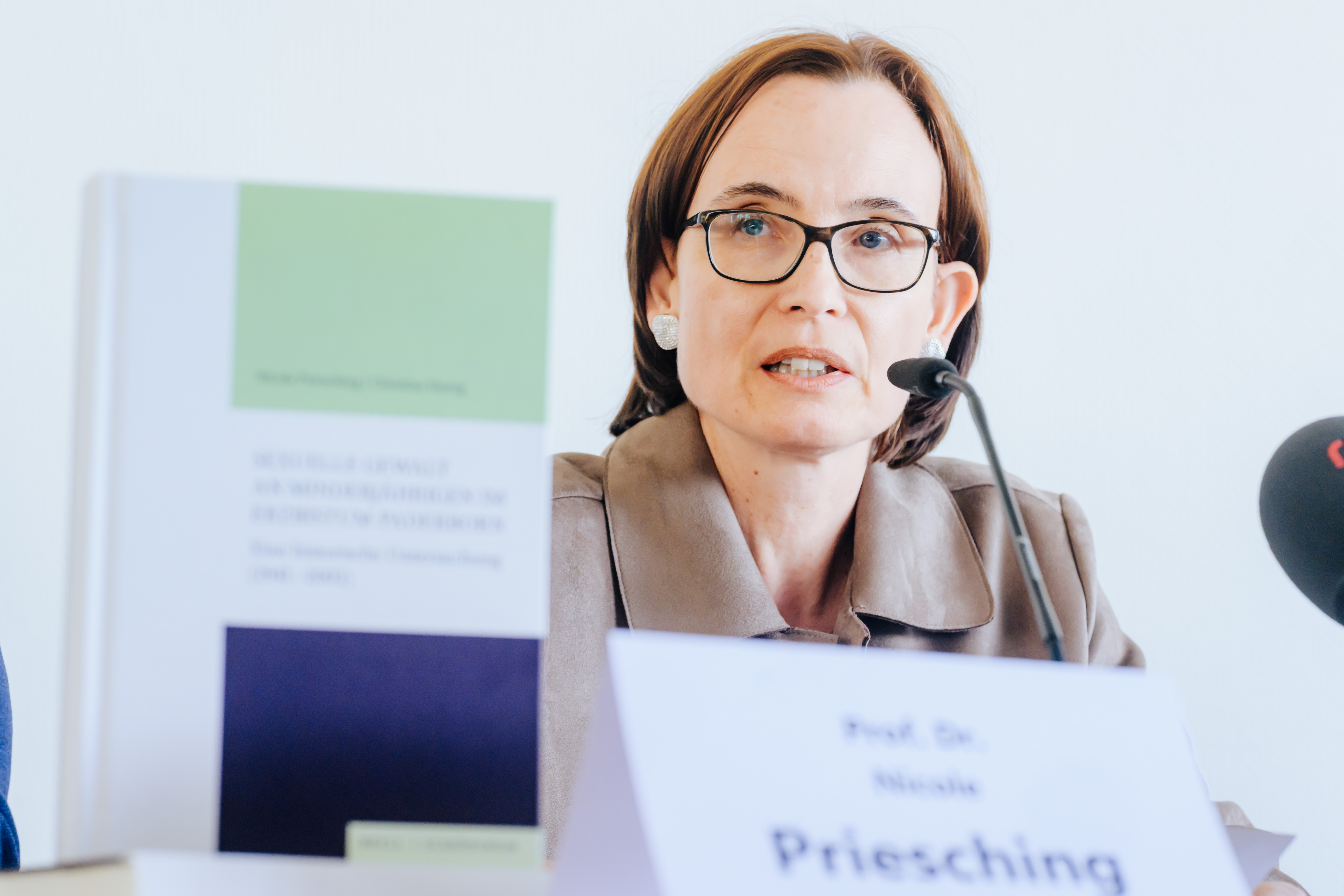
Personal files of accused priests, the archbishop's secret archive, private estates, court and criminal files, minutes, correspondence: for their five-year study on the abuse of minors in the Archdiocese of Paderborn, Prof. Dr. Nicole Priesching and Dr. des. Christine Hartig sifted through extensive material and conducted interviews with contemporary witnesses and those affected. The aim of their historical investigation was to reconstruct the conditions under which priests were able to perpetrate sexual violence against minors and to find out which premises were decisive for the Paderborn leadership. The study covers the terms of office of Cardinals Lorenz Jaeger and Johannes Joachim Degenhardt. The results were presented to the public today, Thursday 12 March.
For the period under investigation from 1941 to 2002, the two researchers have categorised the practices, possibilities and limits of action in connection with accusations of sexual violence in their church-historical context and analysed numerous cases of abuse on the basis of the respective files. "Despite the acts described, the researchers have succeeded in writing a work of church history that adheres to the highest academic standards, always remaining on a factual level and yet clearly stating what can be said," emphasises University President Professor Dr. Matthias Bauer. The interim results of the independent study, which was funded by the Archdiocese of Paderborn, had already shown that the Church and society systematically looked the other way in cases of abuse and condoned criminal offences in several cases. Accused clerics were rarely sanctioned. Instead, the social position of the perpetrator and those affected, as well as the local conditions on the ground, determined the assessment of sexual violence.
"So-called 'bystanders' and 'guardians' often had concrete knowledge of offences of abuse in their environment. This also included the priests and deans immediately superior to the accused. However, adults in supervisory and leadership positions, both in the church and in society, generally ignored cases of sexual violence," explains Professor Priesching. The archdiocesan authorities were rarely informed about allegations. "The reasons for this were the fear of suspecting an innocent person and provoking conflict in the community," she continues. Rumours forced the archbishop's authorities to intervene more in order to eliminate a "nuisance" and avoid a public scandal. "In many cases, allegations were hushed up. If the priest was transferred, they were satisfied."
210 accused and 489 victims: figures as snapshots
For the period from 1941 to 2002, there is evidence of 210 accused and 489 victims. The names of 144 accused and 316 victims are known from Jaeger's time in office. During Degenhardt's term of office, there were 98 accused and 195 victims. Professor Priesching: "The figures should be seen as snapshots that allow statements to be made about the 'bright field' of sexual violence in the Archdiocese of Paderborn. In addition, a 'dark field' can be assumed, the extent of which can only be speculated about."
Spiral of cover-up
Accused clerics, members of the diocese who were entrusted with the cases and even the archbishops themselves sometimes exerted influence on those affected and their relatives to refrain from making reports. "Many deans and priests therefore assumed that they were tacitly expected to exert pressure on those affected as well. This expectation often coincided with the social environment in the parish. This spiral of cover-up in turn ensured that those affected remained at the mercy of the accused priests," says Professor Priesching. The decisive factor in dealing with the accused was, for example, whether they showed remorse. "From the archbishops' point of view, this indicated future obedience. If the priest showed remorse, he was reinstated after a certain time in parish pastoral care, in hospitals or old people's homes, despite a secular conviction. A transfer to another diocese was also possible," says the church historian.
During his entire time in office, Jaeger only took protective measures for possible further victims in individual cases. These were limited to the prohibition of individual contacts. When Jaeger took measures against accused clerics in cases of allegations of sexual violence against minors, these hardly differed from sanctions that followed a consensual relationship between a priest and an adult woman. Allegations of sexual violence were treated by Degenhardt, as they had been by Jaeger, as "complaints" about priests.
Reappraisal is only just beginning
According to Professor Priesching, there were no formal structures for reporting allegations until 2001. Priests who became aware of this were guided by informal knowledge or their own interests. Overall, it can be said that both archbishops, Jaeger and Degenhardt, showed leniency towards accused priests - even when they were convinced of their guilt. They showed no understanding towards those affected. Professor Priesching explains: "Therapeutic offers of help existed, if at all, for the accused clergy with the aim of strengthening their priestly character and reinstating them as soon as possible."
"The church's reappraisal of abuse offences is a process that is far from complete. However, this study makes a major contribution to this and is able to give a voice to many people who have long been invisible to the public," says Reinhold Harnisch, board member and spokesperson of the Representation of Victims in the Archdiocese of Paderborn. The study was presented to the representative body for affected persons and the archdiocese this morning in a non-public setting.
Further information on the study "Sexual violence against minors in the Archdiocese of Paderborn. A historical investigation (1941-2002)" and the study itself can be found here.
This text was translated automatically.