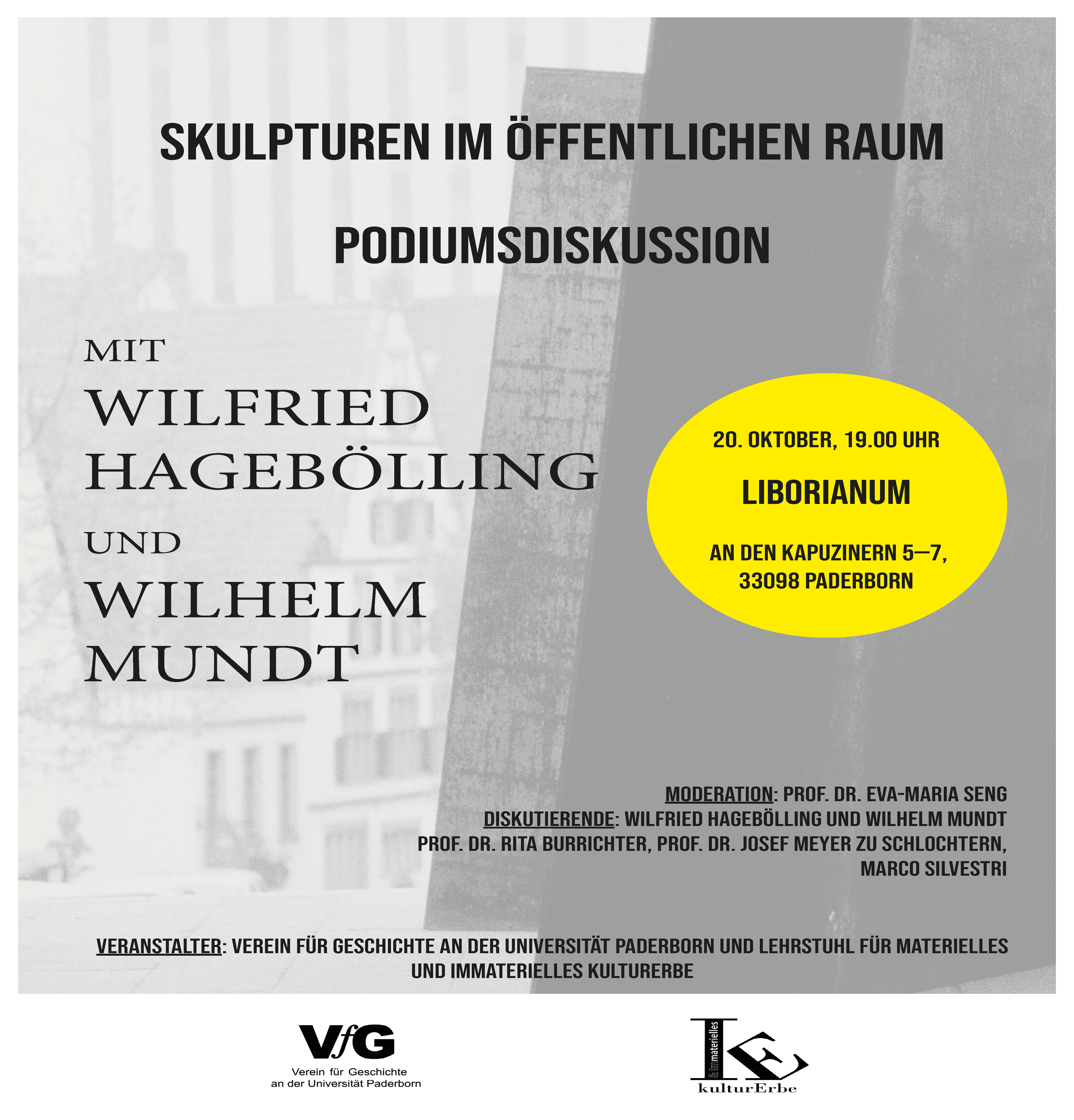
The Association for History at Paderborn University in cooperation with the Chair of Material and Immaterial Cultural Heritage invites you to a panel discussion on sculptures in public space on Friday, 20 October. Starting at 7 p.m. in the Liborianum (An den Kapuzinern 5-7, 33098 Paderborn), the artists Wilfried Hagebölling and Wilhelm Mundt as well as Prof. Dr. Rita Burrichter from the Chair of Practical Theology at the University, Prof. Dr. Josef Meyer zu Schlochtern, professor emeritus at the Paderborn Faculty of Theology, and Marco Silvestri, research assistant at the Chair of Material and Immaterial Cultural Heritage, will discuss the role of art in public space. All interested parties are cordially invited to attend the event, which will be moderated by Prof. Dr. Eva-Maria Seng from the Chair of Material and Immaterial Cultural Heritage. Admission is free, registration is not necessary.
Art in public space
The location-dependency of art in public space raises the question of the political and social significance between acceptance and rejection of such projects. Which negotiation processes are subject to their installation and what influence do these framework conditions also have on the production process? In addition to these questions, the participants will also discuss the future of object art in the urban context.
About the artists
Since his studies at the Academy of Fine Arts in Munich, Wilfried Hagebölling (born 1941) has been intensively concerned with the relationship between object, body and space. This preoccupation has given rise to large-format concrete and steel sculptures that define themselves through their relationship to the environment and are woven into the multi-layered levels of the urban context. His concrete sculpture at the Paderborn Swimming Opera House, his corten steel work at Franz- Stock-Platz or his sculpture garden in Sennelager represent his interest in the representative as well as the neglected site and thus shape the cultural landscape of the city. With the work "Keilstück" in Minden or the Raumpflug at the Kunsthalle Mannheim, Hagebölling is also represented regionally and nationally.
Wilhelm Mundt (born 1959) studied at the Düsseldorf Art Academy and produces amorphous large-scale sculptures from industrial waste, which he encloses in a complex procedure with a shiny, even coat of glass fibre, coloured synthetic resin, bronze or aluminium. These "Trashstones" are reminiscent of erratic blocks and reflect the ecological implications of industrial production as well as the processes of recovery and transformation of sculptural practice. He repeatedly confronts his "Trashstones" with sacred places or installs them in green spaces. The sculptures are also represented in important exhibition houses such as the Lehmbruck Museum in Duisburg and the Kunstmuseum St. Gallen.
This text has been translated automatically.