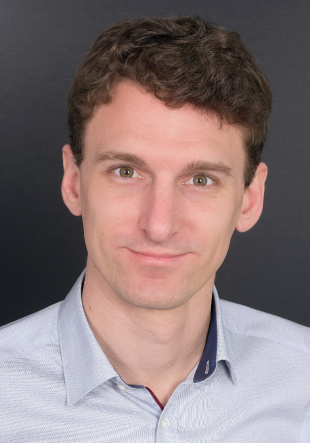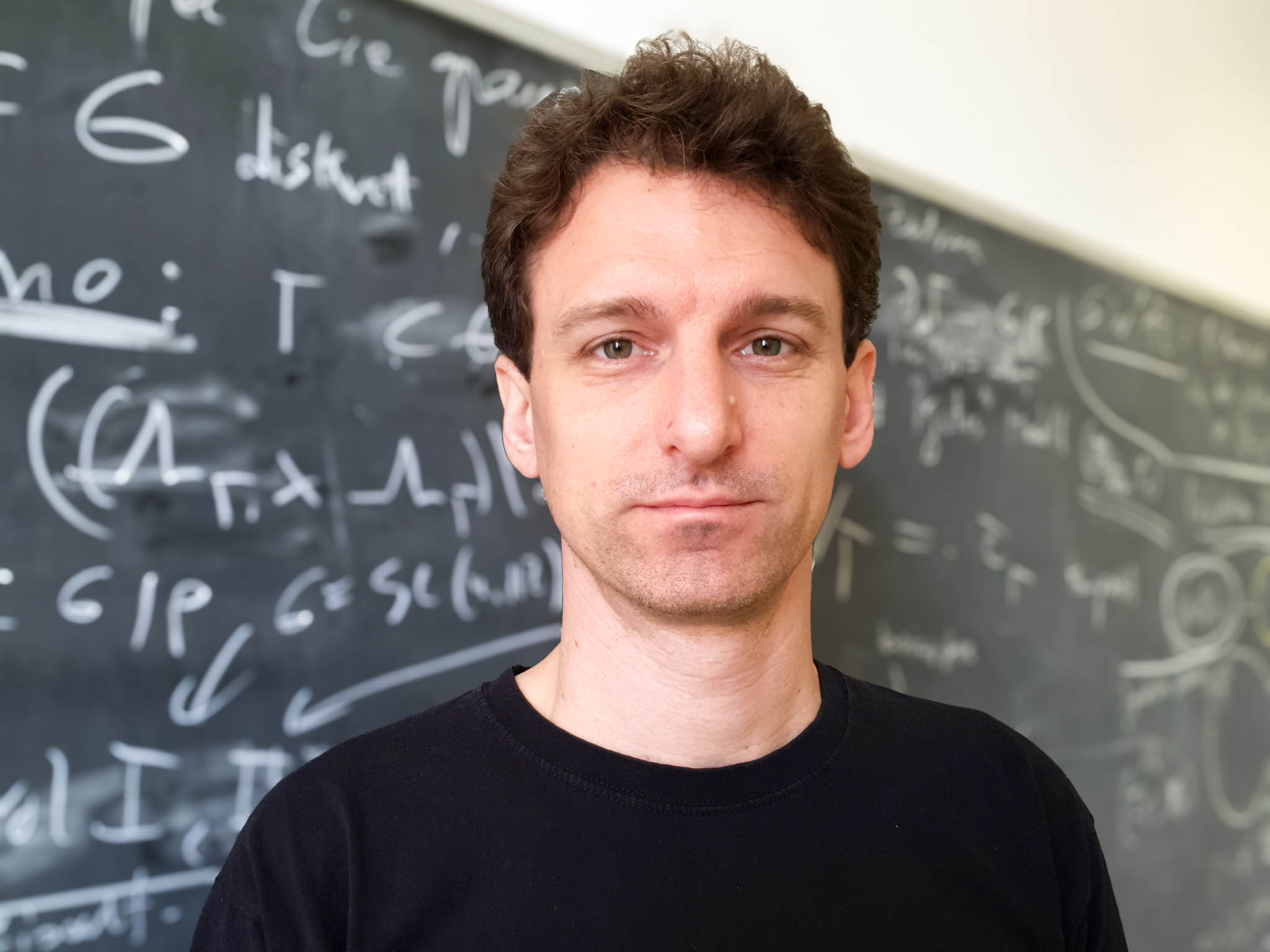
Dr Benjamin Delarue, research associate at the Institute of Mathematics at Paderborn University, has been accepted into the prestigious Heisenberg Programme of the German Research Foundation (DFG). This means that various funding options are now open to him. The programme gives proven scientists who meet all the requirements for appointment to a permanent professorship the opportunity to devote themselves to their research and sharpen their scientific profile until they are appointed.
Dr Delarue's research takes place in the field of spectral analysis at the interface of geometry, Lie theory and Mathematics Physics. A general concept that plays an important role in this is so-called resonances: "This is a mathematical generalisation of the corresponding concept from Physics, which can be observed in everyday life, particularly in acoustics or with vibrations and waves in water, elastic objects, etc. The resonances that we observe in Physics are the resonances that we observe in the spectral analysis. The resonances that we look at in the Spectral Analysis working group in Paderborn are numbers that can be assigned to geometric objects in order to characterise them in more detail - similar to how the shape of bones can be approximately determined in a computer tomography scan using radiation absorption in different directions. Much more abstract questions such as the description of open quantum systems and their long-term behaviour also play a central role," explains Dr. Delarue and adds: "While this type of research classically belongs to analysis, it is a Paderborn speciality that we also use numerous algebraic methods to describe resonances and the underlying geometric objects."
The Heisenberg Programme is named after Professor Dr. Werner Heisenberg (1901-1976), who revolutionised Physics with the development of the uncertainty principle. A total of four funding options are available: Heisenberg professorship, Heisenberg position, Heisenberg rotation position and the Heisenberg fellowship. After being accepted into the programme, researchers can choose between these options and combine them if necessary over the course of the five-year funding period.
This text was translated automatically.