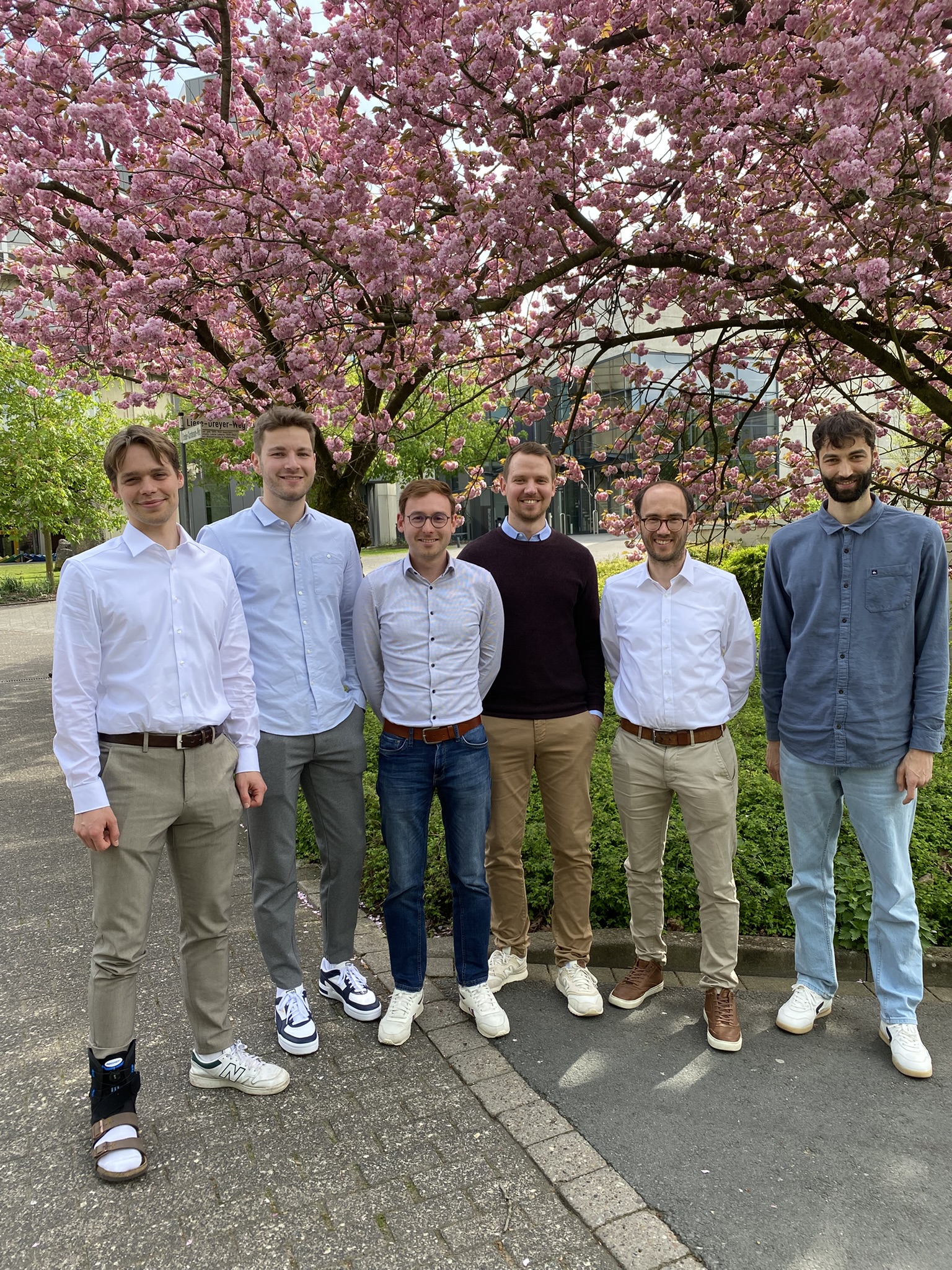
How can special magnetic materials be better calculated and predicted? A team from Paderborn University and the University of Siegen addressed this question in the international "IEEE PELS MagNet Challenge 2" competition. Five doctoral candidates and students spent a whole year developing the best possible mathematical model. They competed against more than 30 high-calibre competitors from Asia, Europe, Australia and America, including top universities such as the University of Cambridge in England and Princeton University in the USA. The model from East and South Westphalia was convincing across the board and took first place.
The model is about predicting the behaviour of magnetic materials that are used in many technical devices, for example in chargers for smartphones, power supplies for data centres and electric drives. These materials react differently depending on how strongly or how quickly current flows through them.
It is precisely this behaviour that is often difficult to predict, but is important for simulations and software-driven development tools. Many very accurate models are slow and require a lot of computing power. What is special about the solution from Westphalia is that it is not only precise, but also particularly fast and lean. The model therefore delivers excellent results without requiring huge computing capacities. This is important so that companies can later use such models in practice. The award-winning model is now available to all interested parties as an open source solution so that as many companies as possible can benefit from it free of charge.
"The award emphasises the strength of cross-location collaboration. Together, we have succeeded in developing a generally applicable and at the same time very efficient modelling approach for a central problem of modern power electronics," says Professor Dr. Jakub Kucka from the Chair of Power Electronics and Electrical Drive Systems at Paderborn University. His Siegen colleague Dr Oliver Wallscheid from the Professor of Interconnected Automation Systems adds: "The success in MagNet Challenge 2 shows that excellent basic research and application-oriented AI methods can set new standards together. The fact that our joint team was able to impress with such a compact yet powerful solution is a strong signal for research at both universities."
The competition was organised for the second time this year. The winning team will receive prize money totalling 10,000 dollars. The competition is organised by the IEEE Power Electronics Society, which has been bringing together researchers and practitioners in the field of power electronics for over 35 years.
This text was translated automatically.