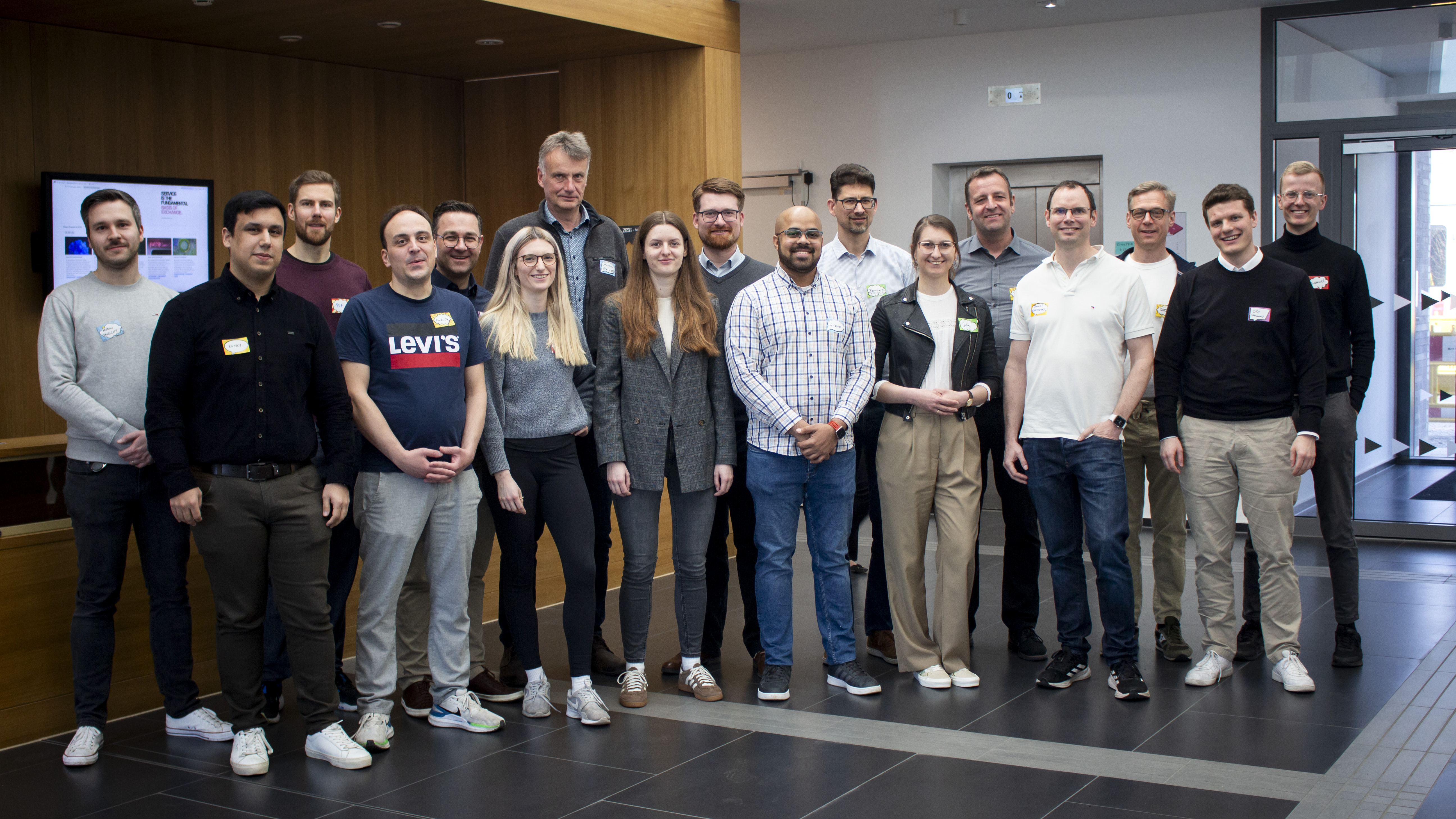
Making the hydrogen value chain more sustainable and reducing dependence on critical raw materials - these are the goals of a new research project involving the Advanced Systems Engineering group at the Heinz Nixdorf Institute (HNI ) at Paderborn University. Hydrogen is a versatile energy carrier and storage medium and is intended to replace fossil fuels such as crude oil or natural gas in the long term. Among other things, it is used for the production of ammonia, which is required for fertilisers, in the steel industry and in heavy goods transport. It can also store surplus wind and solar power, which is a particular advantage in the expansion of renewable energies. However, hydrogen cannot yet be produced completely sustainably. The project partners, led by Ruhr-Universität Bochum, want to counteract this problem with their concept and establish a sustainable value chain in the industry in the long term.
"CircuPEM"[1], as the project is called, has been funded by the European Regional Development Fund (ERDF) with around 2.9 million euros since the beginning of January as part of the "GreenEconomy.IN.NRW" innovation competition. The Ministry of Economic Affairs, Industry, Climate Protection and Energy of the state of North Rhine-Westphalia and the European Union are thus supporting projects from the region in order to shape a sustainable transformation. The funding period covers three years.
Hydrogen as an energy source
In its national hydrogen strategy, the Federal Ministry for Economic Affairs and Energy has stipulated that hydrogen technologies should be established as core elements of the energy transition by 2030 in order to reduce carbon dioxide (CO2) emissions, particularly in industry and transport. Most of the hydrogen on earth is bound in water and must therefore be produced or processed. "CircuPEM" is focussing on so-called PEM electrolysis (PEM - "proton exchange membrane"). In this process, water (H2O) is broken down into hydrogen (H2) and oxygen (O) using electricity. If only electricity from renewable energies is used, so-called "green" hydrogen is produced. This process can save time and energy, as machines do not have to preheat for a long time and can be switched on and off quickly. "The problem, however, is that PEM electrolysis requires critical and expensive raw materials such as iridium, platinum and titanium, which are only available in limited quantities and largely have to be imported. This leads to dependencies and uncertainties along the value chain," says Julia Vehmeyer, research associate at the HNI.
Sustainable concept for practical application
In addition to the HNI and the project management at Ruhr-Universität Bochum, other project partners are also involved. These include the Fraunhofer Institute for Environmental, Safety and Energy Technology (UMSICHT) and the companies Direct Matter and Heraeus Precious Metals. In addition, there are agreements with players involved in the production of hydrogen and thus represent the entire value chain as far as possible.
The project partners are developing a concept with the help of which the raw materials should ideally be completely reused and the value chain made resilient. Accordingly, PEM electrolysis is to be transformed into a "circular economy". This economic model aims to keep components and materials in circulation for as long as possible in order to minimise resource consumption. This is achieved with circular business models that incorporate various factors: Among other things, products and processes are designed in such a way that materials can be reused and recycled in a cycle. The digital product passport, which digitally bundles information about materials, production, use and disposal, is also being optimised. This is intended to create transparency across the entire supply chain.
As a first step, the scientists at the HNI are analysing the existing value creation system and deriving requirements for a circular product, process and business model design. This also takes into account requirements for a digital product passport to support transparency and traceability along the life cycle. Building on this, they develop various business model approaches together with the project partners in iterative, i.e. repetitive and gradually refining work cycles. These are evaluated both qualitatively and quantitatively, for example using simulations, and analysed in terms of their feasibility and economic viability for companies. Finally, recommendations for action will be derived, an integrated overall system designed and potential pilot projects initiated. "The results of the project are to be applied in practice in companies that produce hydrogen. Our overall aim is to anchor the concept in industry. In this way, we are making an important contribution to the development of sustainable hydrogen production that minimises dependence on critical raw materials," explains project manager Sven Hennemann from Ruhr-Universität Bochum.
This text was translated automatically.
[1] Full project name: "Circular Economy for PEM electrolysis"