

Computer Engineering
Master of Science (M.Sc.)
Computer Engineering
Master of Science (M.Sc.)
Overview
In a Nutshell
The master's degree course in Computer Engineering enables you to combine the areas of Computer Science and Electrical Engineering. The fusion of software and hardware expertise qualifies you for a future career in these fields. Since this course is heavily research-based, it enables you to autonomously analyze problems in hardware/software systems and solve them using academic methods.


Academic Prerequisites
A Bachelor's degree in Computer Engineering from Paderborn University or an equivalent Bachelor's degree from another university, including equivalent foreign qualifications, comprising at least:
- 15 CP in Mathematics
- 30 CP in Computer Science
- 30 CP in Electrical Engineering
- 12 CP for an independently written thesis
The Examinations Board shall determine compliance with these requirements.
Language Prerequisites
Proof of English language proficiency must be provided. Accepted certificates or proof include:
- Successful completion of at least five years of English instruction in school, starting from Year 5 or
- Bachelor's degree completed in a country where English is an official language (Amtssprache) with English as the medium of instruction or
- English-language accredited Bachelor’s degree from an institution in Germany or
- TOEFL with a minimum score of 550 (PBT) or 80 (iBT) or
- IELTS with a minimum band score of 6.5 or
- Cambridge Test Certificate in Advanced English (CAE) with a minimum grade of B or
- An equivalent recognised English language certificate
Please note: International students from non-EU countries need to provide proof of the GRE Revised General Test results. A score of at least 157 in the "Quantitative Reasoning" section and a minimum of 3.0 in the "Analytical Writing" section are required. An exception is only possible if your Bachelor's grade is very good, i.e., when converted to the German grading system, it must be below the threshold of 1.8.
You can find all details about deadlines and your next steps on the general Paderborn University Application Information websites.
Please check the admission requirements in advance and also consult our departmental website.
Please note: As an international applicant you have to apply via the uni-assist online portal, which allows you to submit your application electronically. Before registering, please check whether you meet the admission requirements and it is essential that you contact the International Office.
Study Program
What’s this Program about?
The Master's program in Computer Engineering offers you the opportunity to specialize, for example, in the fields of nano- and microelectronics or embedded systems.
Computer Engineering is a degree program with an internationally recognized and accepted profile and career path. With a standard duration of four semesters and a total credit load of 120 ECTS credits, you will earn a degree that meets international standards in both content and scope.
The program also includes a two-semester project group, where teams of about six to twelve students work on an advanced research and development project and practice professional and social skills. The module scientific work style includes research-oriented seminar work and prepares students for their Master‘s thesis. The Master‘s thesis is related to the chosen focus area and lasts a full semester.
This course of studies is designed to be taught bilingually (English, German), which means that you can choose in which language you would like to study. If examination performances have been completed in English language in a sufficient scope, the degree “Master’s Degree Program [...] in English Language” will be attested on the certificate.
Because English is such an important language for the field of information technology, all students must complete modules and the associated examinations with a scope of at least 24 credit points in English language. Within the framework of regulations this means that lectures and materials are given, or are available, respectively, in English language, and examinations are held in English language. Taking an elective course, for example in the area of languages, helps students further improve their language skills.






Study Contents
What is the structure of the course?
Our master’s program consists of two compulsory modules each in computer science and electrical engineering, a required specialization area, a module on academic writing, the project group, and the thesis.
In the compulsory modules in computer science and electrical engineering, you will acquire skills in the core areas of computer engineering. In the required focus area, you specialize by choosing a field of concentration while simultaneously gaining a certain breadth of expertise through additional required elective modules.
A research-oriented seminar is part of the Academic Writing module. In addition, you select a course to strengthen specific skills, such as language, writing, or presentation skills.
The project group is a two-semester course in which you work in a team on a research-oriented topic. The final project consists of the master’s thesis and a preparatory work planning phase, the topic of which often stems from the project group’s theme or your area of specialization.
To prepare your master’s thesis, you will discuss the topic with your advisors during the planning phase and submit a work plan with milestones and expected outcomes. You will then proceed to write your master’s thesis.
In summary, the Master’s program in Computer Engineering consists of the following components:
- 4 compulsory modules
- Statistical Signal Processing
- Analysis and Design of Electronic Circuits
- Advanced Computer Architecture
- Advanced Networked Systems
- 4 modules from your specialization area
- 3 Elective modules from Computer Science and Electrical Engineering
- Scientific Research Methods
- Seminar + Languages, Writing, and Presentation Skills
- Computer Engineering Project Group
- Master’s Thesis (including work plan)
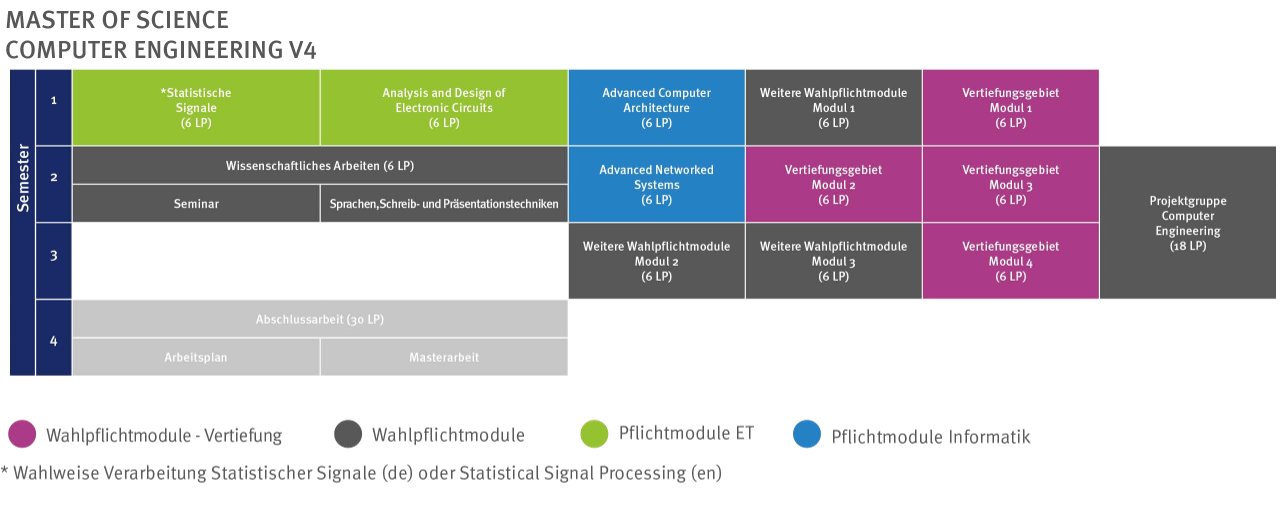
Exemplary Study Plan
The study plan offers you a good orientation about your required and optional modules. However, the chronological order shown here is only an example and may change due to individual focus areas.
Specializations
- Communication and Networks
- Computer Systems
- Control and Automation
- Embedded Systems
- Nano-/Microelectronics
- Signal Processing
Rights and Obligations
The Module Handbook offers a complete overview of all subjects included in the curriculum, helping students understand the structure and scope of their chosen program. It explains the objectives, content, and interrelationships of each module and course, providing useful and binding information to support students in planning their studies.
The Examination Regulations (Prüfungsordnung) for the Master studies represents the legally binding illustration of the rules on study. Here, the admission, formative type of assessment, audit scope, examiners, certificates and similar circumstances are officially regulated.
Please refer to the Module Handbook and Examination Regulations below.
Do you have questions about the examination regulations? Our FAQ explains the most important terms and rules.
Possibilities
Study Abroad
A semester abroad can be of great benefit to your professional and personal development. We offer a wide variety of exchange programmes in cooperation with universities all over the world. Because of this cooperation, you benefit from the fact that you do not have to pay tuition fees at our partner universities (which otherwise can be very high, especially in North America, the United Kingdom or Australia). Oftentimes, we are even able to offer cost compensation for your travels. Depending on which university you choose, we have a programme representative that can act and answer questions on the universities' behalf. Exchange programmes and contact partners can be found on the website of the International Office.
Internship
There is no mandatory internship. Nonetheless, we strongly recommend you to make use of an opportunity of gaining professional experience through a voluntary internship in the time in between terms or during a semester of leave.
Professional Orientation
Research and technology transfer are one of the most important priorities at the Department of Computer Science. Thus, prospective graduates of the Department of Computer Science get the opportunity to gain insights into interdisciplinary research, to work hand in hand with scientists and to establish first contacts with industrial partners through our renowned research institutions such as the Paderborn Center for Parallel Computing (PC²) or the Software Innovation Campus Paderborn (SICP).
The SICP - Software Innovation Campus Paderborn (SICP) is a strategic research and innovation network of the Paderborn University and numerous companies with other partners from business, science and society. The SICP deals with the topics of digitalization in a trans-organizational and interdisciplinary way. Together, the members of the SICP research, design and develop software- and data-driven innovations for the digitally networked society. The goal of the SICP is to form a powerful, trans-organizational institution that links excellent research via application orientation and collaboration with effective research and science transfer. The campus model of the SICP provides for close cooperation between science and industry.
What does the future of engineering look like? Fraunhofer IEM in Paderborn works on convincing solutions to this question, covering the business idea, implementation, and market success stages in the process. Through it all, the focus is on intelligent products, production systems, services, and software applications. Scientists take an interdisciplinary approach to working on new methods, tools, and processes – and use innovative technologies to ensure the long-term competitiveness of customers and partners. Fraunhofer IEM offers jobs for student assistants, assignments for term papers and bachelor or master theses and is looking for dedicated computer sciences or engineering graduates to work on industrial and research projects. Jobs & Career - Fraunhofer IEM
The Fraunhofer Institute for Electronic Nano Systems ENAS focuses on research and development in the fields of Smart Systems Integration by using micro and nano technologies with partners in Germany, Europe and worldwide. Based on prospective industrial needs, Fraunhofer ENAS provides services in:
Development, design and test of MEMS and NEMS (micro and nano electromechanical systems) Wafer-level packaging of MEMS and NEMS Metallization und interconnect systems for micro and nano electronics as well as 3D integration New sensor and system concepts with innovative material systems Integration of printed functionalities into systems Reliability and security of micro and nano systems
The Paderborn Center for Parallel Computing (PC²) is a scientific institute Paderborn University and a National High Performance Computing Center in the NHR network. PC²'s research focuses on the development of new methods for programming and using parallel computer systems for scientific computing and the investigation of innovative, heterogeneous computer architectures. As a National High Performance Computing Center, the PC² operates several supercomputer systems to provide computing resources to researchers from all over Germany and offers consulting and training services for the education and training of users.
The Heinz Nixdorf Institute is an interdisciplinary research institute whose research focuses on intelligent technical systems. In cooperation between Computer Science and Engineering, concepts are designed for these systems, which are adaptable, robust, user-friendly and act with foresight. The Heinz Nixdorf Institute imparts technical, methodological and social skills and prepares those interested to assume responsibility in business and science. Around 20 young scientists complete their doctorates here every year.
The Bielefeld-Paderborn Joint Artificial Intelligence Institute follows a trans- and interdisciplinary approach, focusing on the interplay between AI and applications, as well as studying ethical, legal, and social implications of Artificial Intelligence (AI). Its goal is to lay the foundations for human-centered AI systems that act as competent partners and feature real-world problem-solving abilities in specific domains. Instead of replacing humans, such systems will complement and empower humans by supporting them interactively in decision-making processes.
The Competence Center for Sustainable Energy Technology (KET) was founded by Paderborn University as a central scientific institution in January 2012. The tasks of KET are research, teaching and technology transfer in the field of environmentally friendly and innovative energy generation, conversion and utilization. The scopes and competences of the five research groups from the departments of Electrical and Mechanical Engineering cooperating in KET enable the interdisciplinary development of solutions to energy-related challenges. Acting as an interface between industry and university research facilities, KET addresses institutional and industrial users and offers comprehensive cooperation opportunities through consulting, development, simulation and implementation in regards to modern energy technology.
Future Perspectives
After graduation Master ?
Career Opportunities
Computer engineers hold specialist and managerial positions in research and development, project planning and manufacturing, measurement and testing technology, service and sales, management, and education and training. Their interdisciplinary expertise at the intersection of computer science and electrical engineering is in high demand, particularly in the following areas: Research and Development:
- Computer Engineering
- Communications engineering, e.g., mobile communications
- Nano- and Microelectronics
- Embedded systems, e.g., in automotive engineering, aerospace, and medical technology
- Microsystems Engineering
- Automation of manufacturing processes
- Robotics
These sectors generate high revenue and have a significant demand for qualified workers. This is particularly true in Germany, with its leading companies in the automotive industry, medical technology, automation technology, and mechatronics. In the coming years, the existing “engineer shortage” will continue to grow, meaning that graduates of the Bachelor’s and Master’s programs in Computer Engineering can expect excellent career prospects overall.
Because the specialization tracks of the Master’s program are aligned with the fields listed above, graduates already acquire specialized qualifications in specific areas of practice. Furthermore, through their specialization tracks and their Master’s thesis, they are introduced to current scientific research questions, thereby being optimally prepared for research activities in industrial or academic settings.
Interested in the start-up scene? Then visit us at garage33! We promote start-ups in Paderborn and will support you on your path to self-employment. We’ll be by your side throughout every stage of the start-up process – completely free of charge and with no obligation! garage33 is our dedicated space for creativity and exchange, networking and working. In addition to tailored coaching, we also offer workshops and events for you to learn the theory and practice of setting up a business in an innovative and creative environment, and to help you formulate, develop and validate your idea.
Want to start a business, but lack the seed capital to do so? We can help you apply for grants and put you in touch with our network of business angels and investors. Or merely looking to get an insight into start-ups, for some inspiration or to network with business founders? Then visit our courses or events, such as CALL FOR IDEAS, apply for a start-up job or simply visit us at garage33 – we look forward to meeting you!
Starting a career is a challenge, especially for international students. But with the right networks and free, professional support, you should be able to succeed. There are various offers to help: from workshops and courses to individual advice and useful networks that make it easier to enter the German labour market.
PhD
On completion of your degree, you can also choose to continue your studies with a PhD programme, thereby gaining the experience and qualifications you will need to subsequently take up a research position at a university or non-university research institution.
The Faculty of Electrical Engineering, Computer Science, and Mathematics provides students pursuing postgraduate qualifications with support. The team at the Postgraduate Centre will be more than happy to provide you with information and advice.
The Paderborn PhD & Postdoc Support Office offers support throughout your PhD studies. From deciding whether or not to pursue a PhD to figuring out what to do after passing your exams, we are here to help with individual counselling, welcome and networking events, peer coaching and much more!
Get to Know
Study Start and Orientation
Orientation Days
To help you get off to a smooth start in your master’s program, the Faculty of Computer Science, Electrical Engineering and Mathematics offers the “Welcome Days” before the start of the semester. This event serves as an introduction to your program and campus life, similar to the university-wide Orientation Week (also known as the O-Phase held in German).
We recommend that all students attend the Welcome Days, which are held in English and include most of the information relevant to the Computer Engineering program. The orientation phase provides you with the support you need to find your way around the University of Paderborn and your program. Be sure to set aside time for this so you’ll have all the important information you need when you begin your studies!
Related Studies
Not quite right for you? One of our other study programs might be a better fit!
Campus life
In addition to study-related content, Paderborn University offers you a lot more: for those eager to learn, for those seeking exchange and for all those who want to think outside the box. Learn and improve your language skills at the Center for Language Studies and brush up on your software skills with the courses offered by doIT. The servicecenter-medien offers special media workstations where you can let off steam creatively, and the university sports program ranges from American football to Zumba. Get involved with the university radio station L'UniCo or the university newspaper universal and become part of one of the many project groups or initiatives.
Culture
A regular theater program at our Studionbühne, slams and readings, Big Band and university choir are just a few examples of our diverse cultural offerings. A special highlight is our AStA summer festival: up to 15,000 people make the pilgrimage every year to what is probably Germany's largest outdoor campus festival and enjoy the summer party atmosphere with numerous local student bands as well as well-known headliners on various stages.
Campus
Almost all of Uni Paderborn's buildings are located on campus. There are green meadows to relax in and plenty of places to eat and drink: Mensa Academica and Mensa Forum, the Grill|Café and Café Bona Vista. Everything is within easy walking distance. Our library is also centrally located and is a great place to study thanks to its good opening hours.
Accommodation
Living in accomodations close to campus is possible: The Studierendenwerk Paderborn offers you places in halls of residence directly on campus or in the immediate vicinity. But you will also find what you are looking for on the usual accommodation portals: Both in the immediate vicinity of the university and city center, as well as in the individual Paderborn districts.
Costs and financing
Everyday student life offers you plenty of opportunities to work alongside your studies. However, BAföG or a scholarship are also options that you can use to cover your costs.
Advisory services
We have the right contact point for every concern. For example, our advisory and service facilities are available to answer your questions about academic work, career orientation and goal setting, funding opportunities and many other concerns.
Our university is an open-minded university that also takes a clear stance on gender and diversity. We have been actively promoting equal opportunities and a gender- and family-friendly work and study culture for many years. This includes support for a better balance between studying and family life as well as support for students with health impairments.
Any questions?
Chat with us
The right contact for every concern
The Central Student Advisory Service (ZSB)
E-Mail: zsb@upb.de
Phone:05251/60-2007
You are in the right place with the following concerns
We support prospective students in their choice of studies and in their decision to study. In addition, we advise students in all phases of their studies, especially in phases of reorientation.
Electrical Engineering Student Advisory Service
You are in the right place with the following concerns
Subject-specific advice and information about the degree program, including questions about:
- Does the degree program suit me and my professional expectations?
- Which modules are offered and what do I deal with in the modules?
- How is the study program organised?
- How are the modules, events and examinations organised?
- What focal points can I set in my studies?
- How can I organise my course of study individually?
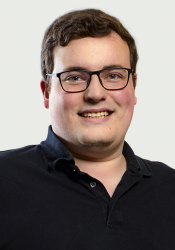
International Office
E-Mail: io-info@zv.uni-paderborn.de
You are in the right place with the following concerns
- How do I apply as an international student? Which prerequisites do I have to bring?
- What opportunities do I have to go abroad during my studies?
- Where can I get information about studying abroad (application deadlines and procedures, internships, scholarships)?
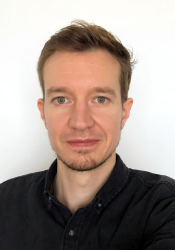
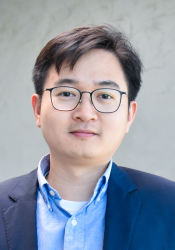
Student Council Electrical Engineering
You are in the right place with the following concerns
- What's this course of studies about?
- What does the "student-life" look like? What does a week at uni look like?
- How much do students like what they do at uni?
- What social activities and possibilities are there next to the formal university studies?
- What fields of specialisation do other students recommend?
- What happens in the first weeks at university? (Orientation week)
Student Service
You are in the right place with the following concerns
- Information and advice on application, admission and enrolment matters
- Processing of applications for change of degree programme, change of subject, leave of absence, exmatriculation, secondary enrolment
- Registration for the qualifying examination
- Health insurance matters
- Re-registration matters
Uni-Assist
You are in the right place with the following concerns
Please apply for this program, regardless of your nationality, via the Uni-Assist Online Portal, if you don't have a German University Entrance Qualification.
Bildungsinländer*innen
You are in the right place with the following concerns
If you don't have the German citizenship, but have received your university entrance qualification from a German school inside or outside of Germany (= Bildungsinländer*innen), apply for the program directly at the online portal PAUL of the admissions office. (Please initially supply a grade of 4,0; follow further instructions by email after registration in the online system.)
Examinations Management
You are in the right place with the following concerns
- Counselling on examination-related questions of the study programme
- Processing of admissions and registrations for examinations with limited repeatability
- Processing withdrawals from examinations due to illness
- Recording examination results
- Administration of study performance accounts, certificates of grades and module assignments
- Transfers to the current version of the examination regulations
- Issuing certificates, diplomas, diploma supplements and transcripts of records
- Issuing duplicates and certificates to internal and external university administrative offices
- Translated with www.DeepL.com/Translator (free version)
FamilienServiceBüro
You are in the right place with the following concerns
We support you in balancing your studies and family life.
Service Centre for Studying with Disabilities
E-Mail: s-m-b@upb.de
Phone:05251/60-5498
You are in the right place with the following concerns
- Advice on all questions related to studying
- Procurement and rental of aids
- Barrier-free campus tours
- Provision of information on the barrier-free campus
- Advice on compensating for disadvantages