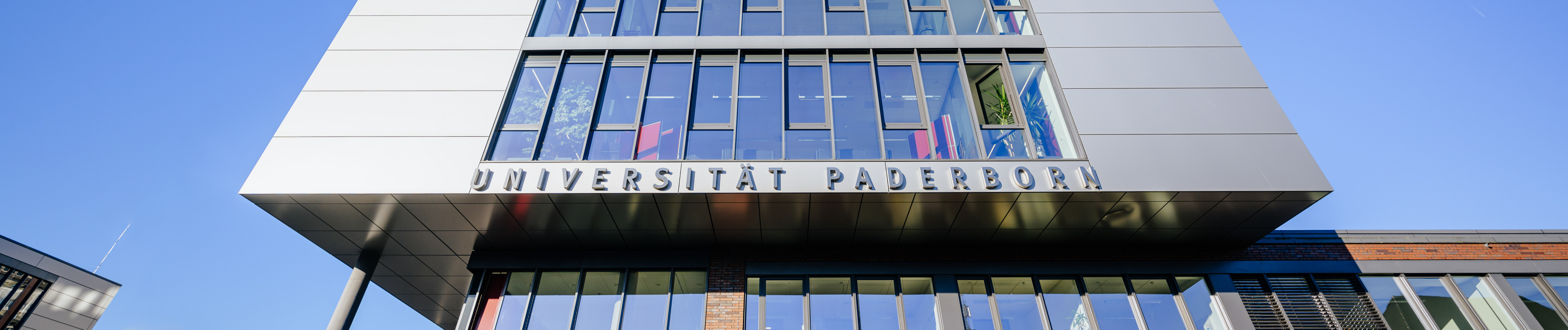
Willkommen zurück - Willkommen an der Universität Paderborn!
Die Universität Paderborn bietet Ihnen eine leistungsstarke, interdisziplinäre Forschungsumgebung und starke Netzwerke – bundesweit und international. Thematisch bieten unsere fünf Fakultäten ein breites Spektrum an Forschungsfeldern in den Kultur-, Natur-, Wirtschafts- und Ingenieurswissenschaften. An der Universität Paderborn ist das Fraunhofer-Institut für Entwurfstechnik Mechatronik IEM angesiedelt und der Standort Ostwestfalen-Lippe gehört zu den stärksten Wirtschaftsregionen Deutschlands.
Aktuelle Stellenausschreibungen
Forschungsstarke Arbeitsgruppen
Computer Networks Group
Have you thought about performing computations on the fly while moving data? Have you imagined running large machine learning models on a collection of embedded devices, even those without batteries?
The Computer Networks group at Paderborn University works on networked systems of all kinds, from large-scale data centers to small IoT devices, powering modern AI applications. Our goal is to improve the efficiency, scalability, and sustainability of these systems. We embrace a hardware-software co-design approach, leveraging new capabilities enabled by emerging hardware to build novel programming tools, systems software, and protocols.
We are seeking a passionate researcher to join our team as a postdoc, working with us on these cutting-edge problems in real-world networked systems. If you are enthusiastic about these topics and would like to be part of an international, dynamic team, come work with us!
More information: https://en.cs.uni-paderborn.de/cn
Mesoscopic Quantum Optics
We study fundamental physics and applications of quantum states of light consisting of several 10s, 100s and 1000s of photons. This scale is crucial for demonstrating true quantum improvement over classical systems in many areas, including metrology, computation and communication. Our research can be divided into three areas: development of enabling technology (full-stack fabrication of waveguides in lithium niobate and superconducting detectors in the cleanroom); cryogenic nonlinear optoelectronics (in the optics lab); and advanced quantum photonic data processing (on the computer, including high-performance computing). We collaborate extensively with research groups and industry in Paderborn (particularly integrated quantum optics, quantum dots, metasurfaces, high-performance computing and quantum information theory), in Germany (superconducting detector development for quantum computing applications) and internationally (superconducting detector arrays and cryogenic electronics). These activities are well supported through external funding, for example an ERC starting grant.
As a diverse, internationally oriented group, we are always on the lookout for ambitious postdocs and collaborators who will contribute to and benefit from our expertise, who take the tools we develop in exciting new research directions.
More information: physik.uni-paderborn.de/en/mesoscopic-quantum-optics
Quantum Computing Lab
Quantum computers are a leading candidate for computing technology capable of revolutionizing certain areas of science and industry. Of course, a quantum computer is arguably only as good as what it is able to compute (at least from a Computer Science perspective!), and thus the purpose of our group, which focuses on quantum algorithms and complexity theory. We aim to answer a variety of questions, such as: Which properties of quantum systems can a quantum computer compute provably faster than a classical computer? Conversely, are there computational problems for which we provably cannot achieve a quantum speedup? Finally, where does the power of current near-term intermediate scale noisy quantum devices lie?
More information: https://groups.uni-paderborn.de/fg-qi/
Self-Optimizing Static Program Analysis
Software pervades our lives – but its lack of security is a threat that should be taken seriously. The topic could hardly be more relevant as the number of successful attacks is constantly increasing. To ensure that software systems are reliable, we have to review their program code. This is where Prof. Eric Bodden’s ERC project comes in: Bodden is developing a technology to produce vulnerability analysis tools that will operate perfectly for the relevant company’s software – all fully automated.
Static program analysis (i.e. the automatic review of program code) is the key technology for ensuring security, as it is able to analyse a program for any potential inputs – including from hackers – and identify errors and vulnerabilities such as data leaks. The technology that Bodden is seeking to research in his ERC project ‘Self-Optimizing Static Program Analysis’ aims to use automation to assist, as it enables users to conduct analyses for any given usage context. Relevant warnings are issued within an extremely short time without users having to manually intervene. They receive precise reports for the programs they provide.
As a result, this project should enable software engineers to independently use this kind of error detection and ensure that any necessary adjustments to the analysis can be performed automatically. ‘And it should help to secure millions of software systems that we have all learned to rely on’, the researcher summarises.
There are currently two types of vacancies in this project: two postdoc positions and multiple research assistant positions.
More information: www.hni.uni-paderborn.de/en/sosa
Technical and Macromolecular Chemistry (TMC)
The chair headed by Prof. Dr.-Ing. Guido Grundmeier is divided into four main research areas
- Adhesion and Corrosion Science
- Sustainable Interfacial Engineering of Advanced Materials and Composites
- Advanced Surface and Interface Spectroscopy
- Nanobiomaterials
Structures, forces, and reactions at interfaces are of paramount importance to the diverse functions of modern materials and biomaterials. The Chair of Technical and Macromolecular Chemistry develops new approaches in the areas of in-situ and operando analysis of interfacial processes and measurement of molecular forces at interfaces. In addition, new surface modification and thin-film deposition processes which lead to functional and durable surfaces and interfaces are developed at the TMC. Examples of sustainable surface and thin film processes are plasma enhanced chemical vapor deposition or electrodeposition. Research in the field of biomaterials and nanobiomaterials focuses on issues of biocompatibility, corrosion, protein adsorption and nanostructuring by means of supramolecular self-organisation. The basic and mostly interdisciplinary work is integrated in various DFG programs. In addition, the chair cooperates on a national and international level with various leading industrial partners in the fields of chemicals, steel, automotive, electroplating and polymers. In the field of teaching, lectures are offered for the faculties of mechanical engineering and natural sciences in the fields of technical chemistry, materials science, electrochemistry, interfacial chemistry, surface analysis and biomaterials.
More information: https://chemie.uni-paderborn.de/en/department/department/technical-chemistry/grundmeier
Postdoc Opportunities:
Development of Advanced Thin Film Deposition Processes:
The development of advanced thin film deposition processes for the protection and functionalization of advanced metallic and polymeric materials paves the way for new applications of such materials in the areas of medical implants, packaging, aerospace constructions or energy conversion. We are seeking for PostDocs who are interested in bridging the gap between fundamental science and industrial relevant technologies. We can offer a rich portfolio of advanced sustainable thin film technologies ranging from combinatorial sputter deposition to self-assembly of functional organic monolayers chemie.uni-paderborn.de/en/department/department/technical-chemistry/grundmeier/research. Most modern surface and thin film analytical techniques enable the detailed analysis of the structure and its correlation with the properties of such films.
To strengthen our team, we are looking for a promising candidate with a background in physical chemistry, physics or materials science to apply for a MSCA, Humboldt, or alternative postdoc fellowship. If you are interested in joining the project and applying for such a fellowship, please contact Guido Grundmeier (guido.grundmeier@uni-paderborn.de).
Advanced Surface and Interface Spectroscopy:
The development of near ambient pressure photoelectron spectroscopies (NAP-PES) allows the investigation of surface processes under realistic pressure conditions. The combination of NAP-PES with infrared spectroscopy is a powerful combination of techniques to tackle investigation of processes in such diverse fields as catalysis, gas sensing or solar sensors, among others.
The “Advanced Surface and Interface Spectroscopy” group is dedicated to the development of novel strategies to explore the full potential of NAP-PES in combination with IRRAS. A particular focus is put in the understanding of basic effects about the interaction of gases with dielectric materials. Dielectric materials pose challenges when investigated with electron-based techniques, due to the accumulation of charge at the surface due to the emission of photoelectrons. Understanding the interplay between surface and gas processes during the photoionization process could open the way towards the development of new approaches to, for example, the in-situ determination of work function changes under operando conditions. Currently we are working in a project oriented to the investigation of vapor phase infiltration processes in polymers.
To strengthen our team, we are looking for a promising candidate with a background in photoelectron spectroscopy to apply for a MSCA, Humboldt, or alternative postdoc fellowship. If you are interested in joining the project and applying for such a fellowship, please contact Teresa de los Arcos (arcos@tc.upb.de).
DNA nanotechnology for antimicrobial drug delivery:
The global spreading of antibiotic resistance is one of the greatest threats of the 21st century and can be compared to climate change in terms of its severity and effect on the world’s population. At the same time, however, fewer and fewer new antibiotics are brought to market. Without efficient antibiotics, many of the achievements of modern medicine that we today take for granted, such as major surgery, organ transplantation, and cancer chemotherapy, will no longer be available. Therefore, novel and unconventional approaches for the treatment of multidrug-resistant infections are urgently needed. The Nanobiomaterials group (https://go.upb.de/nanobiomat) at Paderborn University is dedicated to the rational engineering of biomolecular systems with the aim of developing novel and improved materials, assays, and therapies. Our research is focused on DNA nanotechnology and antimicrobial nanomaterials. This project aims at developing alternative approaches beyond conventional antibiotic chemotherapy to combat drug-resistant bacteria and stop their spreading. We focus in particular on the application of DNA nanostructures as biocompatible and biodegradable carriers of various antimicrobial molecules in order to enhance their efficacy and overcome resistance mechanisms in bacteria and fungi.
To strengthen our team, we are looking for a promising candidate with a background in microbiology to apply for a MSCA, Humboldt, or alternative postdoc fellowship. If you are interested in joining the project and applying for such a fellowship, please contact Adrian Keller (adrian.keller@uni-paderborn.de).
Theorie funktionaler photonischer Strukturen
Unsere Forschung deckt eine Reihe von spannenden Themen in der theoretischen Physik der kondensierten Materie und der Optik ab. In vielen unserer Projekte setzen wir Licht als Untersuchungsinstrument ein, um Einblicke in die Anregungsdynamik und die optischen Eigenschaften von Strukturen im Nanometerbereich auf ultraschnellen (Femtosekunden-)Zeitskalen zu gewinnen. Über die reine Grundlagenforschung hinaus nutzen wir unser Verständnis der nichtlinearen Licht-Materie Wechselwirkung, um Strategien für neuartige Lichtmanipulationen zu entwickeln, z. B. in optischen Schaltern und Quantenlichtquellen. Neben unserer eigenen Arbeit sind wir in ein anregendes lokales Forschungsumfeld eingebettet und arbeiten eng mit einer Reihe von führenden Gruppen in der ganzen Welt zusammen.
Mehr Informationen: physik.uni-paderborn.de/theorie-funktionaler-photonischer-strukturen
Ultrafast Nanophotonics & Metamaterials
Wir beschäftigen uns mit der Erforschung der optischen Eigenschaften von künstlich geschaffenen Materialsystemen. Mit Hilfe moderner Nanotechnologie eröffnet sich die Möglichkeit die Anordnung und Struktur natürlicher Materialien bis in den Bereich weniger Nanometer gezielt zu manipulieren. Dieser Gestaltungsspielraum erlaubt uns zum Beispiel die optischen Materialeigenschaften gezielt einzustellen. Dadurch ergeben sich neue Möglichkeiten zur Realisierung von optischen Elementen und speziellen holografischen Anwendungen im Bereich der Nano- und Mikrooptik. Die entwickelten Konzepte werden dann gezielt zur Erzeugung und Manipulation von Quanten-Licht eingesetzt und weiterentwickelt. Hierfür steht eine ausgezeichnete Laborausstattung im Bereich der Spektroskopie sowie der Nanostrukturierung zur Verfügung.
Mehr Informationen: physik.uni-paderborn.de/ultraschnelle-nanophotonik